All species › Swifts › Hummingbirds › Rufous Sabrewing
Position in the tree Birds Aves › Birds with a flexible palate Neognathae › All other modern birds Neoaves › Birds of the elements Elementaves › Nightjars and swifts Strisores
Rufous Sabrewing | Pampa rufa
Rode sabelvleugel | Fandanguero rojizo
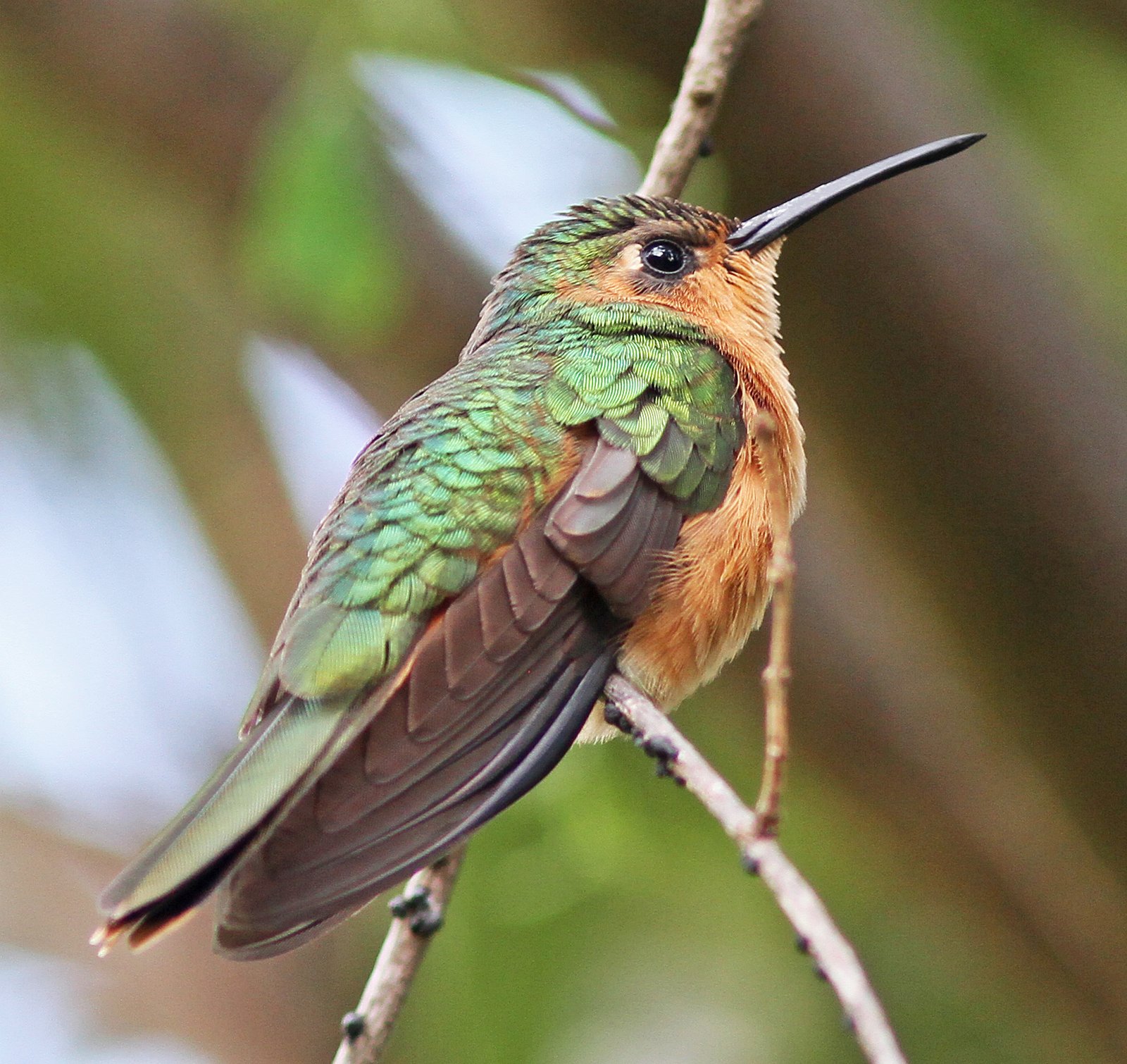
The Rufous Sabrewing is a large hummingbird with cinnamon underparts, endemic to the Pacific slopes of the mountains of Chiapas, Guatemala and El Salvador. In the male the shafts of the outer primaries are thickened and flattened, as in all sabrewings. It often lives in shade-coffee plantations.
Voice
A sharp, dry chip. Males sing in small groups a varied series of squeaky and twittering notes.
Recording: Guillermo Funes — CC BY-NC-SA 4.0 · converted to mono · xeno-canto
Identification
12–13 cm, with a slightly decurved black bill. The upperparts are bronze-green, with a small white spot behind the eye. The underparts are plain cinnamon. The rounded tail is rufous, with a black band before the cinnamon tip; the central feathers are green. The sexes are alike; the male has thickened shafts to the outer primaries.
Confusion species
Cinnamon Hummingbird Amazilia rutila is smaller, has a red bill with a black tip and no black tail band; it lives mainly in the dry lowlands. Violet Sabrewing Campylopterus hemileucurus is larger, the male is dark violet, and both sexes have white outer tail feathers. Wedge-tailed Sabrewing Pampa curvipennis has grey underparts and a wedge-shaped tail without rufous.
Habitat
Humid montane and foothill forest, cloud forest, forest edges and shade-coffee plantations, at about 900 to 2000 m, outside the breeding season also lower. It feeds in the understorey and middle strata, among others at flowers of heliconias and bananas.
Where the bird is most at home, classified by the vegetation units of Mexico and Central America.




Range and movements
Endemic to the guide area. On the Pacific side of the Sierra Madre de Chiapas in southern Mexico, possibly into extreme eastern Oaxaca, and further on the Pacific slopes of the volcanic chain in Guatemala and in western El Salvador.
- Resident
- dark = core range, pale = thinly spread
How and when to look
In the coffee plantations and forest on the slopes of the volcanoes around Lake Atitlán, such as at Los Tarrales; in Chiapas in the El Triunfo Biosphere Reserve; in El Salvador in El Imposible National Park.
Conservation status
Not threatened. Fairly common within a small range. Conversion of shade coffee to open plantations and loss of montane forest can affect the species locally.
Scientific name
Pampa rufa | (Lesson, 1840)
Lesson described the species in 1840 as Campylopterus rufus; because it was later moved to another genus, the author and year stand in brackets. The genus Pampa was introduced in 1854 by Reichenbach. Pampa was taken from Lesson's Ornismya pampa (1832); Lesson did not explain the word and its origin is unclear. rufa is Latin for 'rufous, reddish', after the cinnamon underparts and tail. The specimen the first description was based on came from Guatemala (not specified).