All species › Swifts › Hummingbirds › Wedge-tailed Sabrewing
Position in the tree Birds Aves › Birds with a flexible palate Neognathae › All other modern birds Neoaves › Birds of the elements Elementaves › Nightjars and swifts Strisores
Wedge-tailed Sabrewing | Pampa curvipennis
Wigstaartsabelvleugel | Fandanguero cola cuña
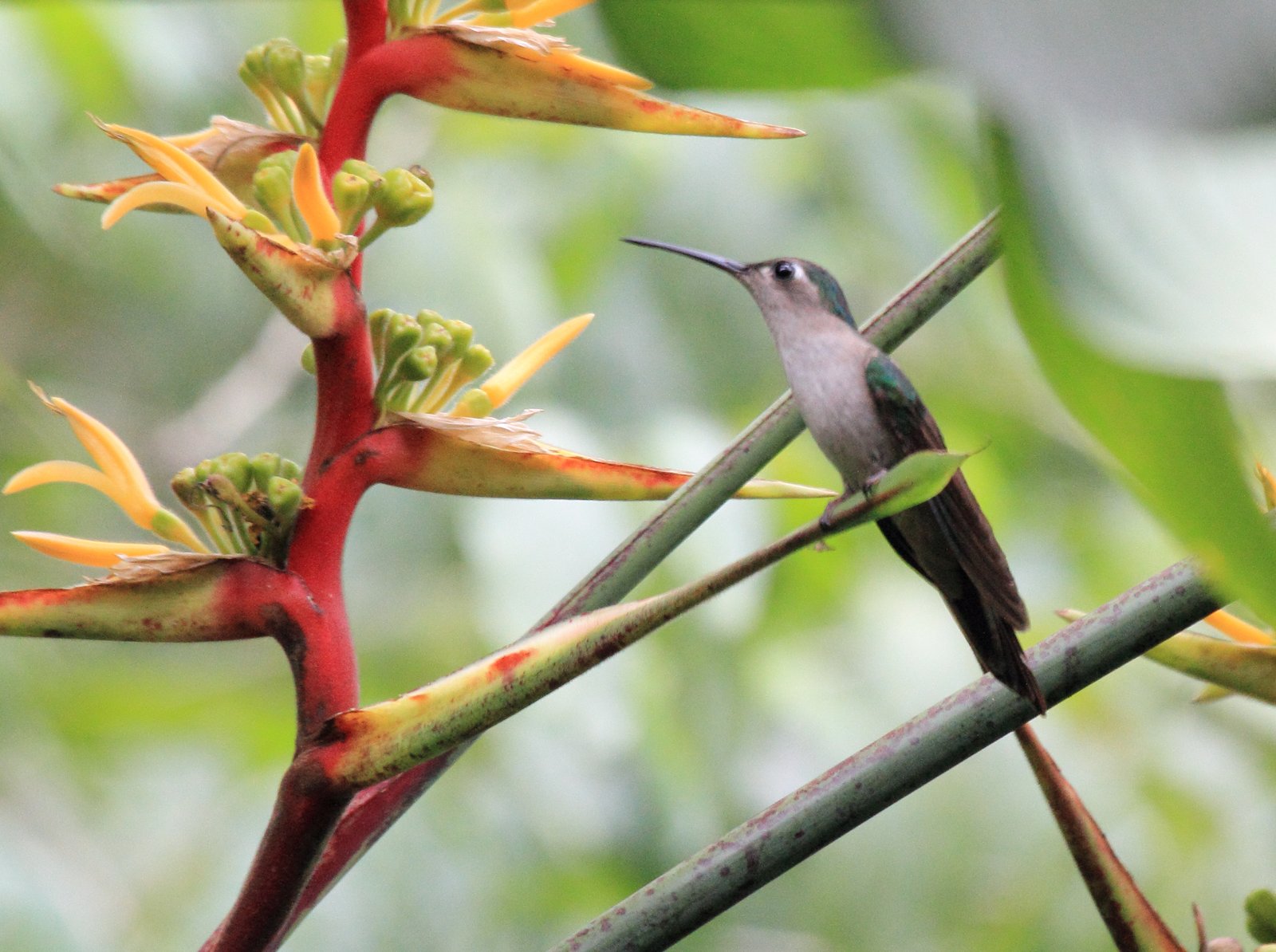
The Wedge-tailed Sabrewing is a medium-sized, grey-bellied hummingbird of the humid forests of eastern Mexico, the Yucatán Peninsula and northern Central America. Males sing a long, complex song in small groups. Some classifications split the species into three: the population of eastern Mexico, that of the Yucatán Peninsula and Belize, and the long-tailed form of the Sierra de los Tuxtlas.
Voice
A sharp chip. The male's song is long and very varied, with squeaky, twittering and buzzing notes, repeated from fixed perches in the understorey.
Recording: Manuel Grosselet — CC BY-NC-SA 4.0 · converted to mono · xeno-canto
Identification
12–13 cm, in the Sierra de los Tuxtlas form up to 15 cm, with a slightly decurved black bill. The upperparts are green, the crown glittering blue to violet-blue, with a small white spot behind the eye. The underparts are pale grey. The long, wedge-shaped tail is green to bronze-green, with grey tips to the outer feathers. The sexes are alike; the male has thickened shafts to the outer primaries.
Confusion species
Violet Sabrewing Campylopterus hemileucurus is larger, the male is dark violet, and both sexes have white outer tail feathers. Rufous Sabrewing Pampa rufa has cinnamon underparts. Scaly-breasted Hummingbird Phaeochroa cuvierii has green-scaled underparts and white tail corners. White-bellied Emerald Chlorestes candida is much smaller, with white underparts.
Habitat
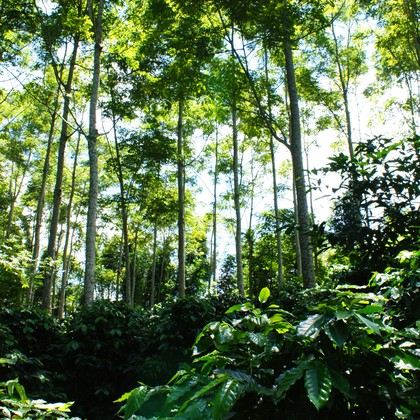
Humid lowland and foothill forest, semi-deciduous forest, forest edges, mature second growth and shade coffee, from sea level to about 1500 m. It feeds in the understorey and middle strata at flowers of heliconias and other plants.
Where the bird is most at home, classified by the vegetation units of Mexico and Central America.





Range and movements
Endemic to the guide area. On the Atlantic slope of Mexico from southern Tamaulipas and south-eastern San Luis Potosí through Puebla and Veracruz to northern Oaxaca and Chiapas; further on the Yucatán Peninsula, in Belize, northern Guatemala and northern Honduras.
- Resident
- dark = core range, pale = thinly spread
How and when to look
In the forest around Calakmul and Tikal and in the Cockscomb Basin reserve in Belize; in Veracruz in the Sierra de los Tuxtlas and in the foothill forests around Xalapa. Often heard before it is seen.
Conservation status
Not threatened. Fairly common in a large range. Deforestation affects the species locally, especially in eastern Mexico. If the Sierra de los Tuxtlas form is recognised as a separate species, it has a very small range.
Scientific name
Pampa curvipennis | (Deppe, 1830)
Deppe described the species in 1830 as Trochilus curvipennis; because it was later moved to another genus, the author and year stand in brackets. The genus Pampa was introduced in 1854 by Reichenbach. Pampa was taken from Lesson's Ornismya pampa (1832); Lesson did not explain the word and its origin is unclear. curvipennis is Latin, from curvus 'curved' and penna 'feather', after the thickened, curved shafts of the male's outer primaries. The specimen the first description was based on came from Mexico (not specified).