All species › Swifts › Hummingbirds › White-eared Hummingbird
Position in the tree Birds Aves › Birds with a flexible palate Neognathae › All other modern birds Neoaves › Birds of the elements Elementaves › Nightjars and swifts Strisores
White-eared Hummingbird | Basilinna leucotis
Witoorsaffierkolibrie | Zafiro oreja blanca
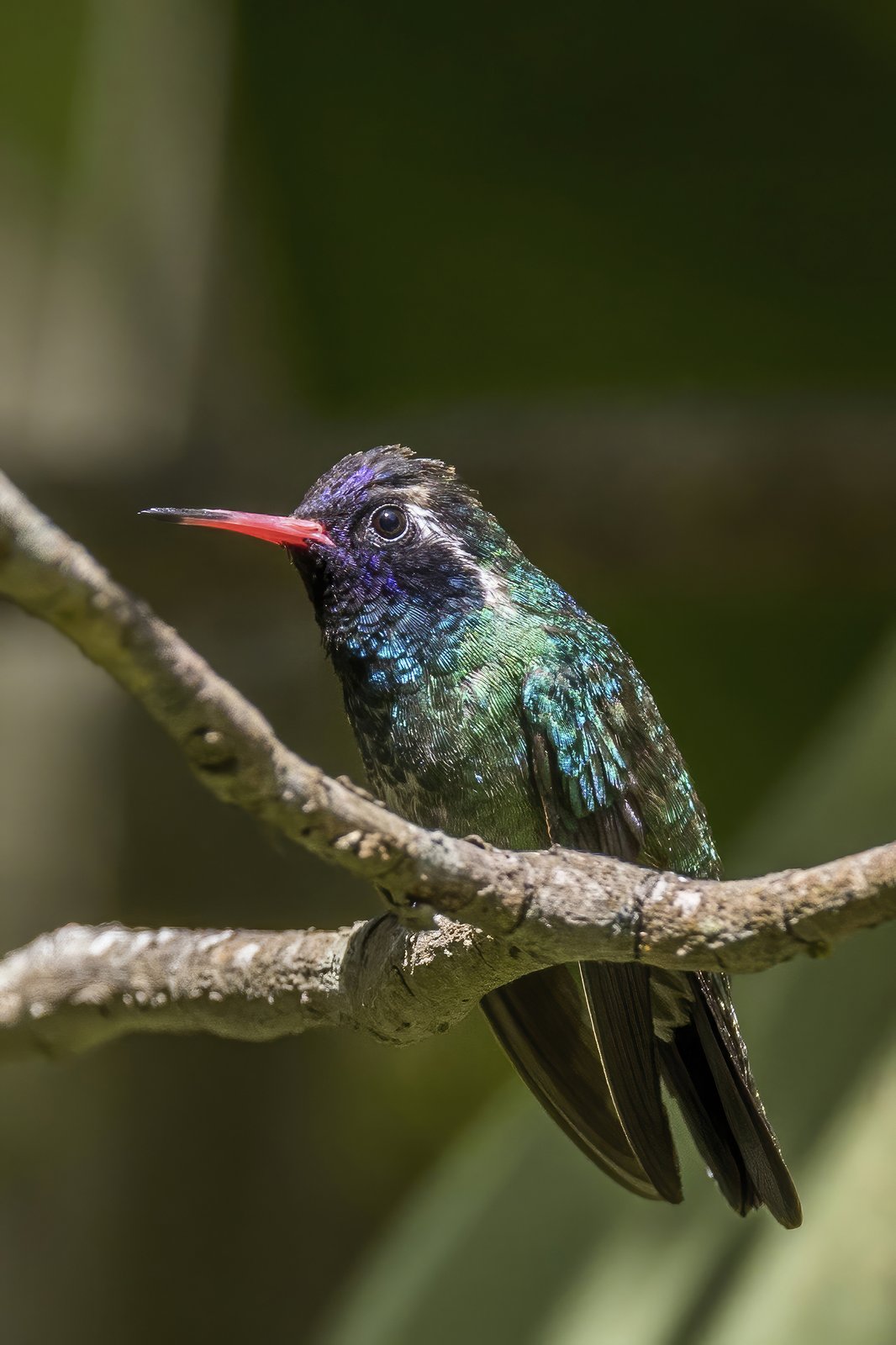
The White-eared Hummingbird is one of the commonest hummingbirds of the pine and pine-oak forests in the mountains of Mexico and northern Central America. The broad white stripe behind the eye and the red bill stand out even at a distance. Males sing at dawn from fixed perches, often several close together.
Voice
A metallic, tinkling tink or chink. Males sing a long, monotonous series tink-tink-tink, mainly at dawn.
Recording: Manuel Grosselet — CC BY-NC-SA 4.0 · shortened to the first 60 s, mono · xeno-canto
Identification
9–10 cm, with a straight red bill with a black tip. Both sexes have a blackish cheek with a broad white stripe behind the eye. The male has a violet-blue forehead and chin, a glittering emerald-green throat, green upperparts and greenish underparts with a pale belly. The female has white underparts spotted with green and a dark tail with white tips to the outer feathers.
Confusion species
Broad-billed Hummingbird Cynanthus latirostris lacks a broad white eyestripe; the male has a blue throat and a dark blue tail. Xantus's Hummingbird Basilinna xantusii occurs only in Baja California and has cinnamon underparts. Females of Amethyst-throated Mountaingem Lampornis amethystinus and Blue-throated Mountaingem Lampornis clemenciae are larger, with a black bill and plain grey or cinnamon underparts. Berylline Hummingbird Saucerottia beryllina has rufous wings and no white eyestripe.
Habitat
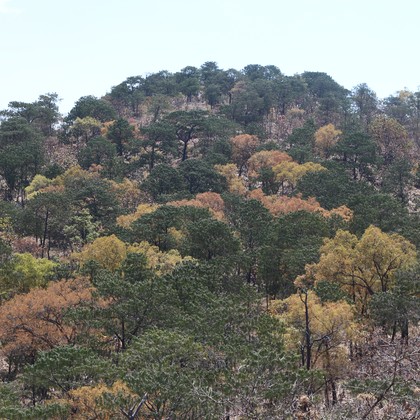
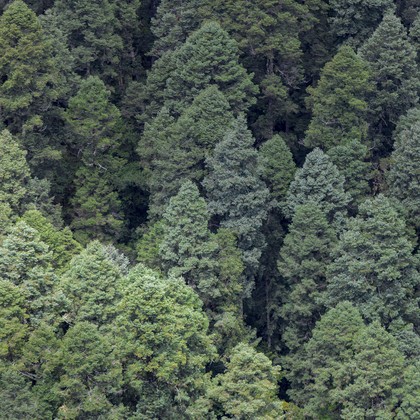
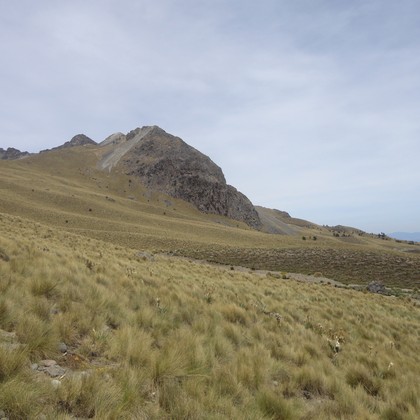
Pine, pine-oak and oak forest, forest edges and clearings with flowering herbs and shrubs, also cloud forest and high-elevation scrub, at about 1200 to 3500 m, mostly between 1800 and 3000 m. It feeds low to mid-level, often at flowers of sage and other herbs.
Where the bird is most at home, classified by the vegetation units of Mexico and Central America.



Range and movements
In the mountains of Mexico, from the Sierra Madre Occidental in Sonora and Chihuahua and the Sierra Madre Oriental from Nuevo León south through the Trans-Mexican Volcanic Belt and the mountains of Guerrero, Oaxaca and Chiapas; further in the highlands of Guatemala, El Salvador, Honduras and northern Nicaragua. Outside the guide area a scarce summer visitor to south-eastern Arizona.
- Resident
- dark = core range, pale = thinly spread
How and when to look
Around San Cristóbal de las Casas in Chiapas, in the pine-oak forests above Oaxaca City and in the mountains around Mexico City; in Guatemala on the volcano slopes around Antigua. Often in flowery clearings and along forest trails.
Conservation status
Not threatened. Common in a large range. Logging of montane forest affects the species locally, but it also uses forest edges and open woodland.
Scientific name
Basilinna leucotis | (Vieillot, 1818)
Vieillot described the species in 1818 as Trochilus leucotis; because it was later moved to another genus, the author and year stand in brackets. The genus Basilinna was introduced in 1831 by Boie. Basilinna is Greek for 'queen', in praise of these handsome hummingbirds. leucotis is Greek, from leukos 'white' and ous, ōtos 'ear', after the bold white stripe behind the eye. The specimen the first description was based on came from Orizaba, Veracruz, Mexico.