All species › Passerines › Tanagers and allies › Ruddy-breasted Seedeater
Position in the tree Birds Aves › Birds with a flexible palate Neognathae › All other modern birds Neoaves › Landbirds Telluraves › Falcons, parrots and passerines Australaves › Falcons and passerines Eufalconimorphae › Parrots and passerines Psittacopasserae
Ruddy-breasted Seedeater | Sporophila minuta
Dwergdikbekje | Semillero pechirrufo
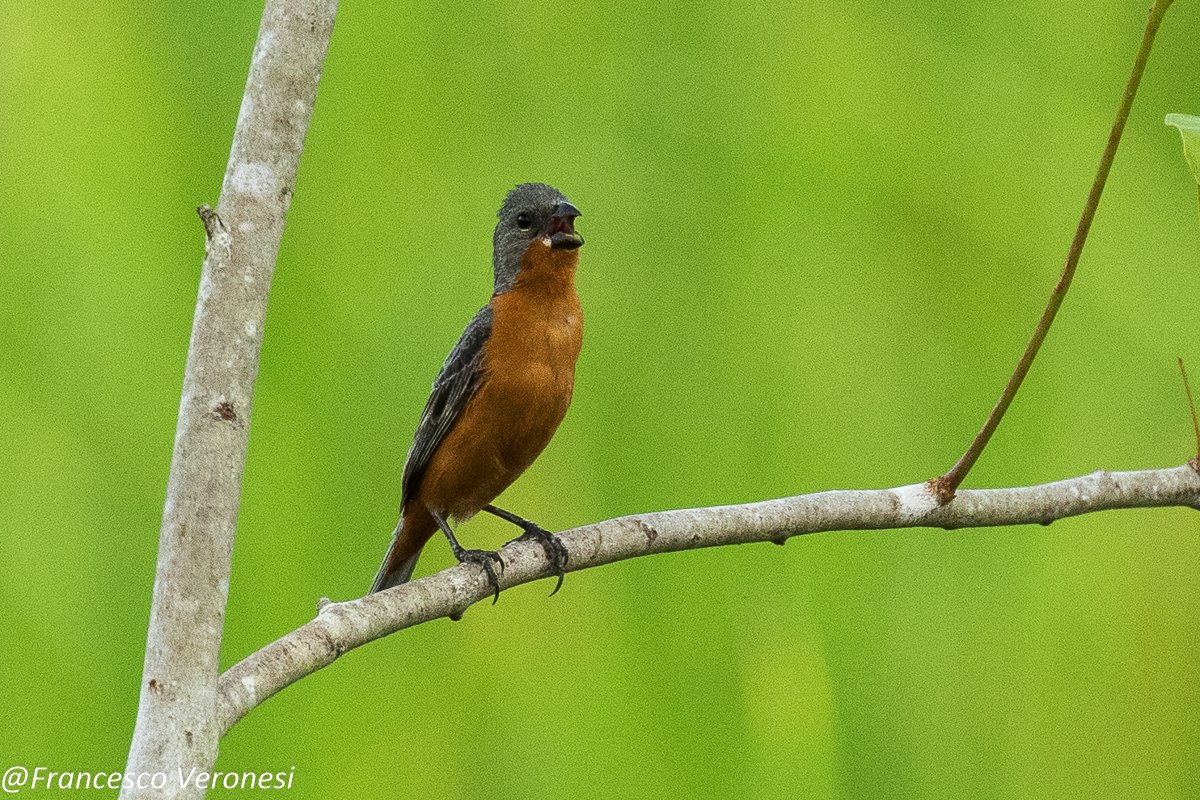
The Ruddy-breasted Seedeater is one of the smallest seedeaters in the region. The male has a grey-brown crown and back and a rufous rump and underparts; the female is dull buffy brown. It lives in grassland and rough pasture in the lowlands, mainly on the Pacific slope, from western Mexico to Panama.
Voice
Song a quick, sweet series of whistled and twittering notes, often beginning with a few clear, repeated notes. Call a soft chee.
Recording: Olivier SWIFT — CC BY-NC-SA 4.0 · converted to mono · xeno-canto
Identification
9–10 cm. Male: crown, cheeks and back grey-brown, rump and entire underparts warm rufous to cinnamon; wings dark with a small white patch at the base of the primaries. Bill short, thick and dark. Female dull buffy brown, paler and warmer buff below, without a wing patch; bill brownish. Young males resemble females and gradually acquire rufous on the rump and belly.
Confusion species
The male Cinnamon-rumped Seedeater Sporophila torqueola (mainly Mexico) has a black crown and side of the head, a pale throat and white wing bars. Females closely resemble those of other seedeaters, such as Variable Seedeater Sporophila corvina and Morelet's Seedeater Sporophila morelleti; female Ruddy-breasted are smaller and warmer buffy brown, and are often near males.
Habitat
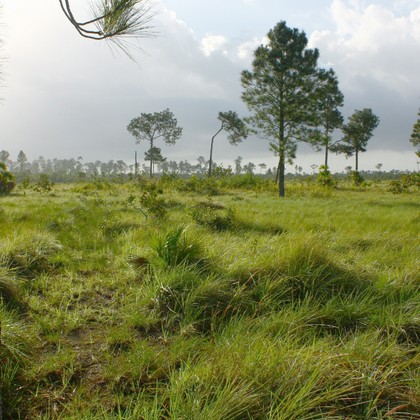
Grassland, savanna, rough pasture, fallow land, rice fields and the edges of wet grassland, mainly in the lowlands up to about 1200 m. It eats grass seeds. Outside the breeding season in small flocks, often with other seedeaters.
Where the bird is most at home, classified by the vegetation units of Mexico and Central America.




Range and movements
Mainly on the Pacific slope, from western Mexico (from about Nayarit) and southern Mexico through Guatemala, El Salvador, Honduras, Nicaragua and Costa Rica to Panama. Outside the guide area in Colombia, Ecuador, Venezuela, Trinidad, the Guianas and northern Brazil.
- Resident
- dark = core range, pale = thinly spread
How and when to look
Mostly seen in the rainy season, when singing males perch in tall grass and on hedgerows. Often in grassy pastures and near rice fields in the Pacific lowlands.
Conservation status
Not threatened (LC). Fairly common, but locally declining because of intensive agriculture and trapping for the cage-bird trade.
Scientific name
Sporophila minuta | (Linnaeus, 1758)
Linnaeus described the species in 1758 as Loxia minuta; because it was later moved to another genus, the author and year stand in brackets. The genus Sporophila was introduced in 1844 by Cabanis. Sporophila is Greek, from sporos 'seed' and philos 'lover': 'seed-lover'. minuta is Latin for 'small', after its very small size. The specimen the first description was based on came from Suriname.