All species › Passerines › Tanagers and allies › Wedge-tailed Grass Finch
Position in the tree Birds Aves › Birds with a flexible palate Neognathae › All other modern birds Neoaves › Landbirds Telluraves › Falcons, parrots and passerines Australaves › Falcons and passerines Eufalconimorphae › Parrots and passerines Psittacopasserae
Wedge-tailed Grass Finch | Emberizoides herbicola
Wigstaartgrasgors | Sabanero coludo
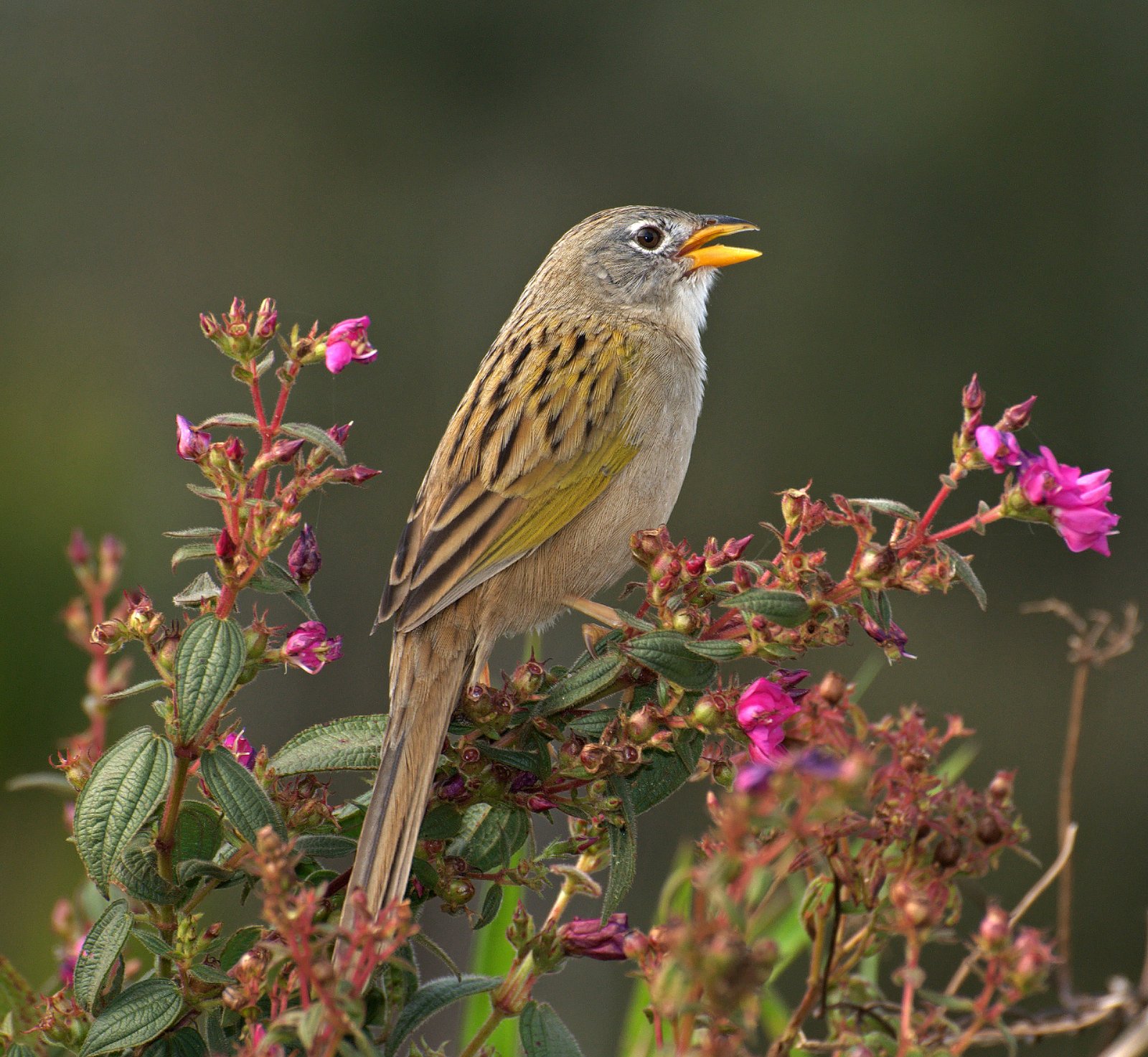
The Wedge-tailed Grass Finch is a large, streaked grassland bird with a long, pointed, graduated tail. It lives in tall grass of savannas and rough pasture and sings from grass stems or low shrubs. In the guide area it occurs only in southern Costa Rica and in Panama.
Voice
Song a short, clear phrase of a few whistles and trills, often repeated from a grass stem or small shrub, mainly in the early morning. Call a soft tsip.
Recording: João Capurucho — CC BY-NC-SA 4.0 · converted to mono · xeno-canto
Identification
18–20 cm, almost half of which is tail. Upperparts brown to buffy brown with broad black streaks; wings with olive-yellow edges and a yellow bend of the wing. Tail long, narrow and pointed, with spiky feathers. Lores and narrow eye-ring white. Underparts whitish, flanks and sides of the breast buff. Upper mandible dark, lower mandible yellowish. Male and female alike; young birds are yellower below and more heavily streaked.
Confusion species
Grasshopper Sparrow Ammodramus savannarum is smaller, with a short tail and a buff central crown stripe. Females of seedeaters and seed finches are much smaller, unstreaked and have a short, thick bill.
Habitat
Tall grass in savannas, rough and lightly grazed pasture and grassland with scattered shrubs, also wet grassland, in the lowlands and foothills up to about 1500 m. It keeps hidden in the grass and eats seeds and insects.
Where the bird is most at home, classified by the vegetation units of Mexico and Central America.



Range and movements
In the guide area in southern Costa Rica (savannas around Buenos Aires and in the Valle de El General) and in Panama, mainly in the savannas of the Pacific slope from Chiriquí to Panamá Province. Outside the guide area locally in South America, from Colombia and Venezuela to Bolivia, Paraguay, Brazil and north-eastern Argentina.
- Resident
- dark = core range, pale = thinly spread
How and when to look
Mostly seen in the early morning, when birds sing from a grass stem or fence post; later in the day they disappear into the grass. Suitable places include the savannas around Buenos Aires in Costa Rica and the grasslands of Coclé in Panama.
Conservation status
Not threatened (LC). Local and scarce in the guide area; sensitive to conversion of grassland to cropland and to overgrazing.
Scientific name
Emberizoides herbicola | (Vieillot, 1817)
Vieillot described the species in 1817 as Sylvia herbicola; because it was later moved to another genus, the author and year stand in brackets. The genus Emberizoides was introduced in 1822 by Temminck. Emberizoides is formed from Emberiza (buntings) and Greek -oidēs 'resembling': 'bunting-like', after its bunting-like appearance. herbicola is Latin, from herba 'grass, herb' and -cola 'dweller': 'grass-dweller', after its life in tall grass. The specimen the first description was based on came from Paraguay.