All species › Woodpeckers and allies › Toucans › Yellow-throated Toucan
Position in the tree Birds Aves › Birds with a flexible palate Neognathae › All other modern birds Neoaves › Landbirds Telluraves › Raptors, owls, kingfishers and woodpeckers Afroaves › Mousebirds, rollers and woodpeckers Coraciimorphae › Trogons and cavity nesters Cavitaves › Hornbills, kingfishers and woodpeckers Picocoraciae › Kingfishers, bee-eaters and woodpeckers Picodynastornithes
Yellow-throated Toucan | Ramphastos ambiguus
Zwartsnaveltoekan | Tucán pechigualdo
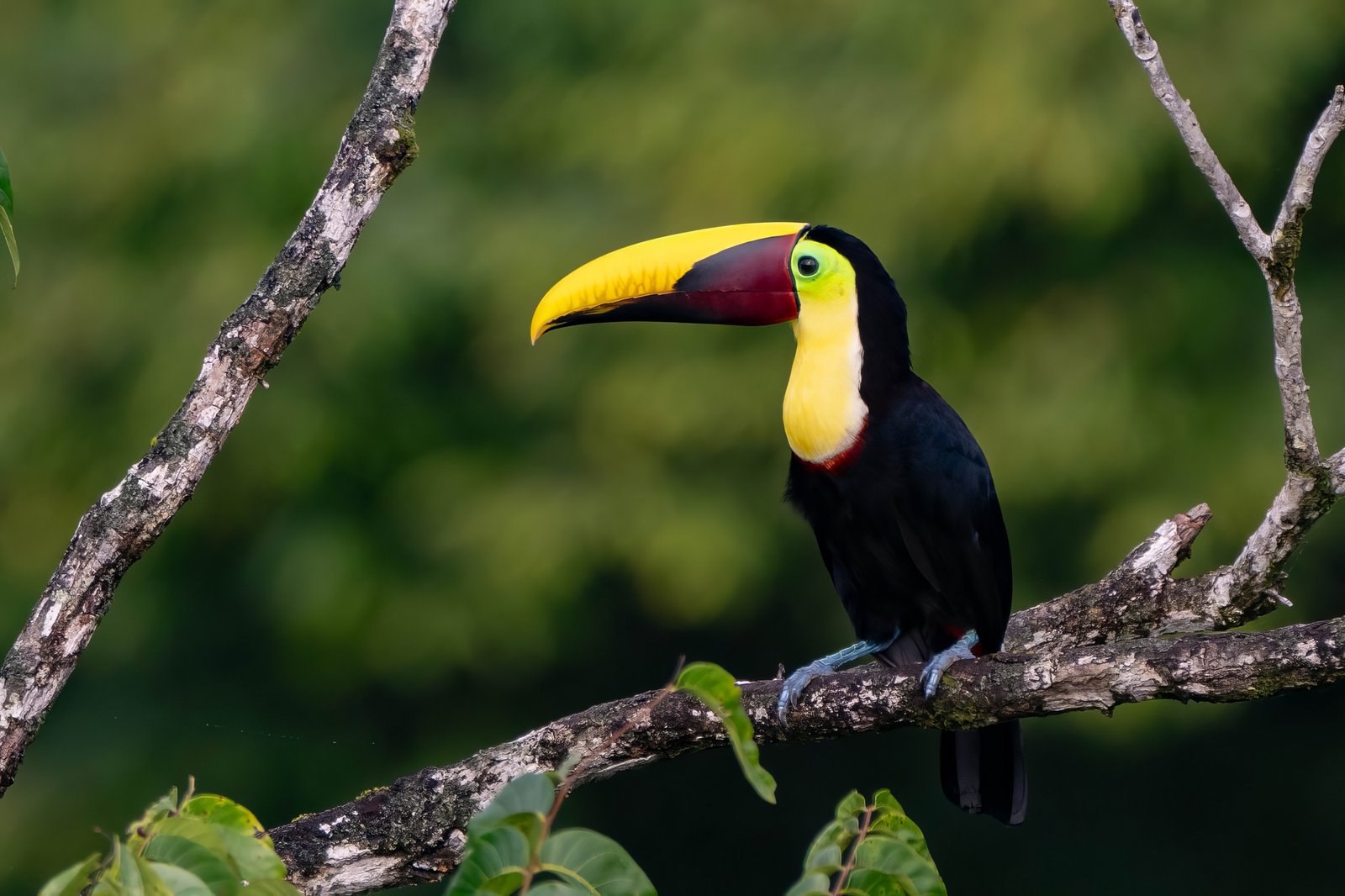
The Yellow-throated Toucan is the largest toucan in the guide area and a bird of humid lowland and foothill forest from Honduras to Panama. Mesoamerica holds the form once treated as a separate species, with a chestnut section in the bill (R. a. swainsonii). It lives in pairs or small groups in the canopy.
Voice
A loud, yelping, rhythmic kee-yoo, tedik-tedik or dios-te-dé, te-dé, which carries far and is repeated from a high bare branch, often with the bill swung up and down. In Costa Rican Spanish the bird is also called dios-te-dé after this call.
Recording: Juan Freile — CC BY-NC-SA 4.0 · shortened to the first 60 s, mono · xeno-canto
Identification
52–61 cm, the bill almost a third of that. The plumage is mostly black, with a bright yellow throat and upper breast, bordered below by a narrow red band. The uppertail coverts are white, the undertail coverts red. The bare skin around the eye is yellow-green. The bill is diagonally two-toned: the upper, forward part yellow, the base and lower mandible dark chestnut to black. The sexes are alike; the female has a slightly shorter bill.
Confusion species
Keel-billed Toucan Ramphastos sulfuratus is smaller, has a multicoloured bill with green, orange and red, and a croaking call. Collared Aracari Pteroglossus torquatus is much smaller and slimmer, with a yellow belly bearing a black spot and a red band.
Habitat
Humid lowland and foothill forest, tall secondary forest, forest edges and semi-open country with tall trees next to forest; up to about 1500 m, most numerous below 1000 m. It forages in the canopy for fruit, and also takes large insects, lizards, eggs and nestlings. It nests in a natural cavity high in a tree.
Where the bird is most at home, classified by the vegetation units of Mexico and Central America.





Range and movements
From eastern Honduras (Olancho, Gracias a Dios) along the Caribbean side of Nicaragua to Costa Rica, where it lives on the Caribbean slope and in the south of the Pacific side, and through the whole of Panama to Darién. Outside the guide area in north-western South America, from Colombia and western Venezuela to Ecuador and Peru.
- Resident
- dark = core range, pale = thinly spread
How and when to look
The call is the best clue: a calling bird often sits high and exposed on a bare branch above the canopy. In Costa Rica in the Caribbean lowlands, for example around La Selva, and in Panama along Pipeline Road near Gamboa.
Conservation status
Least Concern. The species declines where lowland forest is cleared and is hunted locally, but is still fairly common in large forest areas.
Scientific name
Ramphastos ambiguus | Swainson, 1823
Swainson described the species in 1823 and placed it straight away in the genus where it still stands. The genus Ramphastos was introduced in 1758 by Linnaeus. Ramphastos comes from Greek rhamphēstēs 'snouted', from rhamphē 'bill', after the enormous bill. ambiguus is Latin for 'doubtful, uncertain', presumably because the species was hard to tell from related toucans. The specimen the first description was based on came from Buenavista, Colombia (designated later by Chapman, 1917).