All species › Passerines › New World warblers › Prairie Warbler
Position in the tree Birds Aves › Birds with a flexible palate Neognathae › All other modern birds Neoaves › Landbirds Telluraves › Falcons, parrots and passerines Australaves › Falcons and passerines Eufalconimorphae › Parrots and passerines Psittacopasserae
Prairie Warbler | Setophaga discolor
Prairiezanger | Chipe de pradera
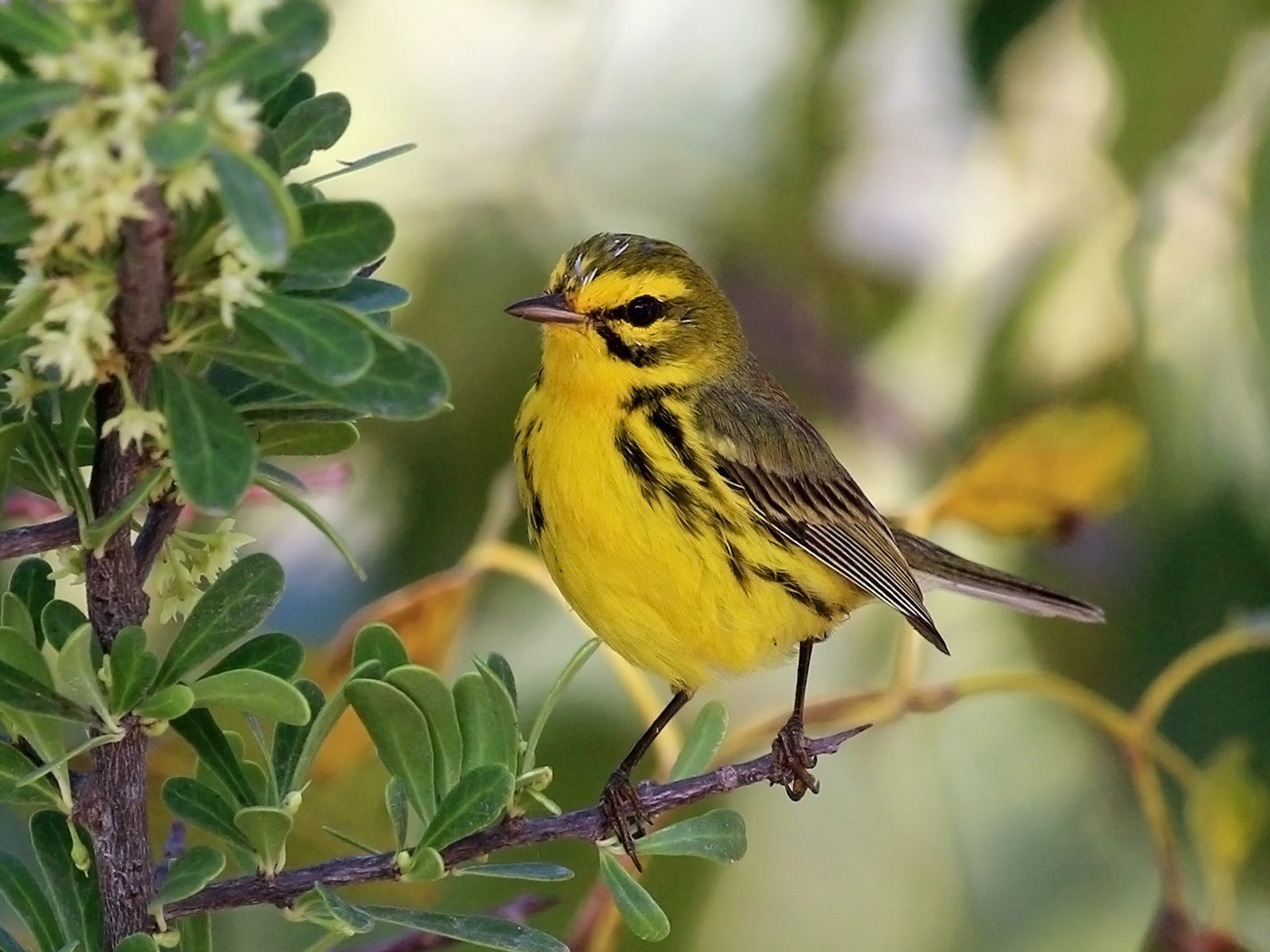
The Prairie Warbler is a small, yellow warbler with black flank streaks that forages low in shrubs and often bobs its tail. Despite its name it does not breed on the prairie but in scrub and young forest in the eastern United States. In the guide area it is a winter visitor, mainly along the coast of the Yucatán Peninsula and on the islands off the Caribbean coast.
Voice
The song is a series of six to ten buzzy notes that rises steadily, roughly zee zee zee zee zee zeee; in the guide area heard mainly in spring. The call is a full chip or chek, the flight call a high see.
Recording: Mario Reyes Jr — CC BY-NC-SA 4.0 · shortened to the first 60 s, mono · xeno-canto
Identification
11–12 cm. Olive-green upperparts, bright yellow underparts with black streaks on the flanks, a yellow supercilium and a yellow crescent below the eye, separated by a dark eye-stripe, and a dark stripe below the cheek. The male has rufous streaks on the back, often barely visible in the field. Females and young birds are duller, with greyish face markings and fainter streaks. It regularly bobs its tail.
Confusion species
Palm Warbler Setophaga palmarum also bobs its tail, but is browner, with yellow undertail coverts and mostly white to pale yellow underparts. Magnolia Warbler Setophaga magnolia has a yellow rump, a white eye-ring or white stripe behind the eye and a white band across the middle of the tail. The female Mangrove Warbler Setophaga petechia has no black flank streaks and a plain face.
Habitat
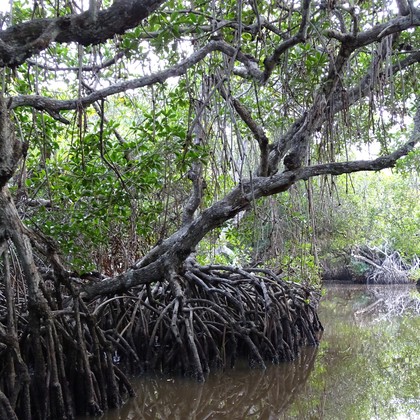
In winter coastal scrub and low forest, mangrove edges, dry seasonal forest, gardens, clearings with shrubs and vegetated cays; mostly close to sea level. It searches low in the vegetation for insects.
Where the bird is most at home, classified by the vegetation units of Mexico and Central America.





Range and movements
Breeds in the eastern and south-eastern United States and the extreme south-east of Canada. Winters in Florida, the West Indies and along the Caribbean coast of Central America. In the guide area fairly common on Cozumel, the islands and coast of Quintana Roo, the cays of Belize and the Bay Islands of Honduras; scarcer elsewhere on the Yucatán Peninsula and along the Caribbean coast to Nicaragua; rare further south and on the Pacific slope.
- Winter visitor (c. Oct–Mar)
- dark = core range, pale = thinly spread
How and when to look
Coastal vegetation and gardens on Cozumel and along the coast of Quintana Roo are the best places; a small yellow warbler that bobs its tail and keeps low in the shrubs is usually this species there.
Conservation status
Not threatened (LC). Still fairly common, but the breeding population has declined considerably since the 1960s as scrub and young forest disappear in the breeding range.
Scientific name
Setophaga discolor | (Vieillot, 1809)
Vieillot described the species in 1809 as Sylvia discolor; because it was later moved to another genus, the author and year stand in brackets. The genus Setophaga was introduced in 1827 by Swainson. Setophaga is Greek, from sēs, sētos 'moth' and -phagos '-eating': 'moth-eater'. discolor is Latin for 'of different colours', after the varied yellow, black and olive plumage. The specimen the first description was based on came from Antilles (not specified further).