All species › Waders, gulls and terns › Jaegers and skuas › Parasitic Jaeger
Position in the tree Birds Aves › Birds with a flexible palate Neognathae › All other modern birds Neoaves › Birds of the elements Elementaves › Cranes and waders Gruimorphae
Parasitic Jaeger | Stercorarius parasiticus
Kleine jager | Págalo parásito
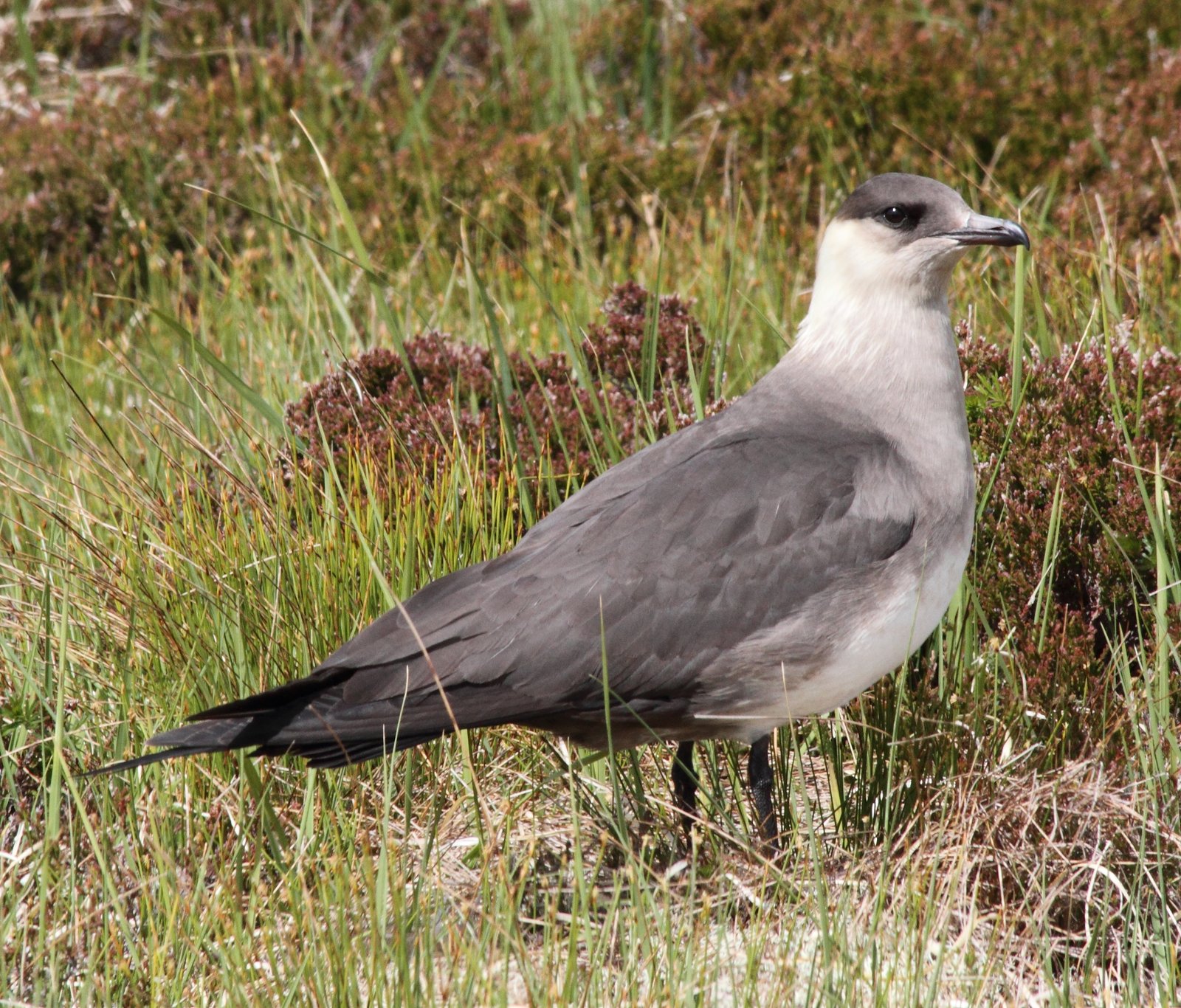
The Parasitic Jaeger is a slim, falcon-like seabird that obtains much of its food by chasing terns and gulls until they drop their catch. It breeds on the Arctic tundra and is a passage migrant and winter visitor in the guide area, seen close inshore more often than the other jaegers. Pale and dark colour morphs occur.
Voice
Almost always silent at sea. On the breeding grounds a nasal, mewing ee-ehh and a sharp kek-kek when disturbed.
Recording: Stanislas Wroza — CC BY-NC-SA 4.0 · converted to mono · xeno-canto
Identification
41–46 cm excluding the elongated tail feathers; in adults the two pointed central tail feathers project a further 5 to 10 cm beyond the tail. Slim, with narrow, pointed wings and a fast, agile flight. The pale morph has a dark cap, yellowish cheeks, white underparts and often a faint grey-brown breast band; the dark morph is uniformly sooty brown. Both morphs show a white flash at the base of the primaries, formed by three to five white shafts. In non-breeding plumage the cap and cheeks are less distinct and the rump and flanks are barred. Juveniles are warm rufous-brown to dark brown and finely barred, with short, pointed central tail feathers.
Confusion species
Pomarine Jaeger Stercorarius pomarinus is heavier, with broader wings, a thicker bill, a slower wingbeat and, in adults, twisted, spoon-shaped central tail feathers. Long-tailed Jaeger Stercorarius longicaudus is slimmer and colder grey above, usually lacks the breast band, shows only two white shafts in the wing and, in adults, has very long, thin tail streamers. Dark young gulls, such as a juvenile Laughing Gull Leucophaeus atricilla, have broader wings without a white primary flash and fly less fast and agilely.
Habitat
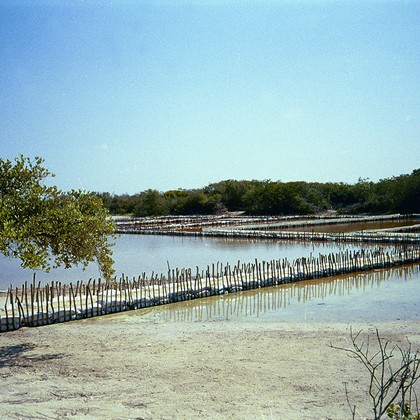
Outside the breeding season at sea, both over the continental shelf and close inshore, in bays, lagoons and harbour mouths where terns and gulls fish. It chases those birds in fast, twisting flight until they release their prey; it also catches fish itself and takes offal behind boats.
Where the bird is most at home, classified by the vegetation units of Mexico and Central America.


Range and movements
Along both coasts of the whole guide area, from Baja California and the Gulf of California to Panama, and on the Gulf of Mexico and Caribbean side. Most numerous during spring and autumn migration; some stay through the winter. Outside the guide area the species breeds right around the North Pole, on the tundra of Alaska, Canada, Greenland, Scandinavia and Siberia, and winters at sea far into the southern hemisphere, including off South America, Africa and Australia.
- Winter visitor (c. Oct–Mar)
- dark = core range, pale = thinly spread
How and when to look
Flocks of fishing terns over a bay or harbour mouth are the best place to look: a dark bird that suddenly appears out of nowhere and pursues a single tern with sharp turns is usually this species.
Conservation status
Not threatened. The world population is large. In the north-east Atlantic numbers have declined along with the colonies of terns and kittiwakes on which the species depends; reliable counts are lacking for North America.
Scientific name
Stercorarius parasiticus | (Linnaeus, 1758)
Linnaeus described the species in 1758 as Larus parasiticus; because it was later moved to another genus, the author and year stand in brackets. The genus Stercorarius was introduced in 1760 by Brisson. Stercorarius is Latin for 'of dung', from stercus 'dung': the food disgorged by seabirds when pursued by skuas was once taken for excrement. parasiticus is Latin for 'parasitic', after the habit of robbing other seabirds of their catch. The specimen the first description was based on came from the coast of Sweden.