All species › Passerines › New World warblers › Ovenbird
Position in the tree Birds Aves › Birds with a flexible palate Neognathae › All other modern birds Neoaves › Landbirds Telluraves › Falcons, parrots and passerines Australaves › Falcons and passerines Eufalconimorphae › Parrots and passerines Psittacopasserae
Ovenbird | Seiurus aurocapilla
Ovenvogel | Reinita hornera
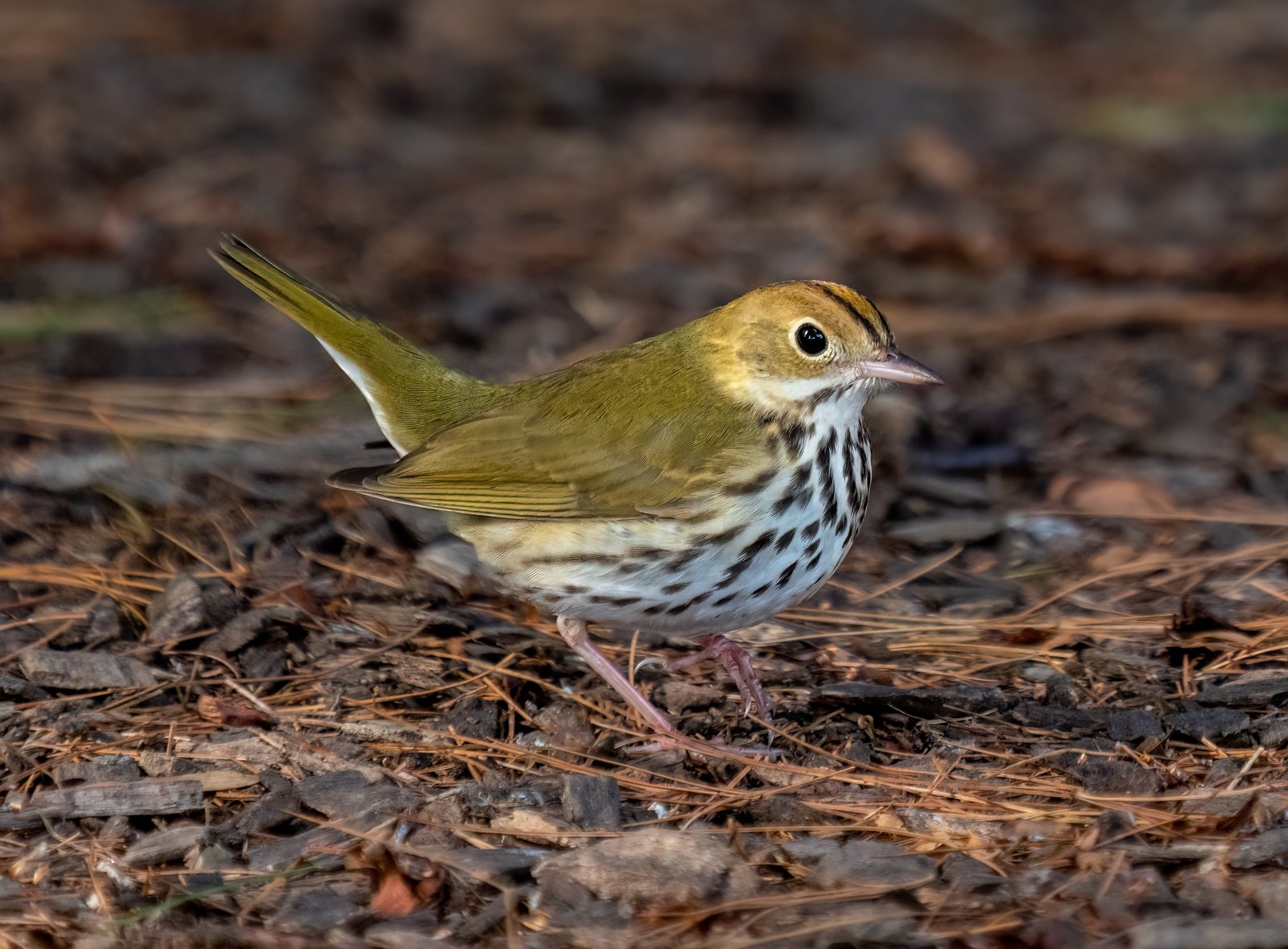
The Ovenbird is an olive-brown, thrush-like warbler that walks over the forest floor rather than hopping. It breeds in deciduous and mixed forest in North America and in the guide area is a common winter visitor and passage migrant in forest from the lowlands up into the middle elevations. The name refers to the domed nest on the ground, shaped like an old-fashioned baking oven.
Voice
The song on the breeding grounds is a loud, swelling series of two-syllable notes, tee-CHER tee-CHER tee-CHER. In winter mainly the call: a dry, sharp chuk or tsik, often repeated when disturbed. In spring it sometimes sings before departure.
Recording: Jeff Stewart — CC BY-NC-SA 4.0 · converted to mono · xeno-canto
Identification
14–16 cm. Upperparts plain olive-brown. An orange central crown stripe, bordered on each side by a black stripe. A distinct white eye-ring on a greyish-olive face. Underparts white with rows of black drop-shaped spots on breast and flanks and a narrow black malar stripe. Legs pink. It walks with measured steps over the ground, tail slightly raised. The sexes are alike.
Confusion species
Northern Waterthrush Parkesia noveboracensis and Louisiana Waterthrush Parkesia motacilla have darker brown upperparts, a long pale supercilium instead of an eye-ring and no orange crown stripe; they bob the rear body constantly and live along water. Wood Thrush Hylocichla mustelina is much larger (19–21 cm), with rufous-brown upperparts and large round spots on the underparts.
Habitat
In winter the floor of humid and semi-humid forest, dry forest with a dense leaf layer, secondary forest and shade coffee, from sea level to about 1500 m, on passage also higher and in parks and gardens. It searches the leaf litter for insects, spiders and other small invertebrates and often holds its own winter territory.
Where the bird is most at home, classified by the vegetation units of Mexico and Central America.







Range and movements
Breeds in southern Canada and the northern and eastern United States. Winters from Florida and the Gulf Coast through Mexico and Central America to Panama, in the Caribbean and scarcely in northern Colombia and Venezuela. In the guide area widespread in the lowlands and foothills of both slopes, from southern Sinaloa and Tamaulipas southwards; most numerous on the Yucatán Peninsula and the Caribbean slope, scarcer in Panama. On passage also in northern Mexico.
- Winter visitor (c. Oct–Mar)
- dark = core range, pale = thinly spread
How and when to look
Best found by listening in forest for the dry call and looking for a bird walking quietly along a trail or over the leaf litter. A disturbed bird often flies up to a low branch and stays there for a moment.
Conservation status
Not threatened (LC). Common and widespread. On the breeding grounds sensitive to forest fragmentation, in the wintering area to clearance of lowland and foothill forest.
Scientific name
Seiurus aurocapilla | (Linnaeus, 1766)
Linnaeus described the species in 1766 as Motacilla aurocapilla; because it was later moved to another genus, the author and year stand in brackets. The genus Seiurus was introduced in 1827 by Swainson. Seiurus is Greek, from seiouros 'wag-tail', after the constant tail-bobbing. aurocapilla is Latin, from aurum 'gold' and -capillus '-crowned', after the orange crown stripe. The specimen the first description was based on came from Pennsylvania.