All species › Passerines › New World warblers › Mourning Warbler
Position in the tree Birds Aves › Birds with a flexible palate Neognathae › All other modern birds Neoaves › Landbirds Telluraves › Falcons, parrots and passerines Australaves › Falcons and passerines Eufalconimorphae › Parrots and passerines Psittacopasserae
Mourning Warbler | Geothlypis philadelphia
Grijskopzanger | Chipe enlutado
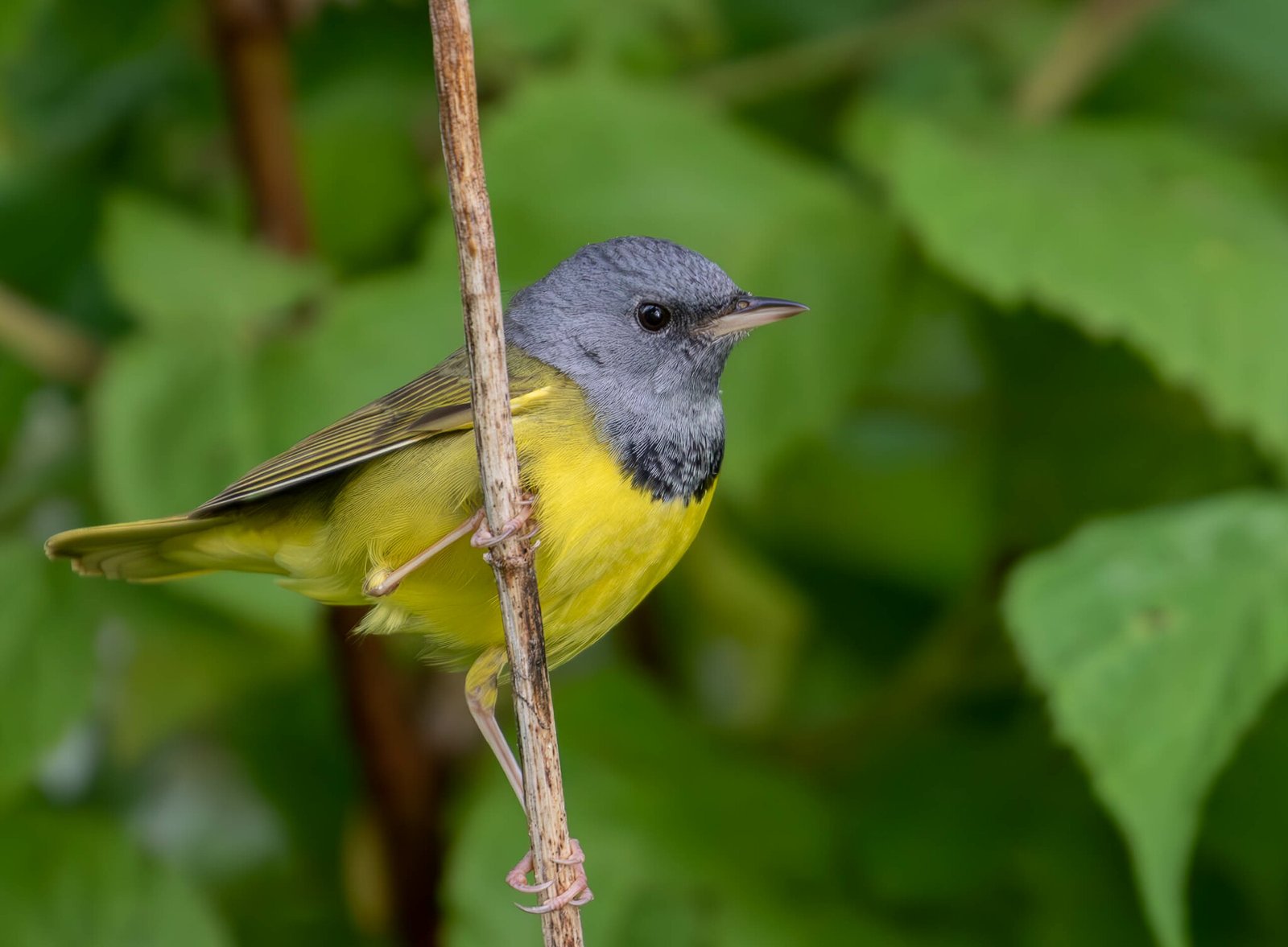
The Mourning Warbler is a sturdy warbler of low vegetation with a grey hood, olive-green upperparts and yellow underparts. It breeds in Canada and the north-eastern United States and migrates through eastern Mexico and Central America to wintering areas from Nicaragua to northern South America. It keeps hidden in dense thickets.
Voice
The song is a series of clear, rolling paired notes followed by a short, lower ending, such as churry-churry-churry-choo-choo. The call is a dry, rather rough chip or chek.
Recording: Stanislas Wroza — CC BY-NC-SA 4.0 · converted to mono · xeno-canto
Identification
12–14 cm. Fairly sturdy, with a short tail and pink legs. The male has a blue-grey hood without an eye-ring and a black, scaly patch on the lower throat and upper breast. The female has a paler greyish-brown hood, a pale throat and often a narrow, broken eye-ring. Young birds in autumn have an olive-grey hood, a yellow throat and a narrow, almost complete pale eye-ring. Upperparts olive-green, belly and undertail coverts yellow.
Confusion species
MacGillivray's Warbler Geothlypis tolmiei has distinct white arcs above and below the eye, black lores in the male and a longer tail; young birds are very similar and are told mainly by call and eye pattern. Both species migrate through part of the same area, but MacGillivray's mainly in the west and Mourning mainly along the Gulf coast. Females of Common Yellowthroat Geothlypis trichas lack a grey hood and have a paler belly.
Habitat
On migration and in winter dense thickets, second growth, forest edges, rank fields with shrubs, banks with dense vegetation and shade coffee; mainly in humid lowlands and foothills up to about 1500 m. It searches for insects and spiders low near the ground.
Where the bird is most at home, classified by the vegetation units of Mexico and Central America.





Range and movements
Breeds in southern Canada and the north-eastern United States. Migrates mainly along the Gulf coast of Mexico and through the Caribbean slope of northern Central America. Winters from Nicaragua through Costa Rica and Panama to Colombia, Venezuela and Ecuador.
- Passage (Mar–Apr, Oct–Nov)
- dark = core range, pale = thinly spread
How and when to look
In winter in Costa Rica and Panama found in dense shrubs along forest edges and rank pastures; the bird usually stays hidden and is most often detected by its dry call.
Conservation status
Not threatened (LC). Common in its breeding range, although the species is slowly declining. In the guide area a fairly common passage migrant and, in the south, winter visitor.
Scientific name
Geothlypis philadelphia | (Wilson, 1810)
Wilson described the species in 1810 as Sylvia Philadelphia; because it was later moved to another genus, the author and year stand in brackets. The genus Geothlypis was introduced in 1847 by Cabanis. Geothlypis is Greek, from gē 'ground' and thlupis, an unidentified small bird: 'ground warbler', after its life low in dense cover. philadelphia refers to Philadelphia, Pennsylvania, where Alexander Wilson collected the first specimen. The specimen the first description was based on came from near Philadelphia, Pennsylvania (USA).