All species › Passerines › New World warblers › MacGillivray's Warbler
Position in the tree Birds Aves › Birds with a flexible palate Neognathae › All other modern birds Neoaves › Landbirds Telluraves › Falcons, parrots and passerines Australaves › Falcons and passerines Eufalconimorphae › Parrots and passerines Psittacopasserae
MacGillivray's Warbler | Geothlypis tolmiei
Rouwkopzanger | Chipe de Tolmie
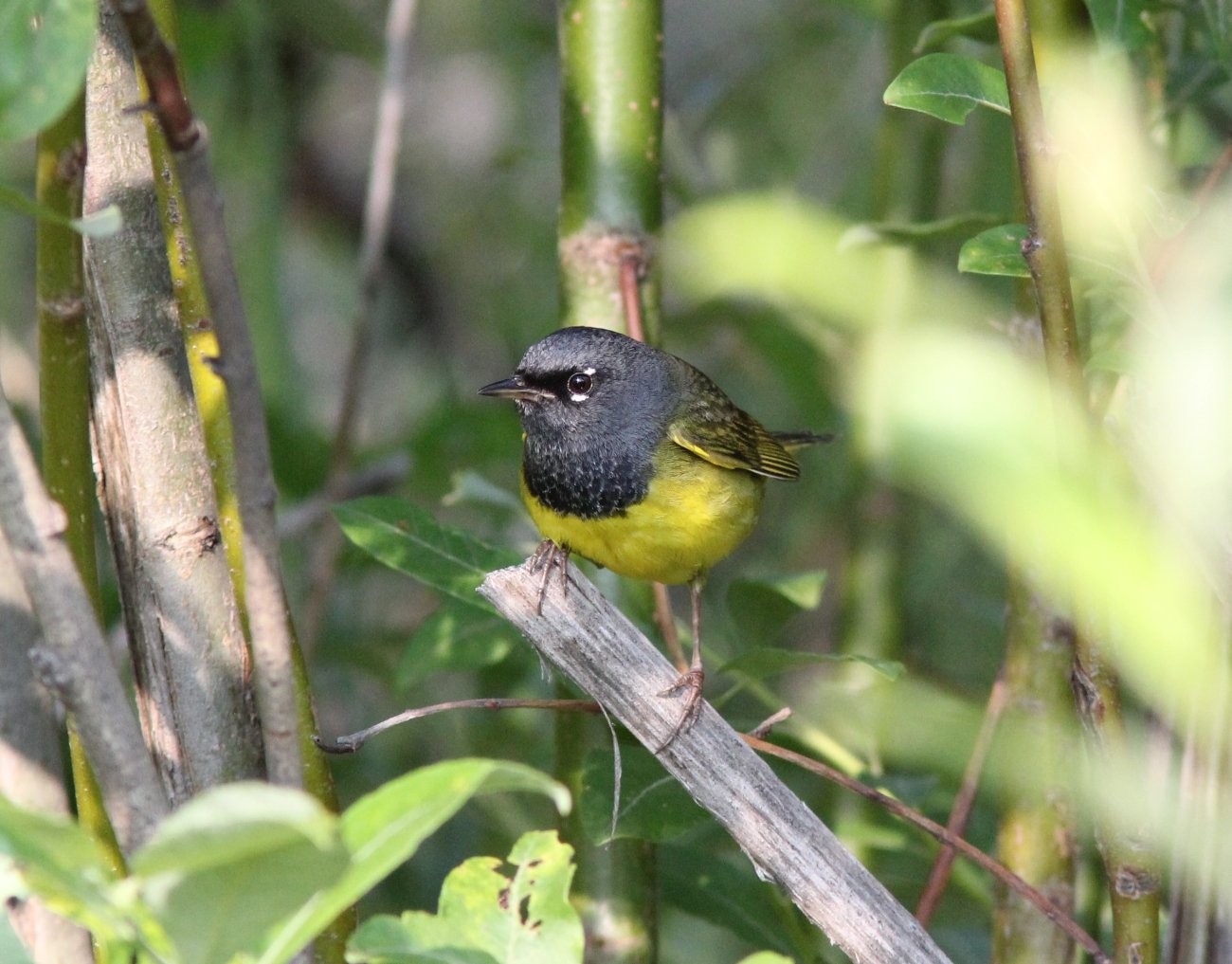
MacGillivray's Warbler is a warbler of low vegetation with a grey hood, white arcs above and below the eye and yellow underparts. It breeds in western North America and winters in much of Mexico and Central America, south to Panama. It lives hidden in dense thickets, often in hills and mountains.
Voice
The song is a quick, rather buzzy series followed by a few lower notes, such as chiddik-chiddik-chiddik-choo-choo. The call is a hard, sharp tsik, louder and sharper than that of Mourning Warbler.
Recording: Manuel Grosselet — CC BY-NC-SA 4.0 · converted to mono · xeno-canto
Identification
12–14 cm. Slim, with a fairly long tail and pink legs. The male has a dark slate-grey hood with a blackish throat and upper breast and black lores; above and below the eye a distinct white arc. The female and young birds have a paler grey hood, a pale grey to yellowish throat and the same white arcs. Upperparts olive-green, belly and undertail coverts yellow.
Confusion species
Mourning Warbler Geothlypis philadelphia lacks white eye markings in the adult male and has a shorter tail; young birds have a narrow, almost complete eye-ring instead of two clearly separated arcs. In the guide area Mourning Warbler migrates mainly along the Gulf coast and winters only from Nicaragua southwards, whereas MacGillivray's is the common species in winter in Mexico and northern Central America. Common Yellowthroat Geothlypis trichas lacks the grey hood and the eye arcs.
Habitat
In winter dense thickets, forest edges, second growth, ravines with dense vegetation, riverside scrub and shade coffee, from the lowlands to about 3000 m, mainly in hills and mountains. The breeding area in north-eastern Mexico lies in brushy mountain country. It searches for insects low near the ground.
Where the bird is most at home, classified by the vegetation units of Mexico and Central America.






Range and movements
Breeds in western North America, from south-eastern Alaska and western Canada to California, Arizona and New Mexico; locally also in the mountains of Coahuila and Nuevo León. Winters from north-western Mexico and southern Baja California through most of Mexico and Central America to western Panama.
- Winter visitor (c. Oct–Mar)
- dark = core range, pale = thinly spread
How and when to look
In winter in the highlands of Chiapas and Guatemala found in dense shrubs along forest edges and in shade coffee; by waiting patiently and listening for the hard call, the bird often shows itself briefly.
Conservation status
Not threatened (LC). Common in its breeding range in western North America; in the guide area a common winter visitor and passage migrant.
Scientific name
Geothlypis tolmiei | (Townsend, 1839)
Townsend described the species in 1839 as Sylvia Tolmiei; because it was later moved to another genus, the author and year stand in brackets. The genus Geothlypis was introduced in 1847 by Cabanis. Geothlypis is Greek, from gē 'ground' and thlupis, an unidentified small bird: 'ground warbler', after its life low in dense cover. tolmiei honours the Scottish surgeon and fur trader William Fraser Tolmie (1812–1886) of the Hudson's Bay Company at Fort Vancouver. The specimen the first description was based on came from Fort Vancouver, Washington.