All species › Passerines › New World warblers › Grey-crowned Yellowthroat
Position in the tree Birds Aves › Birds with a flexible palate Neognathae › All other modern birds Neoaves › Landbirds Telluraves › Falcons, parrots and passerines Australaves › Falcons and passerines Eufalconimorphae › Parrots and passerines Psittacopasserae
Grey-crowned Yellowthroat | Geothlypis poliocephala
Weidemaskerzanger | Mascarita pico grueso
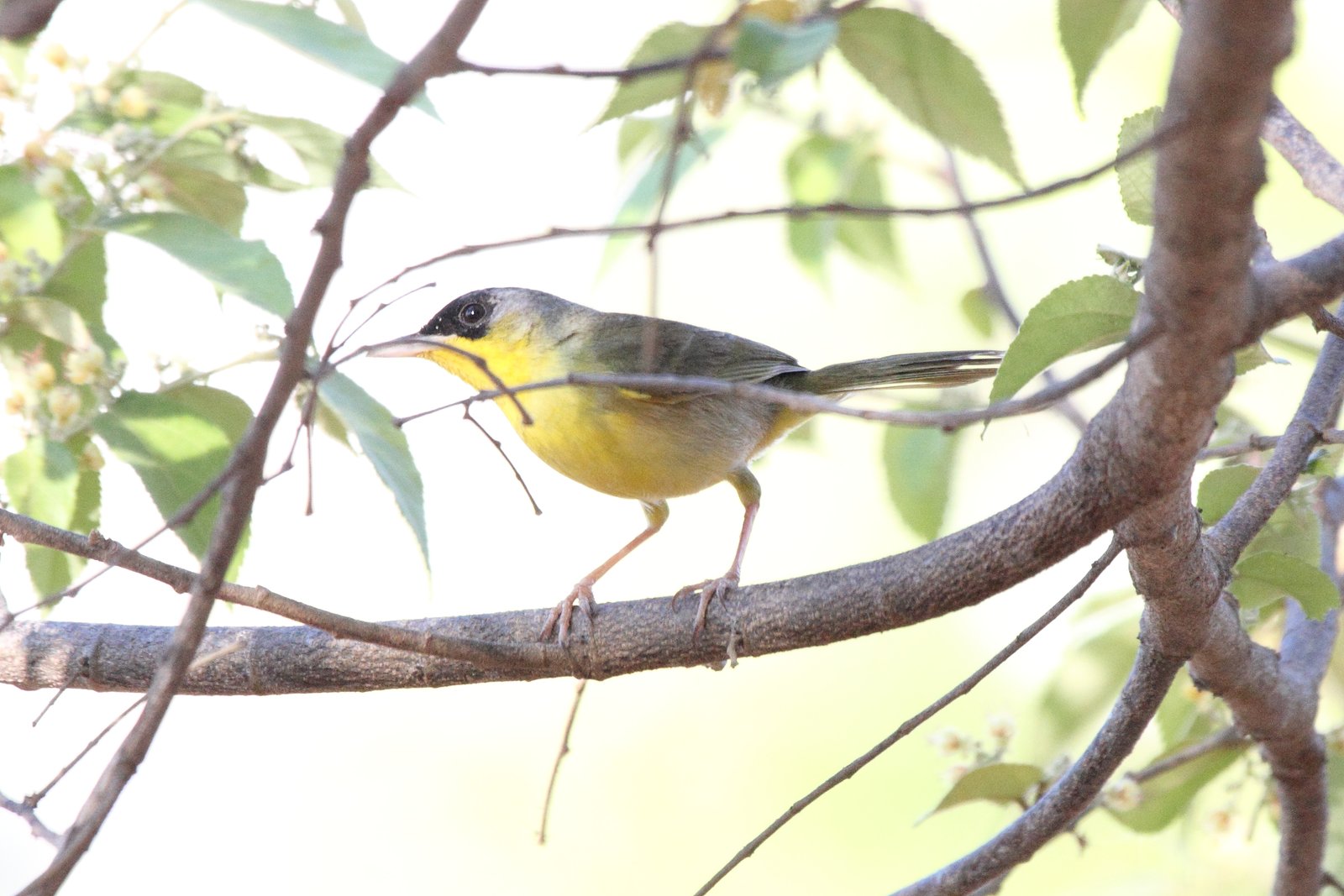
The Grey-crowned Yellowthroat is a fairly large yellowthroat with a grey crown, a small black mask in front of the eye and a thick, two-toned bill. It lives in grassland, savanna and rank pastures with scattered shrubs, from Mexico to western Panama. The male often sings from a tall grass stem or shrub.
Voice
The song is a long, rich, warbling phrase, more reminiscent of a finch or grosbeak than of other yellowthroats. The call is a nasal, somewhat chattering cheedle or a short chep.
Recording: Olivier SWIFT — CC BY-NC-SA 4.0 · converted to mono · xeno-canto
Identification
13–14 cm. Sturdy, with a fairly long, rounded tail and a thick bill with a dark upper mandible and a pale, pinkish-grey lower mandible. The male has a grey crown and cheeks, black lores and a narrow black mask covering only the area in front of and just below the eye, and white arcs above and below the eye. The female has an olive-grey crown and little or no black on the face. Upperparts olive-brown, throat and breast yellow, flanks brownish, centre of belly paler.
Confusion species
Males of Common Yellowthroat Geothlypis trichas, which occurs in the same area in winter, have a broad black mask across the whole eye with a whitish or grey border above, a thinner, all-dark bill and an olive-green crown. Females of Common Yellowthroat have a thinner bill, no grey crown and a paler belly. Olive-crowned Yellowthroat Geothlypis semiflava in the Caribbean lowlands from Honduras to Panama has a large black mask and no grey crown.
Habitat
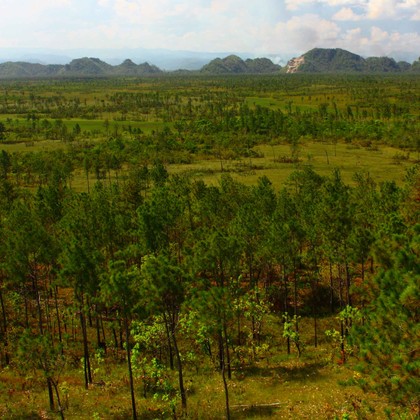
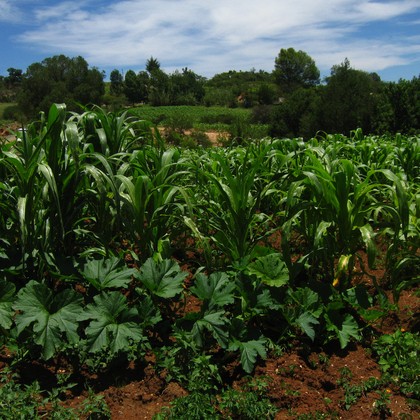
Dry and damp grassland, savanna, pine savanna, rank pastures and abandoned fields with tall grass and scattered shrubs, also marsh edges and dense scrub along forest edges; from sea level to about 1500 m, locally higher. It searches for insects among grass and in low shrubs.
Where the bird is most at home, classified by the vegetation units of Mexico and Central America.




Range and movements
From Sinaloa and Tamaulipas south on both slopes of Mexico and through Belize, Guatemala, Honduras, El Salvador, Nicaragua and Costa Rica to western Panama. Formerly also in extreme southern Texas, where the species is now recorded only rarely.
- Resident
- dark = core range, pale = thinly spread
How and when to look
Best found in rank grassland early in the morning, when the male sings from a protruding grass stem or shrub; afterwards it quickly drops into the vegetation.
Conservation status
Not threatened (LC). Fairly common and widespread in open country; locally benefits from deforestation that creates grassland and rank pastures.
Scientific name
Geothlypis poliocephala | Baird, 1865
Baird described the species in 1865 and placed it straight away in the genus where it still stands. The genus Geothlypis was introduced in 1847 by Cabanis. Geothlypis is Greek, from gē 'ground' and thlupis, an unidentified small bird: 'ground warbler', after its life low in dense cover. poliocephala is Greek, from polios 'grey' and kephalē 'head', after the grey crown. The specimen the first description was based on came from Mazatlán, Sinaloa, Mexico.