All species › Tinamous › Tinamous › Little Tinamou
Position in the tree Birds Aves › Ratites and tinamous Palaeognathae
Little Tinamou | Crypturellus soui
Kleine tinamoe | Tinamú menor
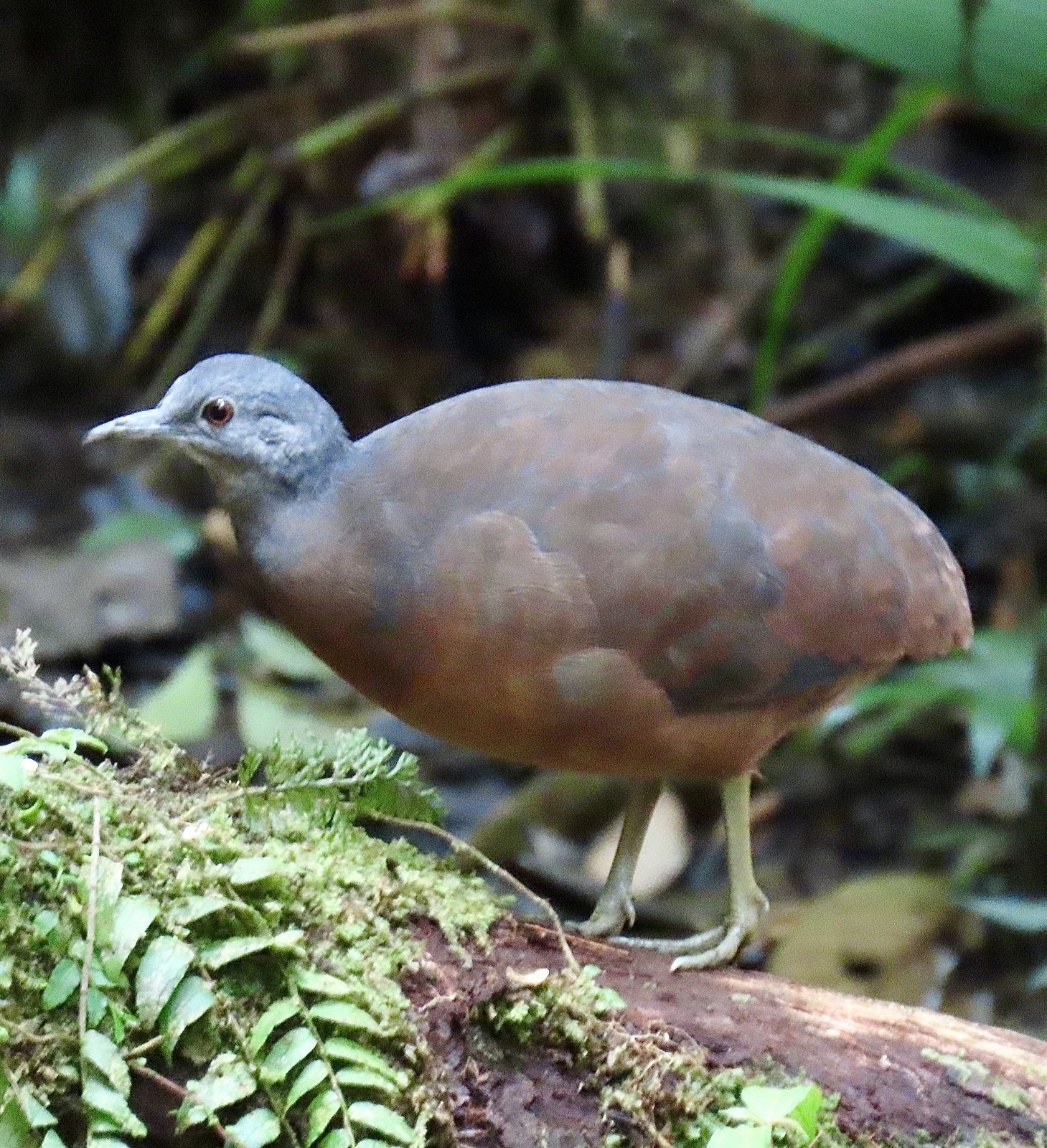
The Little Tinamou is the smallest and most widespread tinamou in the guide area, a plump, almost tailless ground bird of forest edges and dense thickets. It is heard far more often than seen. Unlike Great Tinamou, it tolerates secondary forest and neglected plantations well.
Voice
A series of soft, tremulous whistles that rise in pitch and quicken in tempo; also a single descending, plaintive whistle. Calls at any time of day, but mainly at dusk, often from dense undergrowth.
Recording: Juan Freile — CC BY-NC-SA 4.0 · shortened to the first 60 s, mono · xeno-canto
Identification
21–24 cm, rotund, with a small head, a thin neck and a very short tail. The upperparts are plain dark olive-brown to sooty brown without barring, the head greyer, the throat whitish. The underparts are ochre-brown to rufous; the female is usually brighter rufous than the male. The bill is dark and the legs olive-green to yellowish. When flushed it flies off low on whirring wings over a short distance.
Confusion species
Slaty-breasted Tinamou Crypturellus boucardi and Thicket Tinamou Crypturellus cinnamomeus are larger and have red legs; Thicket Tinamou also has barred upperparts and a pale supercilium. Choco Tinamou Crypturellus kerriae in Darién is larger and darker, with red legs and grey neck sides. Quail-doves such as Ruddy Quail-Dove Geotrygon montana also walk on the forest floor, but have a dove's build, with a distinct tail.
Habitat
Humid lowland and foothill forest with dense undergrowth, but especially forest edges, secondary forest, scrub, overgrown clearings and neglected cacao, coffee and banana plantings; up to about 1500 m. It forages on the ground for seeds, fruit and invertebrates. The nest is a scrape on the ground among leaf litter or at the foot of a tree.
Where the bird is most at home, classified by the vegetation units of Mexico and Central America.





Range and movements
Gulf slope of southern Mexico, from southern Veracruz and northern Oaxaca through Tabasco and Chiapas to southern Campeche and Quintana Roo, and on through Belize, Guatemala, Honduras and Nicaragua, mainly on the Caribbean side. In Costa Rica and Panama on both sides of the mountains, east to Darién. Absent from El Salvador and the dry Pacific lowlands from Guatemala to north-western Costa Rica. Outside the guide area in northern and central South America, east of the Andes to Bolivia and Brazil.
- Resident
- dark = core range, pale = thinly spread
How and when to look
Forest edges and overgrown trails in the lowlands, such as the Caribbean lowlands of Costa Rica and the area around the Panama Canal, are the places to hear it, especially at dusk. A bird walking across a trail often pauses briefly before disappearing into the undergrowth.
Conservation status
Not threatened; fairly common in most of its range and less sensitive to forest loss than the larger tinamous, as it also lives in secondary growth. Hunted locally.
Scientific name
Crypturellus soui | (Hermann, 1783)
Hermann described the species in 1783 as Tinamus Soui; because it was later moved to another genus, the author and year stand in brackets. The genus Crypturellus was introduced in 1914 by Brabourne, WWK-H & Chubb. Crypturellus is a diminutive of the older tinamou genus Crypturus (Greek kruptos 'hidden' and oura 'tail'): 'little hidden-tail'. soui is the onomatopoeic name Soui used by the Galibi around Cayenne for this tinamou. The specimen the first description was based on came from Cayenne, French Guiana.