All species › Tinamous › Tinamous › Slaty-breasted Tinamou
Position in the tree Birds Aves › Ratites and tinamous Palaeognathae
Slaty-breasted Tinamou | Crypturellus boucardi
Grijsborsttinamoe | Tinamú jamuey
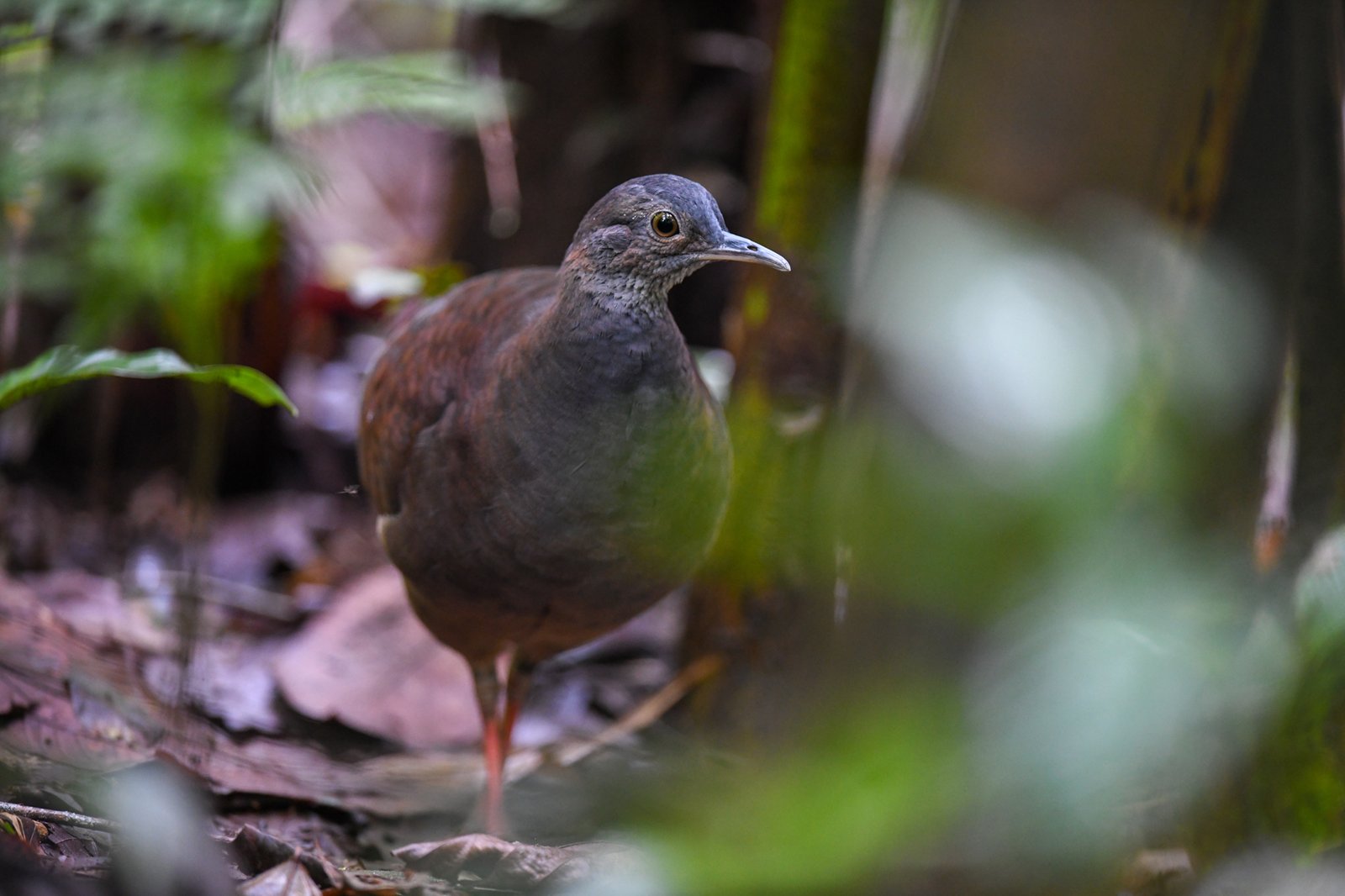
The Slaty-breasted Tinamou is a medium-sized, dark tinamou of humid lowland forest on the Gulf and Caribbean side, from southern Mexico to northern Costa Rica. It is shy and heard far more often than seen. The species does not occur outside the guide area.
Voice
A low, hollow, mournful whistle of two or three syllables, ooo-oooo, lower than in the other tinamous of the guide area. It is repeated at dusk, sometimes for hours with short pauses.
Recording: Patrick ODonnell — CC BY-NC-SA 4.0 · converted to mono · xeno-canto
Identification
26–30 cm; a stocky, almost tailless tinamou with a dark head and bright red legs. The crown, hindneck and sides of the head are blackish-brown, the throat is white. The breast is plain slate-grey, the belly grey-brown, with dark barring on the flanks and undertail coverts. The upperparts are dark chocolate-brown. The bill is dark above and yellowish below. The female has fine pale and dark barring on the wing coverts and rump, which are almost plain in the male. The north of the range holds C. b. boucardi, Honduras to Costa Rica the slightly browner C. b. costaricensis.
Confusion species
Thicket Tinamou Crypturellus cinnamomeus occurs in the same region on the Gulf side and in Yucatán, but is warmer brown, with cinnamon underparts, a pale supercilium and heavily barred upperparts; it lives mainly in drier forest and scrub. Little Tinamou Crypturellus soui is clearly smaller, with a rufous belly and olive-grey legs. Great Tinamou Tinamus major is much larger and more olive-brown, with blue-grey legs.
Habitat
Evergreen humid lowland forest with dense undergrowth, mainly below about 700 m and in Mexico locally to 1500 m; also older secondary forest, riparian forest and overgrown plantations next to forest. It forages on the forest floor for fallen fruit, seeds and invertebrates, especially ants and termites. The male incubates the eggs of several females in a nest on the ground, often between buttress roots.
Where the bird is most at home, classified by the vegetation units of Mexico and Central America.




Range and movements
Gulf-slope lowlands from southern Veracruz and northern Oaxaca, through Tabasco, Chiapas, southern Campeche and southern Quintana Roo to Belize, Guatemala and north-western Honduras (C. b. boucardi), and further along the Caribbean side of Honduras and Nicaragua to northern Costa Rica (C. b. costaricensis). Absent from the Pacific side and from El Salvador.
- Resident
- dark = core range, pale = thinly spread
How and when to look
At Tikal in Petén and in the Cockscomb Basin in Belize it is readily heard at dusk; a bird is sometimes seen early in the morning walking calmly across a quiet forest trail. Where it is not hunted, it is less shy.
Conservation status
Vulnerable. Its range is shrinking through the loss of lowland forest to cattle ranching and agriculture, and the species is heavily hunted. In large protected areas such as the Selva Maya it is still fairly common.
Scientific name
Crypturellus boucardi | (Sclater, 1860)
Sclater described the species in 1860 as Tinamus boucardi; because it was later moved to another genus, the author and year stand in brackets. The genus Crypturellus was introduced in 1914 by Brabourne, WWK-H & Chubb. Crypturellus is a diminutive of the older tinamou genus Crypturus (Greek kruptos 'hidden' and oura 'tail'): 'little hidden-tail'. boucardi honours the French collector and natural history dealer Adolphe Boucard (1839–1905), who collected in Mexico among other places. The specimen the first description was based on came from Playa Vicente and Teotalcingo, Oaxaca, Mexico.