All species › Tinamous › Tinamous › Great Tinamou
Position in the tree Birds Aves › Ratites and tinamous Palaeognathae
Great Tinamou | Tinamus major
Grote tinamoe | Tinamú mayor
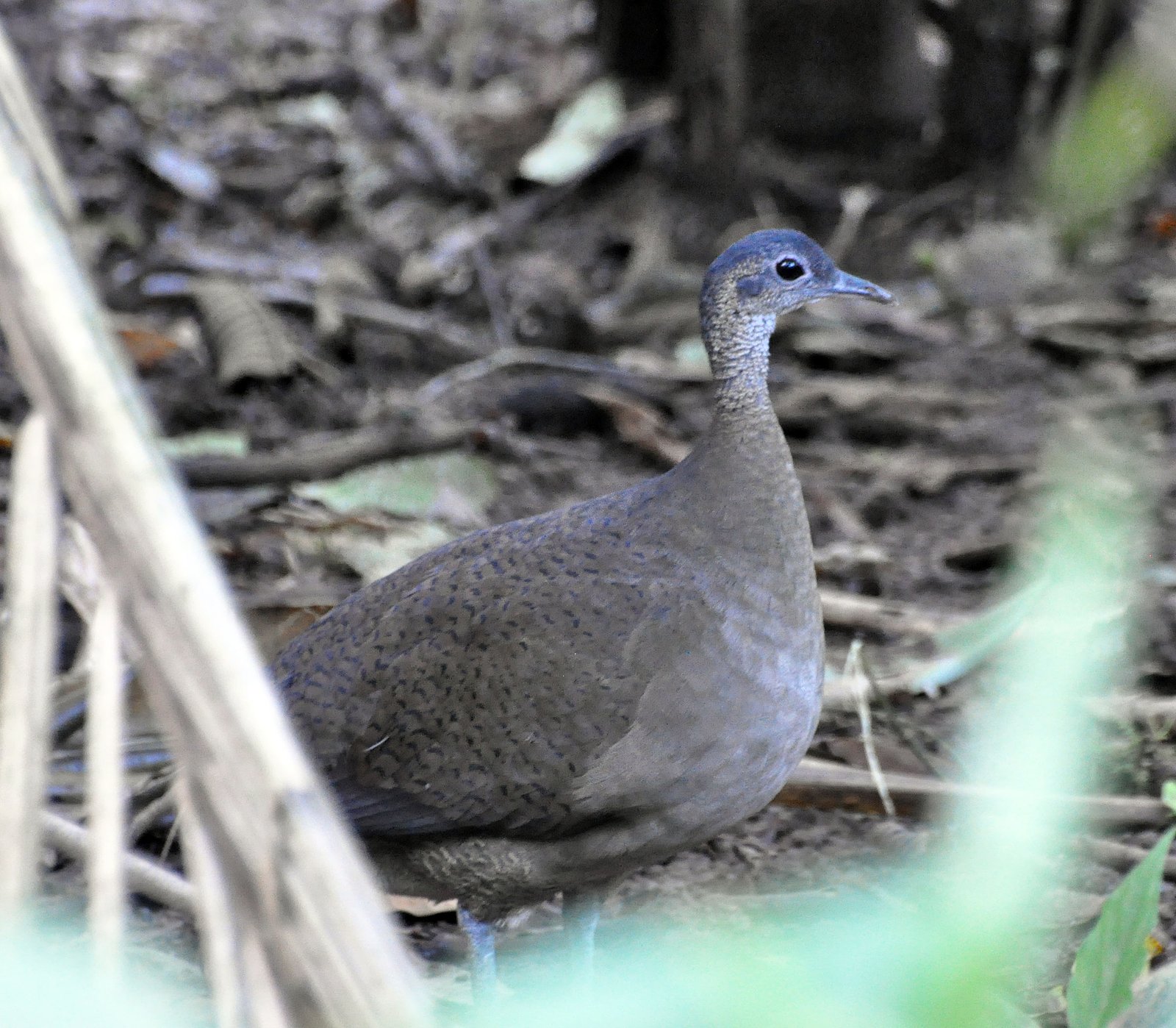
The Great Tinamou is the largest tinamou in the guide area and a characteristic ground bird of humid lowland forest, from southern Mexico to Panama. It is heard more than seen; its tremulous whistles at dusk are among the best-known sounds of the rainforest. The male alone incubates the glossy turquoise eggs.
Voice
A series of a few tremulous, powerful whistles with sliding pitch, mainly at dawn and just before dark, sometimes also at night. When flushed it bursts up with loud wing clatter.
Recording: Jacob Wijpkema — CC BY-NC-SA 4.0 · converted to mono · xeno-canto
Identification
38–46 cm; large and rounded, with a small head, a thin neck and almost no tail. The upperparts are olive-brown to greenish olive, with fine black barring on the back and wings. The crown and hindneck are rufous, with a short dark crest on the nape; the throat is white. The underparts are grey-brown to ochre with dark barring on the flanks, and the undertail coverts are cinnamon. The legs are blue-grey. Several subspecies occur in the guide area, including T. m. percautus on the Yucatán Peninsula, T. m. robustus from southern Mexico to Honduras and T. m. castaneiceps, with a chestnut head, in south-western Costa Rica and western Panama.
Confusion species
Highland Tinamou Nothocercus bonapartei has a rufous throat and cinnamon underparts and lives higher in the mountains. Slaty-breasted Tinamou Crypturellus boucardi and the other Crypturellus species are clearly smaller, with red or yellowish legs instead of blue-grey. Great Curassow Crax rubra also walks on the forest floor, but is much larger, with a long tail and a curly crest.
Habitat
Undisturbed humid lowland and foothill forest, also swamp forest and gallery forest, locally up to about 1500 m. It avoids heavily logged forest and open land, but occurs in old secondary forest. It feeds on the forest floor mainly on fallen fruit and seeds, also insects and small vertebrates. Unlike most tinamous, it roosts on a low branch above the ground.
Where the bird is most at home, classified by the vegetation units of Mexico and Central America.




Range and movements
Gulf-slope lowlands from southern Veracruz and northern Oaxaca through Tabasco, Chiapas, Campeche and southern Quintana Roo to Belize, Guatemala, Honduras and the Caribbean side of Nicaragua. In Costa Rica and Panama on both sides of the mountains, east to Darién. Absent from El Salvador and the dry Pacific lowlands. Outside the guide area through Colombia and Amazonia to Bolivia.
- Resident
- dark = core range, pale = thinly spread
How and when to look
In protected forests without hunting, such as Corcovado and La Selva in Costa Rica, the forests along Pipeline Road in Panama and Calakmul in Campeche, birds sometimes walk calmly along the trails. At dusk the whistles reveal where they are.
Conservation status
Not threatened, but declining in much of its range through hunting and forest loss; in fragmented forest it is often one of the first species to disappear. Still common in large protected areas.
Scientific name
Tinamus major | (Gmelin, 1789)
Gmelin described the species in 1789 as Tetrao major; because it was later moved to another genus, the author and year stand in brackets. The genus Tinamus was introduced in 1783 by Hermann. Tinamus comes from tinamú, the name for these birds in a Carib (Galibi) language of French Guiana. major is Latin for 'greater', as this is one of the largest tinamous. The specimen the first description was based on came from Cayenne, French Guiana.