All species › Parrots › African and New World parrots › Lilac-crowned Amazon
Position in the tree Birds Aves › Birds with a flexible palate Neognathae › All other modern birds Neoaves › Landbirds Telluraves › Falcons, parrots and passerines Australaves › Falcons and passerines Eufalconimorphae › Parrots and passerines Psittacopasserae
Lilac-crowned Amazon | Amazona finschi
Finsch' amazone | Loro corona lila
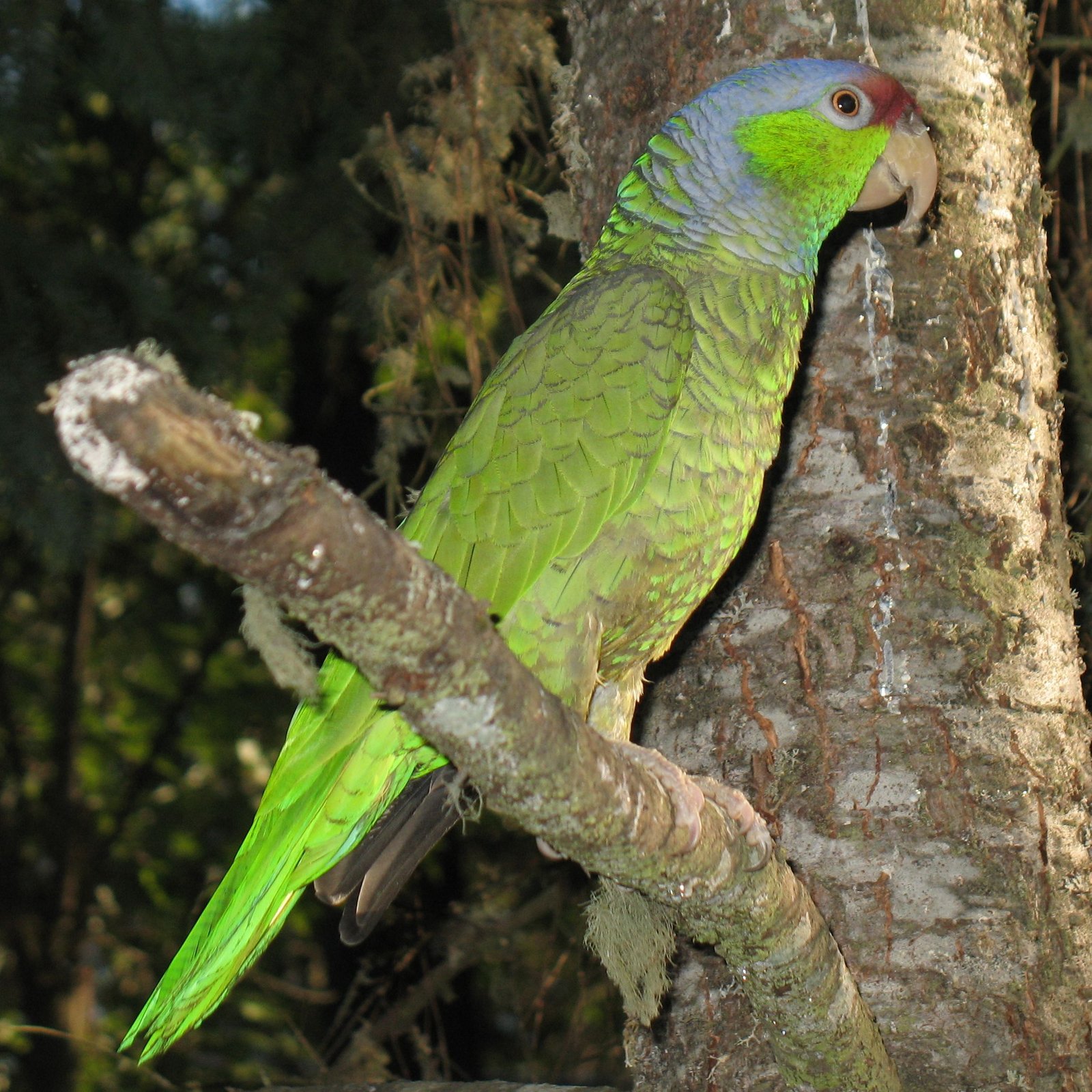
The Lilac-crowned Amazon is a medium-sized amazon with a dark red forehead and a lilac crown and nape. The species occurs only in Mexico, on the Pacific side from Sonora to Oaxaca, and is the characteristic amazon of the dry forest there. It has declined steeply because many chicks are taken from nests for the trade.
Voice
Loud, shrill and harsh; a high, screeching kree-ah and a series of short, grating calls, especially in flight and at communal roosts.
Recording: Manuel Grosselet — CC BY-NC-SA 4.0 · converted to mono · xeno-canto
Identification
31–34 cm. Mostly green, with a dark maroon forehead and lores, pale green cheeks and a lilac to lilac-blue crown and nape. The feathers of the upperparts have dark edges, giving a scaly look at close range. A red speculum shows on the secondaries, the primaries are blue and the fairly long tail is green with a yellowish-green tip. The bill is pale horn. Male and female are alike; young birds have less lilac on the head.
Confusion species
The Red-crowned Amazon Amazona viridigenalis of northeastern Mexico has a bright red forehead and a red crown; the two do not occur together naturally. The White-fronted Amazon Amazona albifrons, which lives in the same dry forest, is smaller, with a white forehead and red around the eye. The Yellow-headed Amazon Amazona oratrix is larger and has a yellow head.
Habitat
Tropical dry forest and semi-deciduous forest in the lowlands and on the slopes, gallery forest along rivers and in valleys, thorn scrub with tall trees, and in the mountains oak and pine-oak forest up to about 2200 m; also semi-open country with large trees. It eats seeds, fruit and flowers. It nests in a cavity in a large tree, usually in dry forest.
Where the bird is most at home, classified by the vegetation units of Mexico and Central America.







Range and movements
Only in Mexico, on the Pacific side: from southeastern Sonora and southwestern Chihuahua through Sinaloa, Durango, Nayarit, Jalisco, Colima, Michoacán and Guerrero to southern Oaxaca. Records elsewhere in Mexico, such as in Mexico City and Monterrey, probably involve escaped cage birds. Outside the guide area feral in southern California.
- Resident
- dark = core range, pale = thinly spread
How and when to look
In Jalisco groups occur in the dry forest of the Chamela-Cuixmala Biosphere Reserve, and in Nayarit around San Blas. They are mostly seen at sunrise and before sunset, when they fly calling loudly between roost and feeding areas.
Conservation status
Endangered. The population has declined steeply through the taking of chicks from nests for the cage-bird trade and the clearance of dry forest for farming and cattle ranching. The loss of large trees with nest cavities limits the number of breeding pairs.
Scientific name
Amazona finschi | (Sclater, 1864)
Sclater described the species in 1864 as Chrysotis finschi; because it was later moved to another genus, the author and year stand in brackets. The genus Amazona was introduced in 1830 by Lesson. Amazona comes from 'Amazone', the French name Buffon gave to various tropical American parrots because they came from the Amazon region. finschi honours the German ornithologist and ethnographer Otto Finsch (1839–1917), an authority on parrots. The specimen the first description was based on came from Mexico (not specified).