All species › Parrots › African and New World parrots › Red-crowned Amazon
Position in the tree Birds Aves › Birds with a flexible palate Neognathae › All other modern birds Neoaves › Landbirds Telluraves › Falcons, parrots and passerines Australaves › Falcons and passerines Eufalconimorphae › Parrots and passerines Psittacopasserae
Red-crowned Amazon | Amazona viridigenalis
Groenwangamazone | Loro tamaulipeco
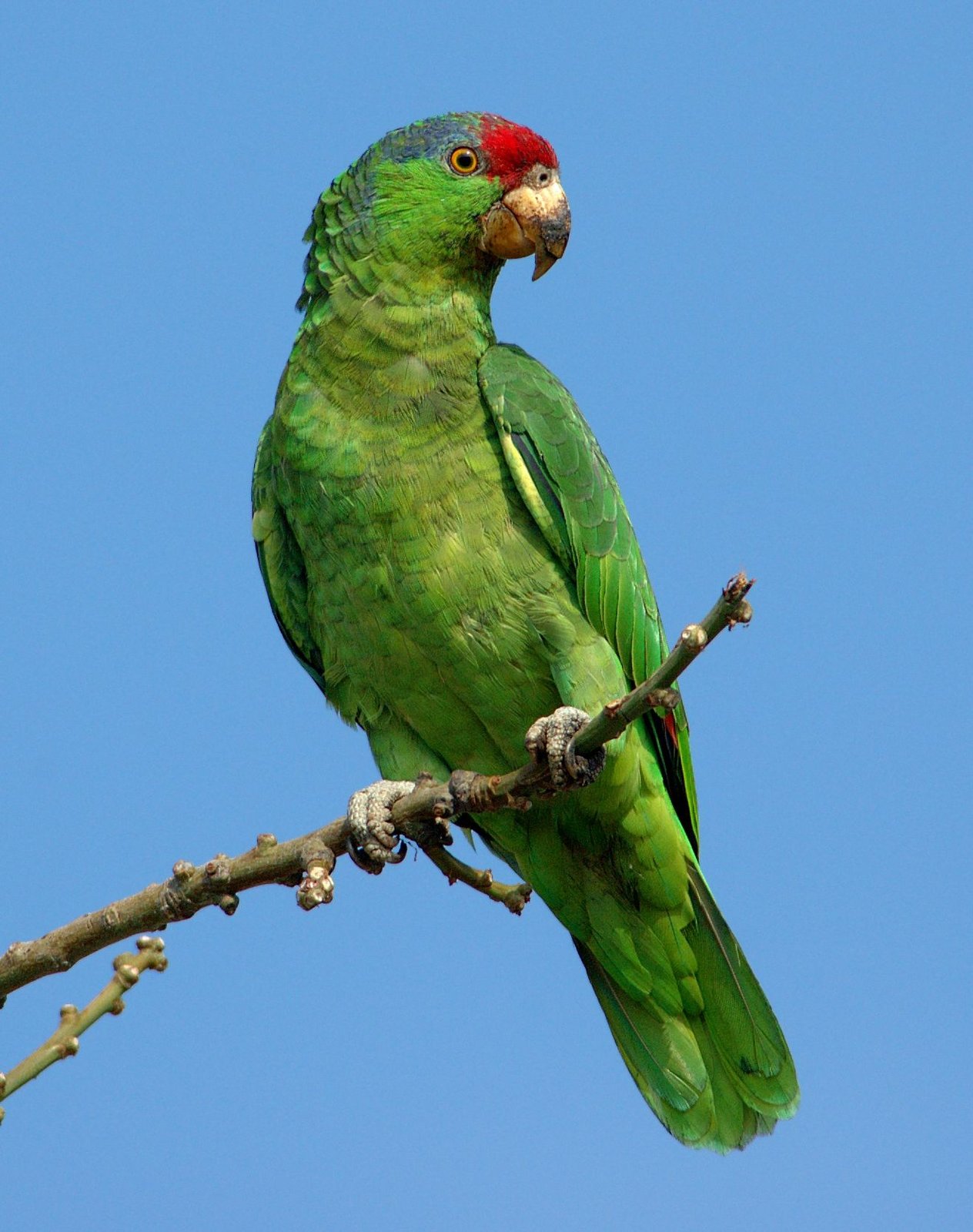
The Red-crowned Amazon is a medium-sized amazon with a red crown and pale green cheeks. Its natural range is small and lies in northeastern Mexico, mainly in Tamaulipas. Nest poaching for the trade has greatly reduced the wild population, while escaped cage birds have formed feral groups in the southern United States and elsewhere.
Voice
Loud and harsh; a characteristic series kee-krak krak krak, as well as shrill, screeching calls, especially in flight and at the roost.
Recording: Richard E. Webster — CC BY-NC-SA 4.0 · shortened to the first 60 s, mono · xeno-canto
Identification
30–33 cm. Mostly green, with a red forehead and crown, bright pale green cheeks and a blue-violet stripe from behind the eye to the nape. The feathers of the hindneck and nape have black edges, giving those parts a scaly look. A red speculum shows on the secondaries, the primaries are bluish and the tail is green with a yellowish-green terminal band. The bill is pale horn. In females and young birds the red on the head is less extensive, in young birds often limited to the forehead.
Confusion species
The Red-lored Amazon Amazona autumnalis, which overlaps in southern Tamaulipas and in Veracruz, has yellow cheeks, red only on the forehead and lores, and a lilac-blue crown. The Lilac-crowned Amazon Amazona finschi of the Pacific side has a dark maroon forehead and a lilac crown and nape. The White-fronted Amazon Amazona albifrons is smaller and has a white forehead.
Habitat
Gallery forest along rivers, semi-deciduous and dry forest in the lowlands and on the lower slopes of the Sierra Madre Oriental, up into oak and pine-oak forest at about 1200 m, and semi-open country with large trees. Feral birds live in towns with parks and avenues. It eats seeds, fruit, nuts and blossom. It nests in a tree cavity.
Where the bird is most at home, classified by the vegetation units of Mexico and Central America.







Range and movements
Native to northeastern Mexico: Tamaulipas, eastern San Luis Potosí, northern Veracruz and southeastern Nuevo León, nowadays fragmented. Groups in cities such as Monterrey probably consist wholly or partly of escaped or feral birds. Outside the guide area feral populations live in southern California, Florida and Puerto Rico, among other places; the groups in southern Texas are partly feral, partly perhaps wanderers from Tamaulipas.
- Resident
- dark = core range, pale = thinly spread
How and when to look
In Tamaulipas the best chance is around the El Cielo Biosphere Reserve near Gómez Farías and in the Río Sabinas valley, where groups fly calling loudly between roost and feeding areas at sunrise and sunset.
Conservation status
Endangered. The wild population has declined steeply since the 1970s, mainly through the taking of chicks from nests for the cage-bird trade and the clearance of lowland forest for farming and cattle ranching. The birds are vulnerable because they depend on old trees with nest cavities.
Scientific name
Amazona viridigenalis | (Cassin, 1853)
Cassin described the species in 1853 as Chrysotis viridigenalis; because it was later moved to another genus, the author and year stand in brackets. The genus Amazona was introduced in 1830 by Lesson. Amazona comes from 'Amazone', the French name Buffon gave to various tropical American parrots because they came from the Amazon region. viridigenalis is Latin, from viridis 'green' and gena 'cheek', after the bright green cheeks. The specimen the first description was based on came from northeastern Mexico (originally given in error as South America).