All species › Nightjars › Nightjars and nighthawks › Lesser Nighthawk
Position in the tree Birds Aves › Birds with a flexible palate Neognathae › All other modern birds Neoaves › Birds of the elements Elementaves › Nightjars and swifts Strisores
Lesser Nighthawk | Chordeiles acutipennis
Texasnachtzwaluw | Chotacabras menor
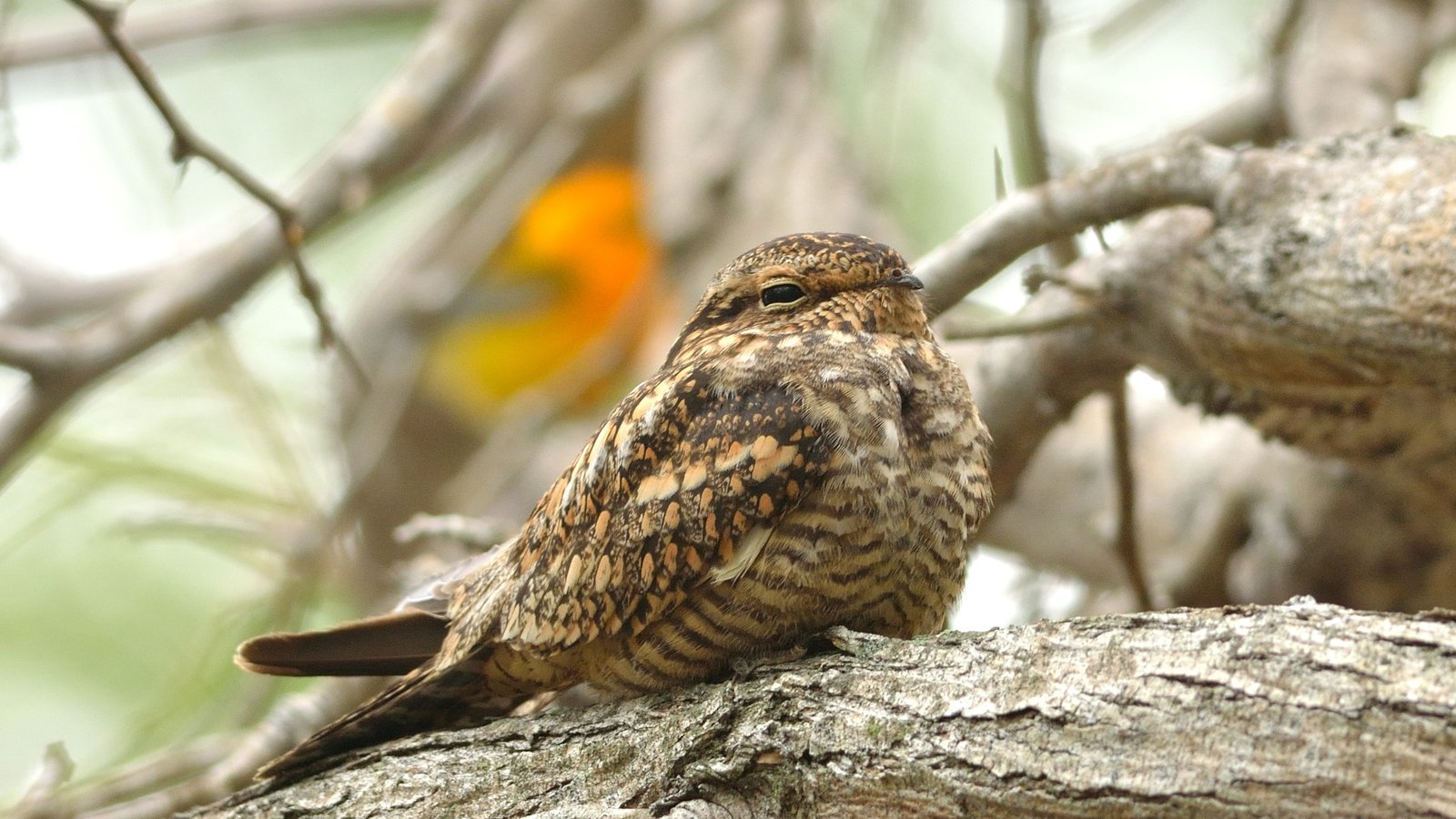
The Lesser Nighthawk is a small nightjar with long, pointed wings that hunts insects on the wing over open, dry country. Its Dutch name refers to Texas, but that state is only a small part of a range that extends from the south-western United States through the whole guide area to South America. In the guide area it is one of the most frequently seen nightjars, especially along the coast and in dry lowlands. It often hunts early in the evening, low and fluttering over the ground or water.
Voice
The song, given from the ground, is a long, soft, toad-like trill that can last many seconds and is repeated after short pauses. In flight a soft bleating, laughing wa-wa-wa-wa and a low, bubbling sound. Much quieter than the Common Nighthawk; the nasal peent of that species is lacking.
Recording: Richard E. Webster — CC BY-NC-SA 4.0 · shortened to the first 60 s, mono · xeno-canto
Identification
19–23 cm. A slender nightjar with long, narrow, pointed wings that extend beyond the tail on a perched bird, and a slightly forked tail. The plumage is grey-brown, finely spotted and speckled with a warm buff tone; the underparts are buff with fine barring. A white (buff in the female) band crosses the primaries, closer to the wingtip than in the Common Nighthawk. The inner primaries bear buff spots. The male has a white throat patch and a white band across the tail; the female has a buff throat and no tail band.
Confusion species
The Common Nighthawk Chordeiles minor is slightly larger and darker, has the white wing band halfway between the bend of the wing and the tip, no buff spots in the primaries, a more pointed wingtip, and usually flies higher. The Short-tailed Nighthawk Lurocalis semitorquatus is darker, without a wing band, with a short tail, and hunts over forest. The Pauraque Nyctidromus albicollis and the whip-poor-wills Antrostomus have rounded wings and hunt from the ground or a branch rather than on the wing.
Habitat
Dry, open country: thorn scrub, desert and semi-desert, savanna, coastal plains, beaches and dunes, the edges of marshes, lagoons, mangroves and salt pans, and fields and rice paddies; mainly in the lowlands, up to about 1500 m. It hunts flying insects at dusk and in the first part of the night low over the ground and water, also around street lights. The egg is laid without a nest on bare ground, sand or gravel.
Where the bird is most at home, classified by the vegetation units of Mexico and Central America.







Range and movements
Throughout the lowlands of the guide area, on both the Pacific and the Gulf and Caribbean sides, from Baja California, Sonora, Chihuahua, Coahuila and Tamaulipas through the Yucatán Peninsula and all of Central America to Panama; scarce or absent in the higher interior. In northern Mexico mainly a summer visitor; on the Yucatán Peninsula present mainly in the breeding season. In winter, birds from the north join those in southern Mexico and Central America. Outside the guide area from the south-western United States to northern and central South America.
- Resident
- Summer visitor (c. Apr–Sep)
- Winter visitor (c. Oct–Mar)
- Passage (Mar–Apr, Oct–Nov)
- dark = core range, pale = thinly spread
How and when to look
Around sunset over coastal plains, lagoons, beaches and dry scrub, for example along the Gulf of California in Sonora and Sinaloa, on the Pacific coast of Guatemala and El Salvador and in Guanacaste in Costa Rica. The birds then often fly back and forth low over the ground in loose groups. The best field mark in flight is the position of the white wing band, close to the tip.
Conservation status
Not threatened. Common in a very large range and locally benefiting from open, human-made terrain and from lighting that attracts insects. As a ground nester it is sensitive to disturbance and to free-roaming domestic animals.
Scientific name
Chordeiles acutipennis | (Hermann, 1783)
Hermann described the species in 1783 as Caprimulgus acutipennis; because it was later moved to another genus, the author and year stand in brackets. The genus Chordeiles was introduced in 1832 by Swainson. Chordeiles is Greek, from khoreia 'dance' and deilē 'evening', after the dancing hunting flights at dusk. acutipennis is Latin, from acutus 'pointed' and penna 'feather, wing', after the pointed wings. The specimen the first description was based on came from Cayenne, French Guiana.