All species › Nightjars › Nightjars and nighthawks › Mexican Whip-poor-will
Position in the tree Birds Aves › Birds with a flexible palate Neognathae › All other modern birds Neoaves › Birds of the elements Elementaves › Nightjars and swifts Strisores
Mexican Whip-poor-will | Antrostomus arizonae
Mexicaanse whippoorwill | Tapacaminos cuerporruín mexicano
The Mexican Whip-poor-will is a nightjar of montane pine-oak forests, from the south-western United States to Honduras. Until 2010 it was considered a subspecies of the Eastern Whip-poor-will, which breeds in eastern North America; the split rests mainly on differences in song and genetics. In the guide area it is one of the most frequently heard night birds in the highlands. Northern birds move south after the breeding season.
Voice
The song is a lower, burry and somewhat halting prrip-purr-rreel, repeated at length; less clear and fluid than that of the Eastern Whip-poor-will. It sings mainly at dusk and by moonlight, most often in spring and early summer. The call is a soft, dry quit.
Recording: Manuel Grosselet — CC BY-NC-SA 4.0 · shortened to the first 60 s, mono · xeno-canto
Identification
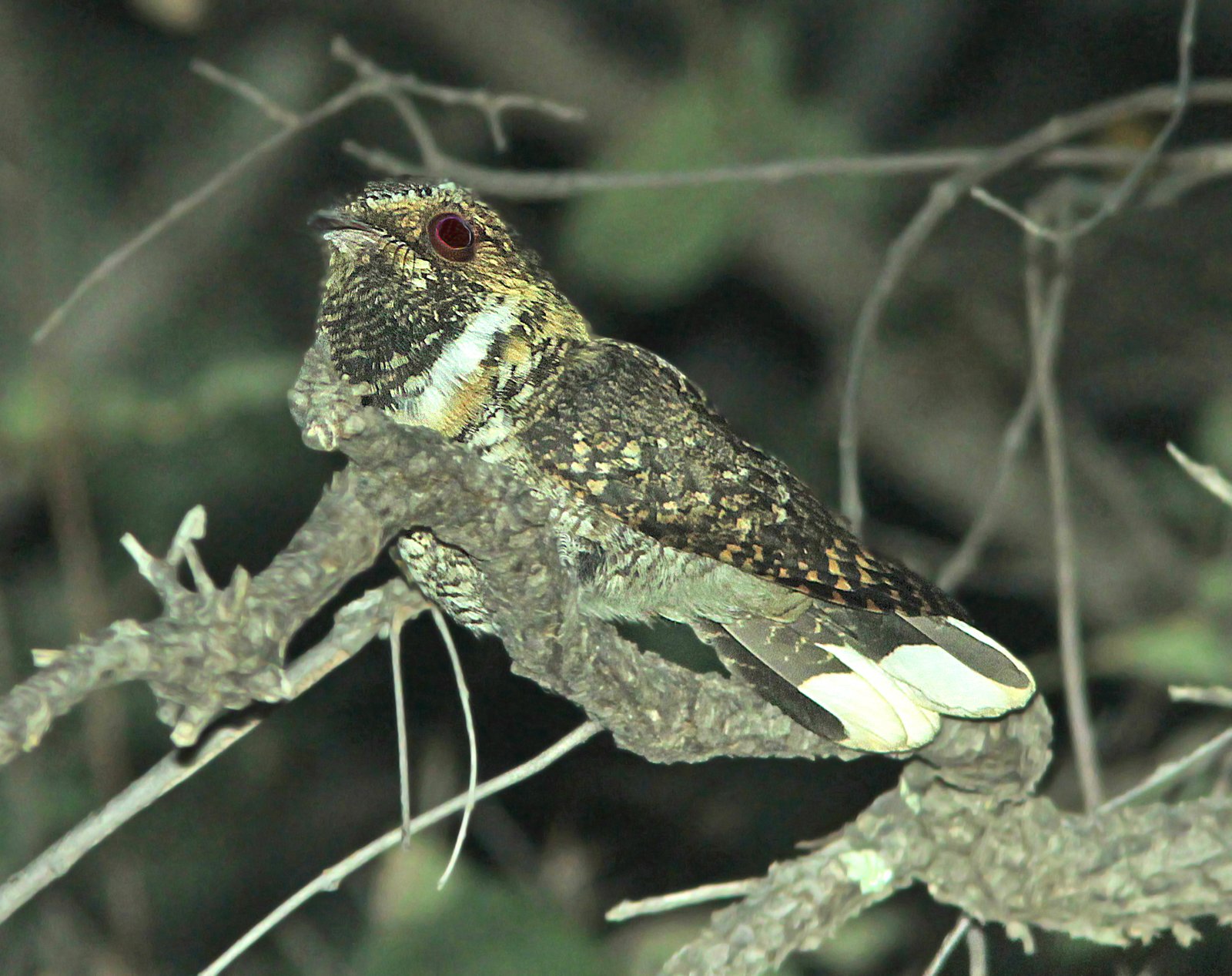
23–25 cm. A stocky nightjar with a large head, short bill with long bristles and rounded wings without a white wing band. The plumage is grey-brown, finely spotted and streaked with black and grey, with a dark throat and a narrow white (buff in the female) throat band. The male has white tips to the three outer tail feathers, conspicuous when it flushes; the female has narrow buff tips. Birds in the south of the range are on average darker and browner than those in the north.
Confusion species
The Eastern Whip-poor-will Antrostomus vociferus is a winter visitor mainly to the lowlands and foothills of the Gulf and Caribbean side; it is slightly browner, the male has more white in the tail, and the song is clearer and faster. Silent birds cannot be separated with certainty in winter. The Buff-collared Nightjar Antrostomus ridgwayi has a buff nape collar and a ticking, accelerating song, and lives in lower dry scrub. The Common Poorwill Phalaenoptilus nuttallii is smaller and shorter-tailed, with a sharply contrasting white throat band.
Habitat
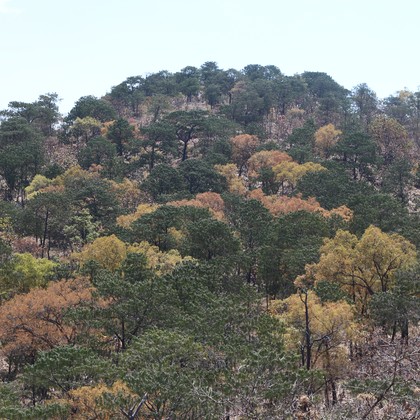
Pine-oak forest, oak forest and open conifer forest in the mountains, often with clearings, ravines and a shrubby understorey; also the edges of cloud forest. Mainly between about 1200 and 3000 m; in winter some birds descend to lower forest. It hunts moths and beetles at dusk and by moonlight from the ground or a low branch. The eggs are laid without a nest on the forest floor, among leaf litter.
Where the bird is most at home, classified by the vegetation units of Mexico and Central America.




Range and movements
In the mountains of Mexico: the Sierra Madre Occidental from Sonora and Chihuahua to Jalisco, the Sierra Madre Oriental from Coahuila and Nuevo León to Hidalgo and Puebla, the volcanic belt of central Mexico, the Sierra Madre del Sur in Guerrero and Oaxaca, and the highlands of Chiapas. Also in the highlands of Guatemala, El Salvador and Honduras. Birds from northern Mexico and the south-western United States move south after breeding and winter in western and central Mexico; south of central Mexico the birds are resident.
- Resident
- Summer visitor (c. Apr–Sep)
- Winter visitor (c. Oct–Mar)
- Passage (Mar–Apr, Oct–Nov)
- dark = core range, pale = thinly spread
How and when to look
From April to June the song rings out after sunset in the pine-oak forests of almost every Mexican mountain range, for example in the Sierra Madre Occidental in Durango and Sinaloa, around the volcanoes near Mexico City and in the highlands of Chiapas and Guatemala. When searched for with a torch, birds give themselves away by red eyeshine on the forest floor or on a branch.
Conservation status
Not threatened. Fairly common in suitable montane forest, but poorly studied because of its nocturnal habits. Locally, habitat is lost through logging and forest fires.
Scientific name
Antrostomus arizonae | Brewster, 1881
Brewster described the species in 1881 and placed it straight away in the genus where it still stands. The genus Antrostomus was introduced in 1838 by Bonaparte. Antrostomus is Greek, from antron 'cave' and stoma 'mouth': 'cave-mouth', after the enormous gape. arizonae refers to Arizona, where the type was collected. The specimen the first description was based on came from Chiricahua Mountains, Arizona, USA.