All species › Passerines › New World blackbirds, troupials and allies › Hooded Oriole
Position in the tree Birds Aves › Birds with a flexible palate Neognathae › All other modern birds Neoaves › Landbirds Telluraves › Falcons, parrots and passerines Australaves › Falcons and passerines Eufalconimorphae › Parrots and passerines Psittacopasserae
Hooded Oriole | Icterus cucullatus
Maskertroepiaal | Bolsero encapuchado
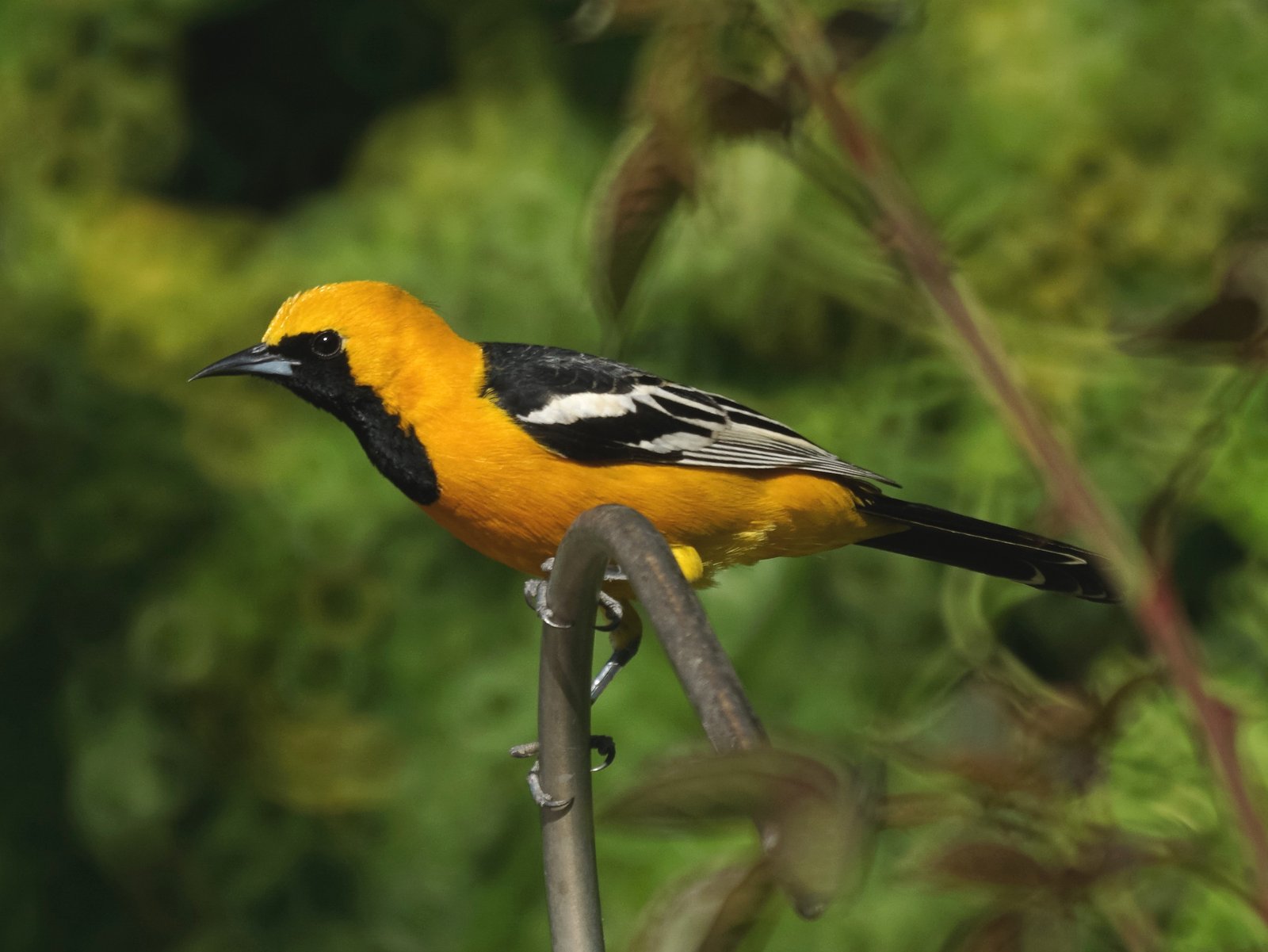
The Hooded Oriole is a slender, long-tailed oriole with a yellow to deep orange head and a black mask and throat. It is closely tied to palms, to which it sews its nest. Northern birds move south in winter; the populations of eastern and south-eastern Mexico and the Yucatán Peninsula are resident.
Voice
The song is a fast, somewhat jumbled series of whistled and chattering notes, often including imitations of other birds. Calls include a rising wheet and a dry chatter.
Recording: Richard E. Webster — CC BY-NC-SA 4.0 · shortened to the first 60 s, mono · xeno-canto
Identification
18–20 cm. Slender, with a long, graduated tail and a long, clearly decurved bill. Male: head, underparts and rump yellow to orange, more yellow in the north-west and deep orange on the Yucatán Peninsula; a black mask from bill to eye and a black throat; back, wings and tail black, with two white wing bars. In winter the male's back has pale fringes. Female: olive-yellow with a greyish back, yellow underparts and two narrow white wing bars. The first-year male resembles the female but has a black throat.
Confusion species
Altamira Oriole Icterus gularis is larger, with a thick, straight bill and an orange shoulder patch instead of white wing bars. Streak-backed Oriole Icterus pustulatus has an orange back with black spots or streaks. The female Orchard Oriole Icterus spurius is smaller, with a shorter tail and shorter bill. Bullock's Oriole Icterus bullockiorum has a black crown, a black eye-stripe and a large white wing patch.
Habitat
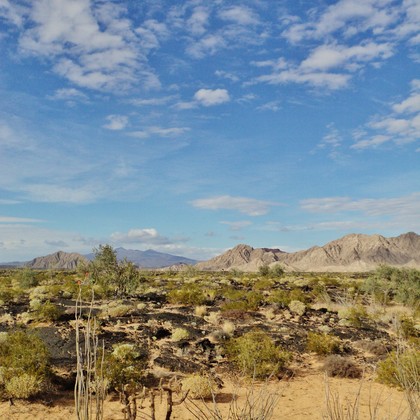
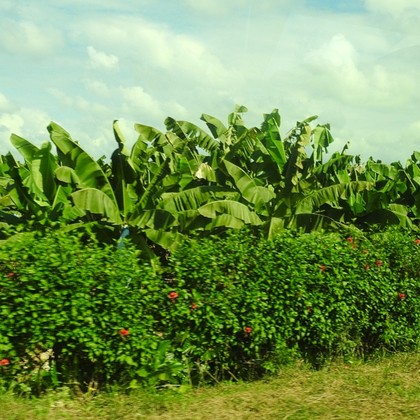
Dry and semi-open country with palms and scattered trees: riparian woodland, thorn scrub, dry seasonal forest, desert oases, plantations, gardens, parks and villages, mostly below 1500 m. The nest is a woven pouch sewn to the underside of a palm frond. It eats insects, fruit and much nectar.
Where the bird is most at home, classified by the vegetation units of Mexico and Central America.




Range and movements
Breeds in the south-western United States and northern Mexico, including Baja California. Resident in southern Baja California, along the Gulf of Mexico coast to Tabasco and on the Yucatán Peninsula with Belize and northern Guatemala. Northern birds winter in western and central Mexico.
- Resident
- Summer visitor (c. Apr–Sep)
- Winter visitor (c. Oct–Mar)
- Passage (Mar–Apr, Oct–Nov)
- dark = core range, pale = thinly spread
How and when to look
Best found at palms in villages, hotel grounds and gardens, especially on the Yucatán Peninsula, where the deep orange males are present year-round.
Conservation status
Not threatened (LC). Common; in the north it has benefited from the planting of ornamental palms in gardens and towns.
Scientific name
Icterus cucullatus | Swainson, 1827
Swainson described the species in 1827 and placed it straight away in the genus where it still stands. The genus Icterus was introduced in 1760 by Brisson. Icterus is from Ancient Greek ikteros, a yellow bird usually taken to be the golden oriole, the sight of which was thought to cure jaundice. cucullatus is Latin for 'hooded', after the hood-like pattern of the head. The specimen the first description was based on came from Temascaltepec, State of México (Mexico).