All species › Passerines › New World blackbirds, troupials and allies › Yellow-backed Oriole
Position in the tree Birds Aves › Birds with a flexible palate Neognathae › All other modern birds Neoaves › Landbirds Telluraves › Falcons, parrots and passerines Australaves › Falcons and passerines Eufalconimorphae › Parrots and passerines Psittacopasserae
Yellow-backed Oriole | Icterus chrysater
Geelrugtroepiaal | Bolsero dorso dorado
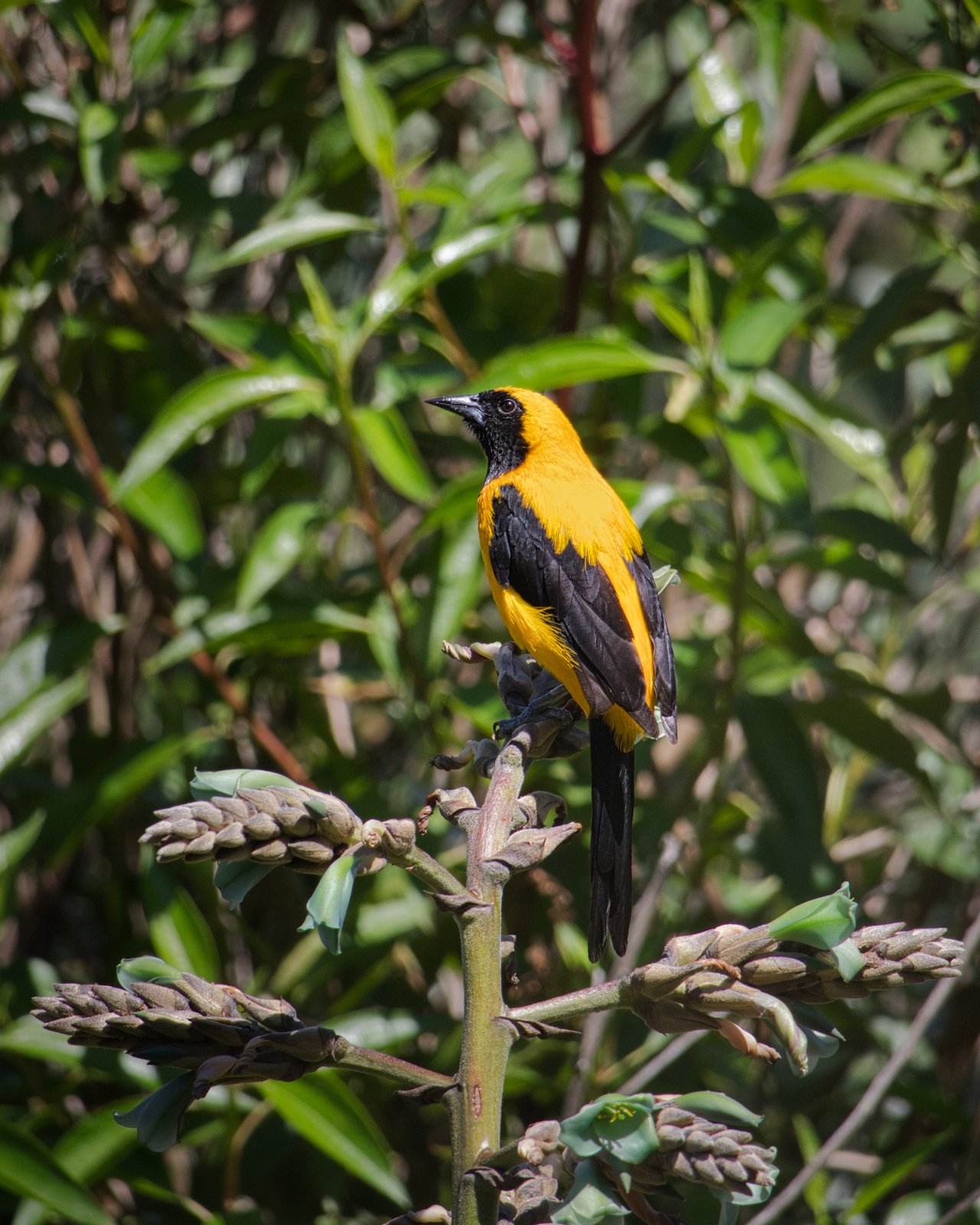
The Yellow-backed Oriole is a large, entirely yellow oriole with a black mask and black wings and tail. Unlike most other orioles in the guide area it has a yellow back. It lives from south-eastern Mexico to Nicaragua, is absent from Costa Rica and occurs again in Panama and beyond in northern South America.
Voice
The song is a slow, irregular series of clear, full whistles somewhat reminiscent of human whistling. Calls include a nasal nyeh and a dry chek.
Recording: Max Noack — CC BY-NC-SA 4.0 · converted to mono · xeno-canto
Identification
21–23 cm. Head, back, rump and underparts yellow to orange-yellow, often with an orange tinge on the head and breast. A black mask from forehead and lores to around the eye, continuing into a black throat and upper breast. Wings and tail wholly black, without white wing bars and without yellow in the tail. Bill strong and black, with a bluish-grey base to the lower mandible. Male and female are nearly alike; the female is sometimes slightly greener on the back. Young birds are olive-yellow with a less extensive black mask.
Confusion species
Yellow-tailed Oriole Icterus mesomelas has a black back, a yellow shoulder patch and yellow in the tail. Bar-winged Oriole Icterus maculialatus has a black back and a white wing bar. Altamira Oriole Icterus gularis is more orange and has a black back and an orange shoulder patch. On the Yucatán Peninsula, Orange Oriole Icterus auratus has an orange back and white wing bars.
Habitat
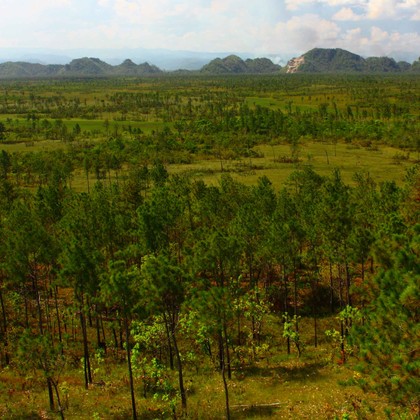
Semi-open pine-oak woodland, pine savanna, edges of cloud forest and humid forest, secondary forest, shade coffee and country with scattered trees, from sea level (pine savannas in Belize and on the Yucatán Peninsula) to about 2500 m. It searches the canopy in pairs or small groups for insects, fruit and nectar.
Where the bird is most at home, classified by the vegetation units of Mexico and Central America.





Range and movements
South-eastern Mexico (Veracruz, Oaxaca, Chiapas and the Yucatán Peninsula) through Belize, Guatemala, El Salvador and Honduras to northern Nicaragua. Absent from Costa Rica and occurs locally again in Panama. Outside the guide area in Colombia and Venezuela.
- Resident
- dark = core range, pale = thinly spread
How and when to look
Often heard before it is seen: the slow whistles carry far through open pine-oak woodland. In Belize regularly seen in the pine savannas along the inland roads.
Conservation status
Not threatened (LC). Fairly common in semi-open woodland and tolerant of small-scale clearing.
Scientific name
Icterus chrysater | (Lesson, 1844)
Lesson described the species in 1844 as Xanthornus chrysater; because it was later moved to another genus, the author and year stand in brackets. The genus Icterus was introduced in 1760 by Brisson. Icterus is from Ancient Greek ikteros, a yellow bird usually taken to be the golden oriole, the sight of which was thought to cure jaundice. chrysater combines Greek khrusos 'gold' and Latin ater 'black', after the golden-yellow and black plumage. The specimen the first description was based on came from Mexico.