All species › Woodpeckers and allies › Woodpeckers › Hairy Woodpecker
Position in the tree Birds Aves › Birds with a flexible palate Neognathae › All other modern birds Neoaves › Landbirds Telluraves › Raptors, owls, kingfishers and woodpeckers Afroaves › Mousebirds, rollers and woodpeckers Coraciimorphae › Trogons and cavity nesters Cavitaves › Hornbills, kingfishers and woodpeckers Picocoraciae › Kingfishers, bee-eaters and woodpeckers Picodynastornithes
Hairy Woodpecker | Leuconotopicus villosus
Haarspecht | Carpintero velloso mayor
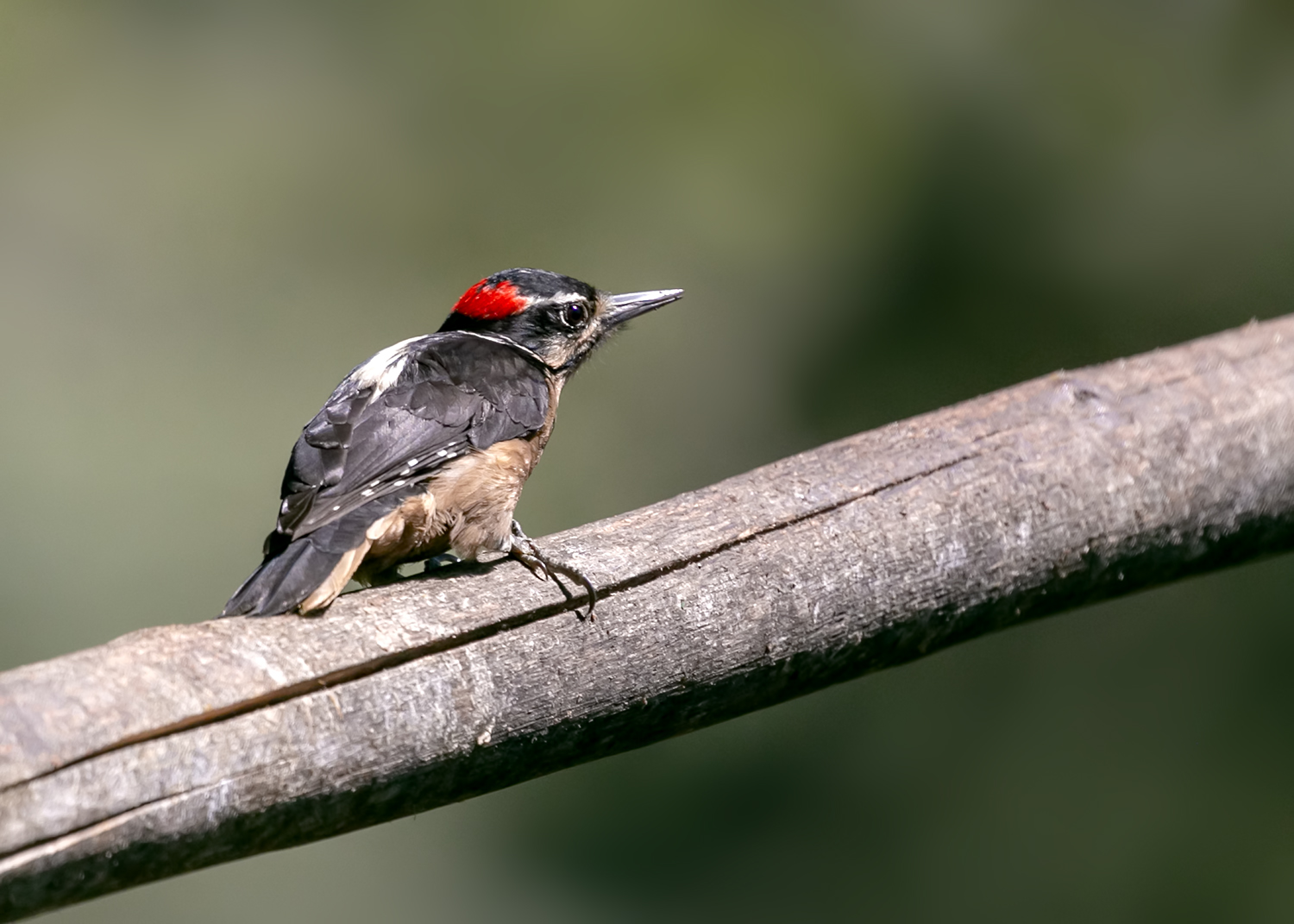
The Hairy Woodpecker is a black-and-white woodpecker with a white back stripe, which in the guide area lives in montane forest, from Baja California and the Sierras Madre to western Panama. Towards the south the birds become smaller and darker; in Costa Rica and Panama the underparts are brownish-grey instead of white.
Voice
A sharp, loud peek and a fast, ringing rattle that stays on one pitch. Drums in hard, fast rolls, used by pairs to mark their territory.
Recording: Valerie Heemstra — CC BY-NC-SA 4.0 · converted to mono · xeno-canto
Identification
18–22 cm. Back black with a broad white or off-white stripe down the centre; wings black with rows of white spots. Head black with a white stripe above the eye and a white moustachial stripe. Bill long and strong, about as long as the head. Underparts white in northern Mexico, drab buff further south, brownish-grey in Costa Rica and Panama, where the white areas of the back and head are also tinged brown. Outer tail feathers white. The male has a red patch on the hindcrown, the female does not.
Confusion species
Ladder-backed Woodpecker Dryobates scalaris and Nuttall's Woodpecker Dryobates nuttallii have a black-and-white barred back instead of a white back stripe. Arizona Woodpecker Leuconotopicus arizonae and Strickland's Woodpecker Leuconotopicus stricklandi have a brown back, a brown ear patch and spotted underparts. Smoky-brown Woodpecker Leuconotopicus fumigatus is almost plain brown, with no white back stripe.
Habitat
Pine-oak forest, oak forest, conifer forest and cloud forest in the mountains, locally also riparian woodland; in Mexico mostly between about 1200 and 3500 m, in Costa Rica and Panama mainly above 1500 m up to the treeline. It eats mainly insect larvae from wood and bark, also fruit and seeds. The nest hole is excavated in a dead trunk or branch.
Where the bird is most at home, classified by the vegetation units of Mexico and Central America.





Range and movements
Resident in the mountains of Baja California (Sierra Juárez and Sierra San Pedro Mártir), the Sierra Madre Occidental and Sierra Madre Oriental, the Trans-Mexican Volcanic Belt, the Sierra Madre del Sur and the mountains of Oaxaca and Chiapas; also in the highlands of Guatemala, El Salvador, Honduras and northern and central Nicaragua, and in the mountains of Costa Rica and western Panama. Outside the guide area in North America, from Alaska and Canada through the United States, and in the northern Bahamas.
- Resident
- dark = core range, pale = thinly spread
How and when to look
On the Cerro de la Muerte and around San Gerardo de Dota in Costa Rica, and on the slopes of Volcán Barú in Panama, in oak forest. In Mexico in pine-oak forest, for example in the Sierra San Pedro Mártir and the mountains around Mexico City.
Conservation status
Not threatened. In Central America tied to montane forest and locally vulnerable to deforestation there.
Scientific name
Leuconotopicus villosus | (Linnaeus, 1766)
Linnaeus described the species in 1766 as Picus villosus; because it was later moved to another genus, the author and year stand in brackets. The genus Leuconotopicus was introduced in 1845 by Malherbe. Leuconotopicus combines Greek leukos 'white' and nōtos 'back' with Latin picus 'woodpecker': 'white-backed woodpecker'. villosus is Latin for 'hairy, shaggy', after the long, hair-like white feathers down the middle of the back. The specimen the first description was based on came from Raccoon, New Jersey (USA).