All species › Woodpeckers and allies › Woodpeckers › Ladder-backed Woodpecker
Position in the tree Birds Aves › Birds with a flexible palate Neognathae › All other modern birds Neoaves › Landbirds Telluraves › Raptors, owls, kingfishers and woodpeckers Afroaves › Mousebirds, rollers and woodpeckers Coraciimorphae › Trogons and cavity nesters Cavitaves › Hornbills, kingfishers and woodpeckers Picocoraciae › Kingfishers, bee-eaters and woodpeckers Picodynastornithes
Ladder-backed Woodpecker | Dryobates scalaris
Ladderspecht | Carpintero mexicano
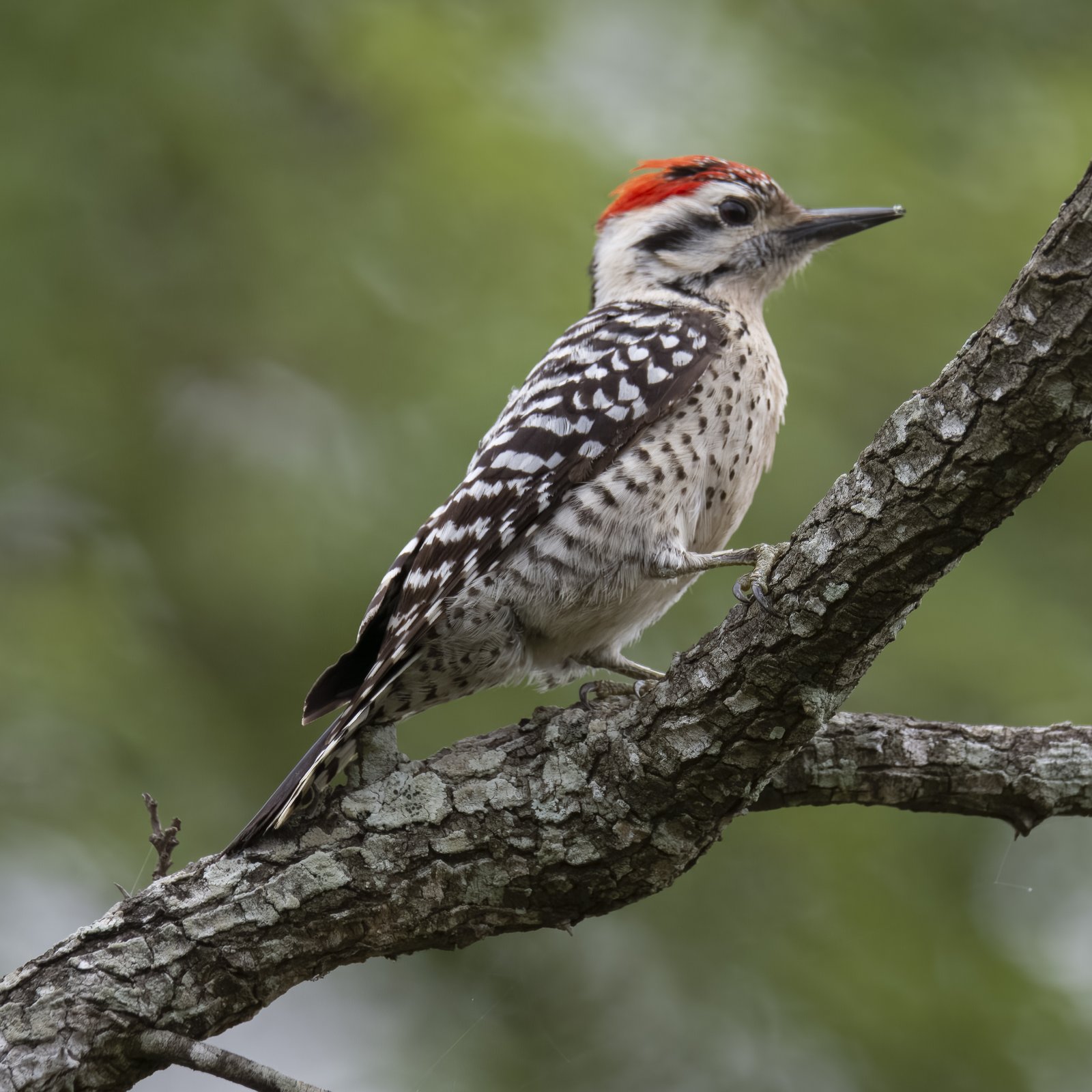
The Ladder-backed Woodpecker is the commonest small woodpecker of the arid regions of Mexico. It lives in desert, thorn scrub, dry forest and villages, and further south locally in pine savannas and dry lowlands as far as Nicaragua. The black-and-white barred back gave it its name.
Voice
A sharp, dry pik, and when excited a fast, ringing rattle that drops in pitch and slows slightly at the end. Drums in short, fast rolls on dead branches, posts and agave flower stalks.
Recording: Scott Olmstead — CC BY-NC-SA 4.0 · converted to mono · xeno-canto
Identification
16–19 cm. Back barred black and white from top to bottom; wings black with rows of white spots. Head off-white with a black eye stripe and a black cheek stripe, which together form a triangle around the ear coverts. Underparts drab buff to greyish-brown, with black spots on the sides of the breast and bars on the flanks. The male has a red crown with white speckling at the front, extending onto the nape; the female has a black crown. Southern birds are smaller and browner below.
Confusion species
Nuttall's Woodpecker Dryobates nuttallii, only in north-western Baja California, has more black on the upper back, a blacker head and whiter underparts; in the male the red is confined to the hindcrown and nape. Hairy Woodpecker Leuconotopicus villosus has a white back stripe without bars. Gila Woodpecker Melanerpes uropygialis and Golden-fronted Woodpecker Melanerpes aurifrons are larger, with a plain grey or greyish-brown head without black facial stripes. Arizona Woodpecker Leuconotopicus arizonae has a plain brown back.
Habitat
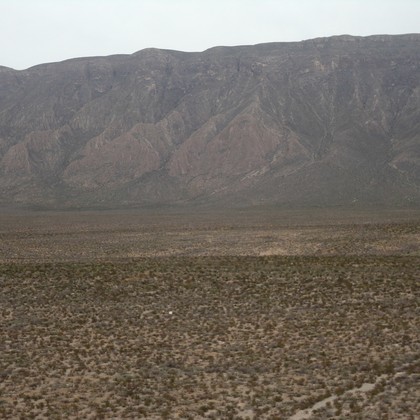
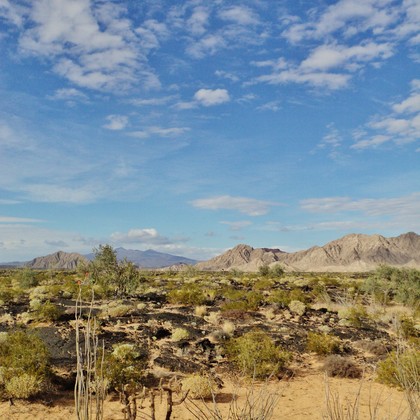
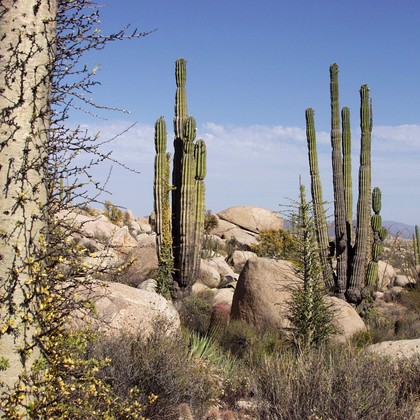
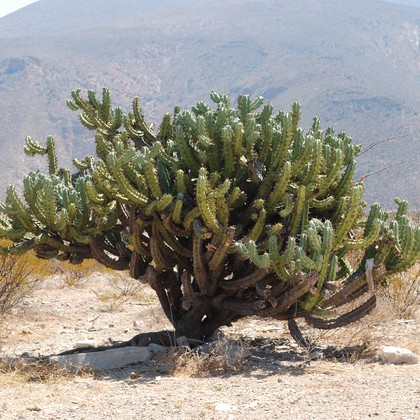
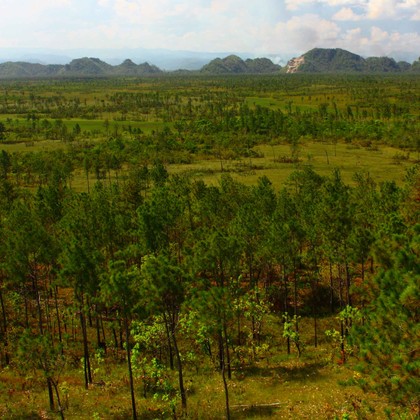
Desert with cacti, mesquite and yucca, thorn scrub, dry forest, riparian woodland, pine savanna and open country with scattered trees, also in villages and gardens, from sea level to about 2500 m. It eats mainly insects and larvae from branches, cacti and agave stalks, and some fruit. The nest hole is excavated in a dead branch, post, yucca or agave stalk.
Where the bird is most at home, classified by the vegetation units of Mexico and Central America.


Range and movements
In arid and semi-open country across almost all of Mexico, including Baja California and the north of the Yucatán Peninsula; absent from the humid lowlands of the south-east. Also locally in Belize, Guatemala, El Salvador, Honduras and Nicaragua, in pine savannas, dry interior valleys and the dry Pacific lowlands around the Gulf of Fonseca and near León and Chinandega. Outside the guide area in the south-western United States.
- Resident
- dark = core range, pale = thinly spread
How and when to look
In Mexico in almost any dry scrub and in many villages and gardens. In Belize in the lowland pine savannas, and in Honduras and Nicaragua in dry scrub around the Gulf of Fonseca.
Conservation status
Not threatened. Common and well adapted to man-made landscapes.
Scientific name
Dryobates scalaris | (Wagler, 1829)
Wagler described the species in 1829 as Picus scalaris; because it was later moved to another genus, the author and year stand in brackets. The genus Dryobates was introduced in 1826 by Boie. Dryobates is Greek, from druos 'woodland, tree' and batēs 'walker': the bird that works its way over timber. scalaris is Latin for 'of a ladder', after the black-and-white 'ladder' barring on the back. The specimen the first description was based on came from central Veracruz, Mexico (restricted later; originally Mexico).