All species › Woodpeckers and allies › Woodpeckers › Smoky-brown Woodpecker
Position in the tree Birds Aves › Birds with a flexible palate Neognathae › All other modern birds Neoaves › Landbirds Telluraves › Raptors, owls, kingfishers and woodpeckers Afroaves › Mousebirds, rollers and woodpeckers Coraciimorphae › Trogons and cavity nesters Cavitaves › Hornbills, kingfishers and woodpeckers Picocoraciae › Kingfishers, bee-eaters and woodpeckers Picodynastornithes
Smoky-brown Woodpecker | Leuconotopicus fumigatus
Roetspecht | Carpintero café
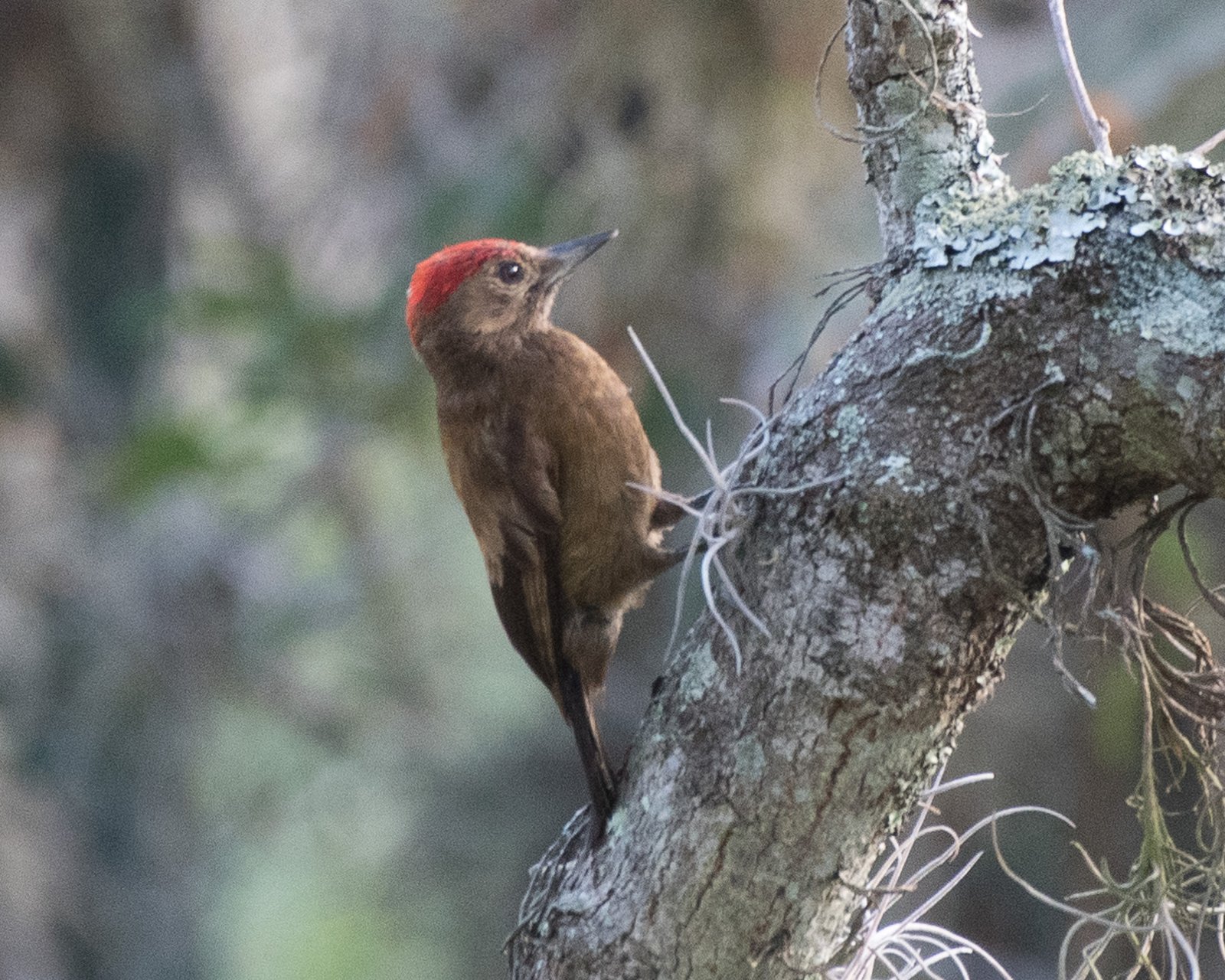
The Smoky-brown Woodpecker is a small, almost plain brown woodpecker of humid forest, from Mexico to Panama. It often forages low in dense vegetation and on thin branches and vines, and therefore often goes unnoticed.
Voice
A sharp, slightly hoarse keek or cheek, sometimes in series, and a short, ringing rattle. Drums in short rolls.
Recording: José María Loaiza B. — CC BY-NC-SA 4.0 · converted to mono · xeno-canto
Identification
15–17 cm. Almost entirely smoky brown, without bars or spots; wings and tail slightly darker. Head paler, with drab buff to whitish sides to the face and a darker ear patch. Bill fairly long and dark. The male has a red crown, the female a dark brown one.
Confusion species
Red-rumped Woodpecker Veniliornis kirkii, in Costa Rica and Panama, has an olive back, a red rump and finely barred underparts. Arizona Woodpecker Leuconotopicus arizonae has white stripes on the head and white underparts spotted with brown. Chestnut-colored Woodpecker Celeus castaneus and Cinnamon Woodpecker Celeus loricatus are larger, more rufous and crested.
Habitat
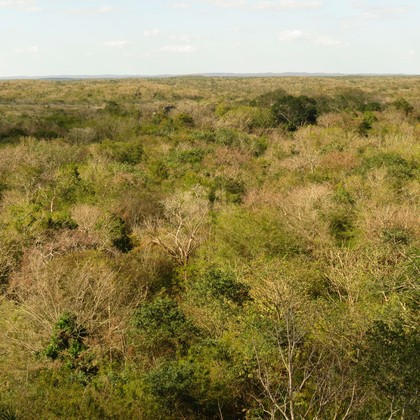
Humid lowland and foothill forest, forest edges, young forest, semi-deciduous forest and shade coffee, and in the mountains cloud forest, from sea level to about 2500 m. It forages on thin branches, vines and in shrubbery, often low down and regularly with mixed flocks of other birds. It eats mainly insects and larvae.
Where the bird is most at home, classified by the vegetation units of Mexico and Central America.






Range and movements
On the Gulf side from southern Tamaulipas and San Luis Potosí through Veracruz, Tabasco, the Yucatán Peninsula and Chiapas, and on the Pacific side from Jalisco and Colima through Guerrero and Oaxaca; also throughout Central America to Panama, scarce in El Salvador. Outside the guide area in northern and western South America, from Venezuela and Colombia along the Andes to north-western Argentina.
- Resident
- dark = core range, pale = thinly spread
How and when to look
At forest edges and in young forest in Belize, around Tikal and in the Caribbean foothills of Costa Rica, often with mixed flocks. A small brown woodpecker tapping low in a tangle of vines is usually this species.
Conservation status
Not threatened. Widespread and tolerant of young forest and forest edges.
Scientific name
Leuconotopicus fumigatus | (d'Orbigny, ACVMD, 1840)
D'Orbigny, ACVMD described the species in 1840 as Picus fumigatus; because it was later moved to another genus, the author and year stand in brackets. The genus Leuconotopicus was introduced in 1845 by Malherbe. Leuconotopicus combines Greek leukos 'white' and nōtos 'back' with Latin picus 'woodpecker': 'white-backed woodpecker'. fumigatus is Latin for 'smoked', after the uniform sooty-brown plumage. The specimen the first description was based on came from Corrientes (Argentina) and Santa Cruz de la Sierra (Bolivia).