All species › Birds of prey › Kites, Old World vultures, eagles and hawks › Grey-headed Kite
Position in the tree Birds Aves › Birds with a flexible palate Neognathae › All other modern birds Neoaves › Landbirds Telluraves › Raptors, owls, kingfishers and woodpeckers Afroaves › Hawks and owls Hieraves
Grey-headed Kite | Leptodon cayanensis
Grijskopwouw | Gavilán cabeza gris
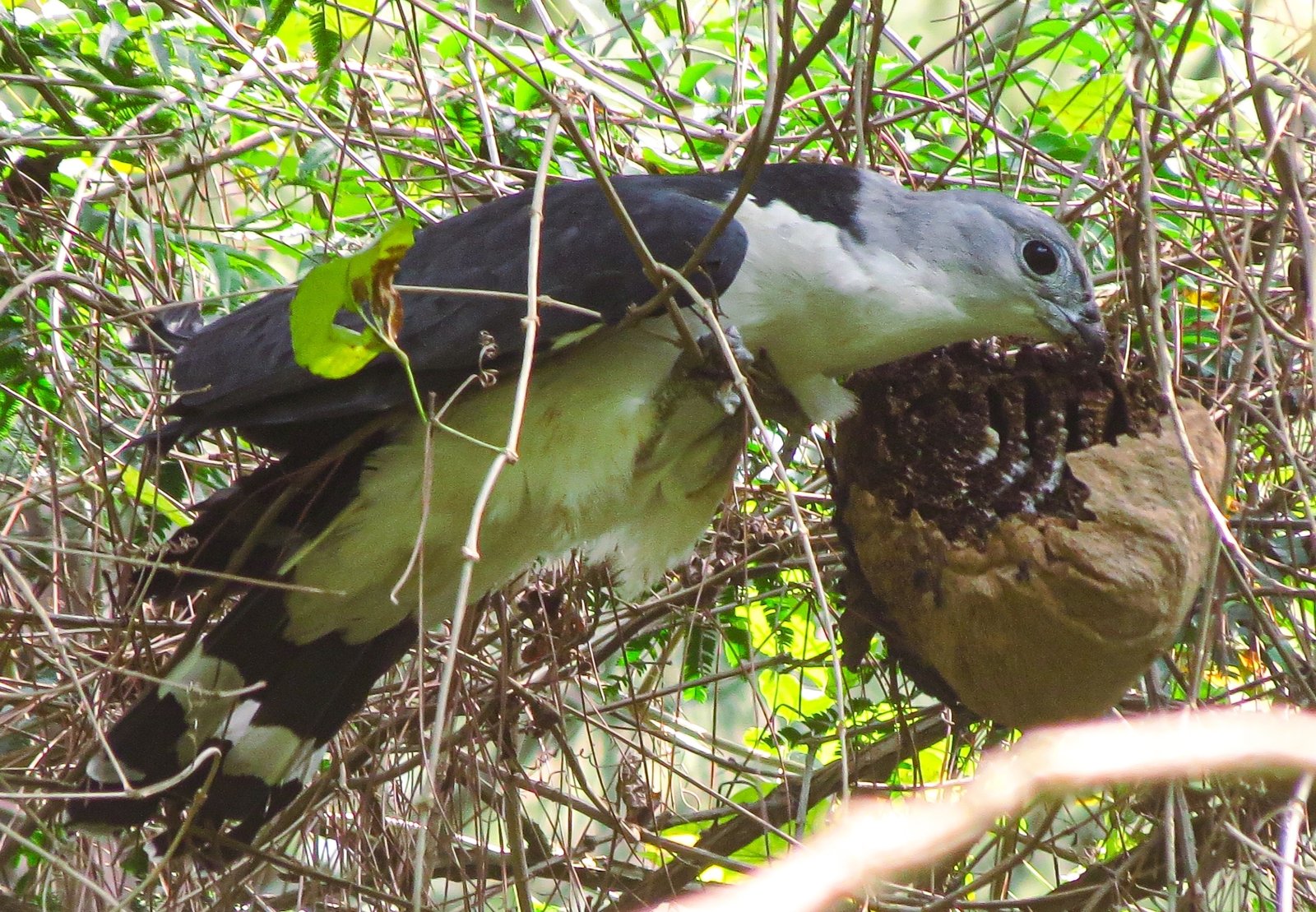
The Grey-headed Kite is a medium-sized kite of tropical forest, with a grey head, blackish upperparts and white underparts. It sits motionless in the canopy for long periods and is noticed mainly when it soars over the forest in the early morning or climbs in a display flight with its tail spread. It feeds on insects, wasp nests, lizards, frogs and bird nests. In the guide area it is resident from southern Mexico to Panama.
Voice
A long, loud series of cackling notes, kek-kek-kek-kek-kek, recalling a Laughing Falcon or a forest falcon, often given from the canopy. Also a mewing kyew.
Recording: JAYRSON ARAUJO DE OLIVEIRA — CC BY-NC-SA 4.0 · converted to mono · xeno-canto
Identification
46–53 cm, with a small head, broad, rounded wings and a long tail. Adults have a lead-grey head, blackish back and wings and white underparts; the eye is dark and the legs are blue-grey. The tail is black with two or three greyish-white bands. In flight the black underwing coverts contrast with the strongly barred, paler flight feathers. Young birds occur in a pale morph with white head and underparts, a black crown and a black spot behind the eye, and in a dark morph with a dark-streaked brown head and underparts. Male and female are alike.
Confusion species
The Double-toothed Kite Harpagus bidentatus is much smaller, with a rufous or barred breast and fluffy white undertail coverts. The Grey-lined Hawk Buteo nitidus has finely grey-barred underparts and a shorter tail. The Hook-billed Kite Chondrohierax uncinatus has a pale eye, a heavy hooked bill and usually barred underparts. Pale-morph young Grey-headed Kites resemble the Black-and-white Hawk-Eagle Spizaetus melanoleucus, which is larger, with feathered legs, an orange cere and a black mask around the eye.
Habitat
Humid lowland and foothill forest, gallery forest, swamp forest, mangroves and edges of old secondary forest, mainly in the lowlands and lower hills. It forages in the canopy and at forest edges, taking insects, larvae from wasp nests, lizards, tree frogs and the eggs and young of birds.
Where the bird is most at home, classified by the vegetation units of Mexico and Central America.






Range and movements
Resident from southern Mexico to Panama: in Mexico in Veracruz, Oaxaca, Tabasco, Chiapas and on the Yucatán Peninsula; further in Belize, Guatemala, Honduras, Nicaragua, Costa Rica and Panama, commoner on the Caribbean than on the Pacific side. Scarce in El Salvador. Outside the guide area in tropical South America south to northern Argentina.
- Resident
- dark = core range, pale = thinly spread
How and when to look
The best chance is in the early morning, when birds rise and soar above the forest edge, for example over lowland forest in Belize, the Caribbean lowlands of Costa Rica or along the Panama Canal. The loud cackling from the canopy often gives away a perched bird that would otherwise go unnoticed.
Conservation status
Not threatened. Scarce to fairly common in the guide area; declining through the clearing of lowland forest.
Scientific name
Leptodon cayanensis | (Latham, 1790)
Latham described the species in 1790 as Falco cayanensis; because it was later moved to another genus, the author and year stand in brackets. The genus Leptodon was introduced in 1836 by Sundevall. Leptodon is Greek, from leptos 'fine, slender' and odous, odontos 'tooth', after the fine tooth-like projection on the edge of the bill. cayanensis means 'of Cayenne', in French Guiana, where the species was described. The specimen the first description was based on came from Cayenne, French Guiana.