All species › Birds of prey › Kites, Old World vultures, eagles and hawks › Hook-billed Kite
Position in the tree Birds Aves › Birds with a flexible palate Neognathae › All other modern birds Neoaves › Landbirds Telluraves › Raptors, owls, kingfishers and woodpeckers Afroaves › Hawks and owls Hieraves
Hook-billed Kite | Chondrohierax uncinatus
Langsnavelwouw | Gavilán pico gancho
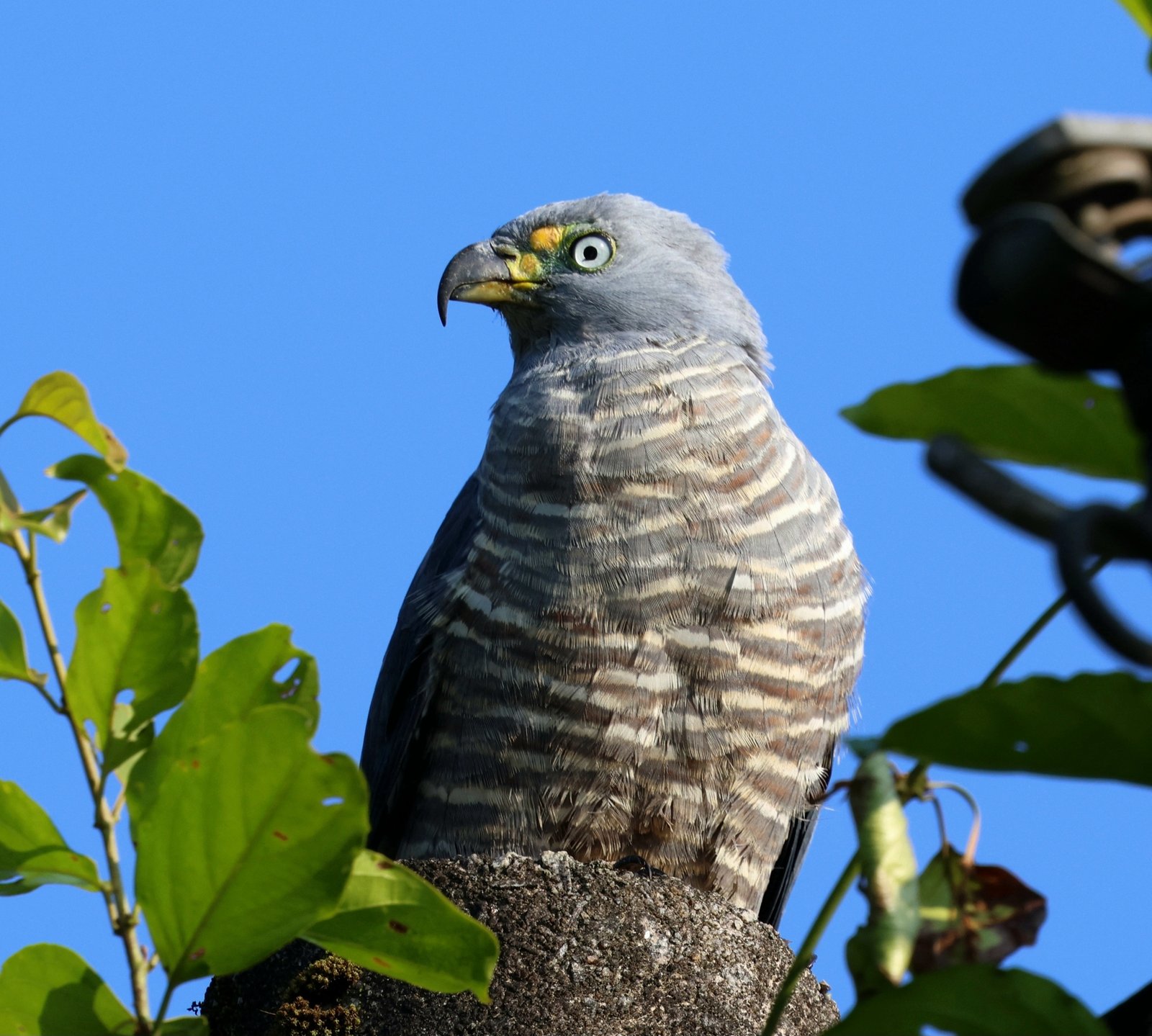
The Hook-billed Kite is a kite of forest and forest edge that lives almost entirely on tree snails, which it pulls from their shells with its heavy, strongly hooked bill. Piles of empty snail shells often lie beneath its regular feeding perches. The plumage is very variable, with grey males, brown females and an all-black morph. In the guide area it is resident from Sinaloa and Tamaulipas to Panama.
Voice
A musical, rapid chattering whistle, wi-i-i-i-i-oo, and a dry, rattling kekekekek, mainly around the nest. Rarely heard outside the breeding season.
Recording: JAYRSON ARAUJO DE OLIVEIRA — CC BY-NC-SA 4.0 · converted to mono · xeno-canto
Identification
38–51 cm, with broad, paddle-shaped wings narrowed at the base, a fairly long tail and a large, strongly hooked bill. The eye is white to pale green; above the lores there is an orange-yellow patch of bare skin. Males are slate grey with grey-barred underparts; females are brown with a rufous collar and rufous-barred underparts. In both the tail is dark with two or three pale bands. The dark morph is entirely blackish with a single broad white tail band. Young birds have a dark crown, a white collar and white, coarsely barred underparts. Bill size varies greatly between individuals and populations.
Confusion species
The Grey Hawk Buteo plagiatus has a dark eye, a small bill, a shorter tail and more compact wings. The Grey-headed Kite Leptodon cayanensis has white, unbarred underparts and a dark eye. The Snail Kite Rostrhamus sociabilis has a slimmer hooked bill and a white rump and lives in marshes. The dark morph resembles the Common Black Hawk Buteogallus anthracinus, which has a dark eye, yellow legs and broader wings.
Habitat
Humid and dry forest, gallery forest, swamp forest, mangroves and forest edges, from the lowlands into the mountains; also in woodlots in farmland as long as tree snails are plentiful. It searches for snails in the canopy and mid-storey, clambering and hopping along branches. The nest is a small, flimsy stick platform in a tree.
Where the bird is most at home, classified by the vegetation units of Mexico and Central America.






Range and movements
Resident on the Pacific side of Mexico from Sinaloa and Nayarit and on the Gulf side from Tamaulipas, south through Oaxaca, Chiapas and the Yucatán Peninsula and throughout Central America to Panama. Locally scarce and patchy. In autumn small groups of Hook-billed Kites are sometimes seen over Veracruz and Panama moving with other raptors; where these birds come from is not well known. Outside the guide area in the far south of Texas, on a few Caribbean islands and in tropical South America south to northern Argentina.
- Resident
- dark = core range, pale = thinly spread
How and when to look
It often sits still in the canopy for long periods and is therefore inconspicuous; the best chance is in the morning, when birds briefly circle over the forest with their paddle-shaped wings held slightly forward. Where many empty tree-snail shells lie beneath a tree, there is often a regular feeding perch.
Conservation status
Not threatened. Dependent on forest with enough tree snails; locally declining through deforestation.
Scientific name
Chondrohierax uncinatus | (Temminck, 1822)
Temminck described the species in 1822 as Falco uncinatus; because it was later moved to another genus, the author and year stand in brackets. The genus Chondrohierax was introduced in 1843 by Lesson. Chondrohierax is Greek, from khondros 'coarse' or 'cartilage' and hierax 'hawk'; possibly because this kite lacks a bony shield above the eye. uncinatus is Latin for 'hooked', from uncus 'hook', after the large, strongly hooked bill. The specimen the first description was based on came from northern Brazil and the Guianas (not specified).