All species › Tinamous › Tinamous › Highland Tinamou
Position in the tree Birds Aves › Ratites and tinamous Palaeognathae
Highland Tinamou | Nothocercus bonapartei
Bergtinamoe | Tinamú serrano
The Highland Tinamou is the only high-mountain tinamou in the guide area and occurs here only in the mountains of Costa Rica and western Panama. It is a large, shy ground bird of wet montane forest that is noticed almost only by its call. Elsewhere the species lives in the Andes, from Venezuela to northern Peru.
Voice
The male calls mainly at dusk and after dark, a loud, hollow, somewhat hoarse two-syllable call, repeated for long periods with short pauses. It carries far through the forest.
Recording: Mauricio Cuellar Ramirez (@Birding.travel) — CC BY-NC-SA 4.0 · converted to mono · xeno-canto
Identification
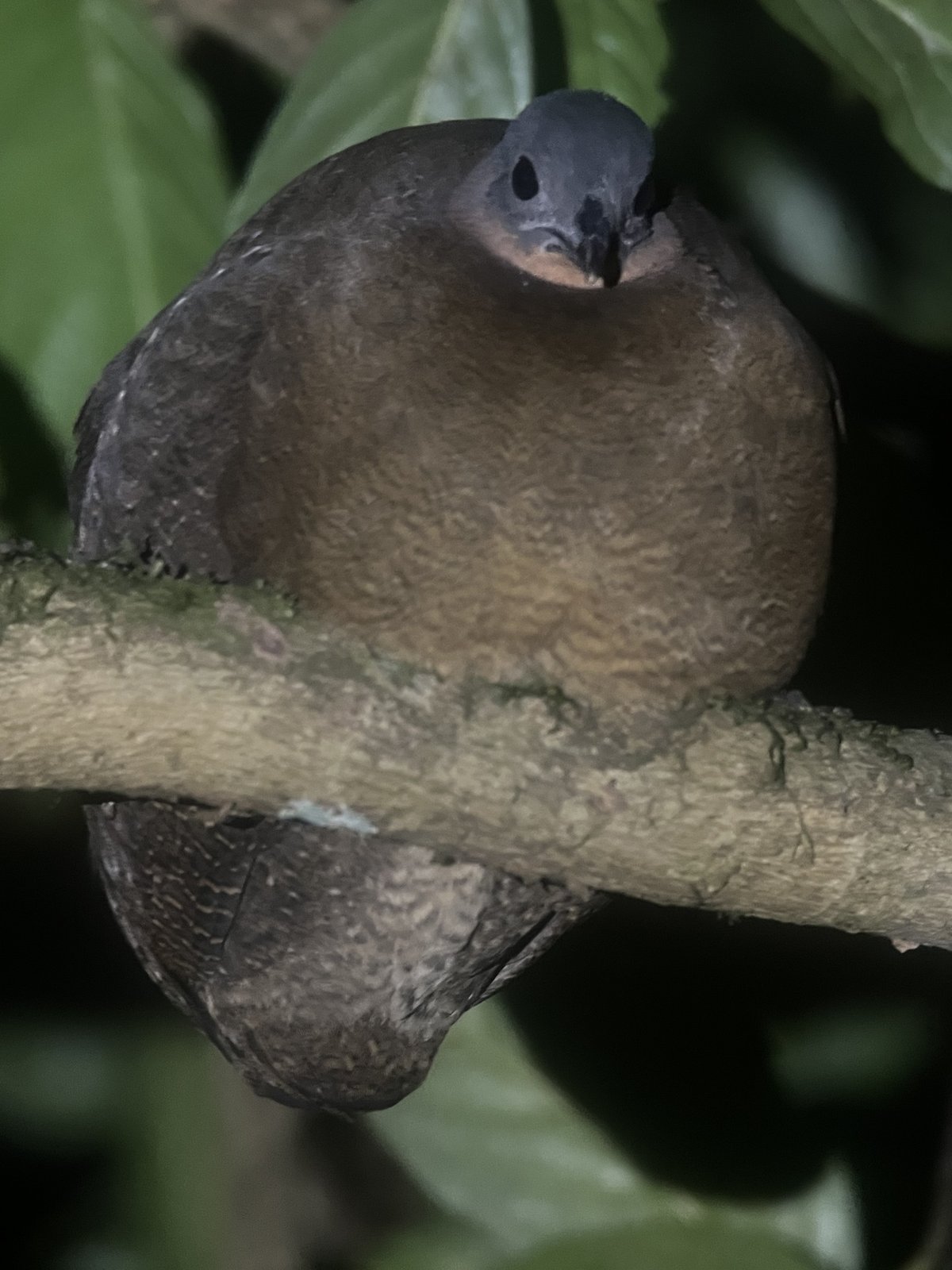
35–40 cm; a large, stocky tinamou with a short neck and an almost invisible tail. The crown is dark, the throat and sides of the head warm rufous. The upperparts are dark brown, finely vermiculated black and dotted with small ochre spots, especially on the wing coverts. The underparts are cinnamon to ochre-brown, with fine dark barring on the flanks and lower belly. The bill is dark. Male and female are almost alike. The subspecies in the guide area is N. b. frantzii.
Confusion species
Great Tinamou Tinamus major is slightly larger and more olive-brown, with a white throat and blue-grey legs, and lives mainly lower, below about 1500 m; where the two meet they occur together. Wood quails such as Spotted Wood Quail Odontophorus guttatus are much smaller, have a crest and a distinct tail and live in small groups. Black Guan Chamaepetes unicolor shares the same forest, but is a plain black bird with a long tail that keeps mainly to the trees.
Habitat
Wet montane forest and cloud forest from about 1200 to 3000 m, mainly above 1500 m, with a preference for dense bamboo undergrowth (Chusquea), ravines and stream valleys. It forages on the forest floor for fruit, seeds and invertebrates. As in all tinamous, the male incubates the eggs and cares for the young.
Where the bird is most at home, classified by the vegetation units of Mexico and Central America.

Range and movements
In the guide area in the highlands of Costa Rica, from the Cordillera de Tilarán and Cordillera Central to the Talamanca range, and in western Panama in Chiriquí, Bocas del Toro and Veraguas. Outside the guide area in the mountains of Colombia and Venezuela and south to eastern Ecuador and extreme northern Peru.
- Resident
- dark = core range, pale = thinly spread
How and when to look
The species is mostly heard, at dusk along forest trails in the Talamanca range, for example at San Gerardo de Dota, and on the slopes of Barú in Chiriquí. The best chance of seeing one is early in the morning on quiet trails, where a bird sometimes walks slowly across the path.
Conservation status
Not threatened. Fairly common but rarely seen in large, undisturbed forests in Costa Rica and Panama; outside protected areas vulnerable to hunting and forest loss.
Scientific name
Nothocercus bonapartei | (Gray, 1867)
Gray described the species in 1867 as Tinamus Bonapartei; because it was later moved to another genus, the author and year stand in brackets. The genus Nothocercus was introduced in 1856 by Bonaparte. Nothocercus is Greek, from nothos 'spurious, false' and kerkos 'tail', after the barely visible tail. bonapartei honours the French naturalist and ornithologist Charles Lucien Bonaparte (1803–1857). The specimen the first description was based on came from Aragua valley, Venezuela.