All species › Passerines › Tyrant flycatchers and allies › Great Kiskadee
Position in the tree Birds Aves › Birds with a flexible palate Neognathae › All other modern birds Neoaves › Landbirds Telluraves › Falcons, parrots and passerines Australaves › Falcons and passerines Eufalconimorphae › Parrots and passerines Psittacopasserae
Great Kiskadee | Pitangus sulphuratus
Grote kiskadie | Luis bienteveo
The Great Kiskadee is one of the best-known birds of Mexico and Central America: a noisy, stocky tyrant flycatcher with a black-and-white striped head and bright yellow belly, seen in every village and along almost every body of water. Its kis-ka-dee call gave it its name. In the guide area it lives from northern Mexico to central Panama.
Voice
A loud, clear kis-ka-DEE or bien-te-VEO, heard throughout the day, and also a hoarse, falling keeeeur and loud chattering, often by two birds together.
Recording: Juan Freile — CC BY-NC-SA 4.0 · converted to mono · xeno-canto
Identification
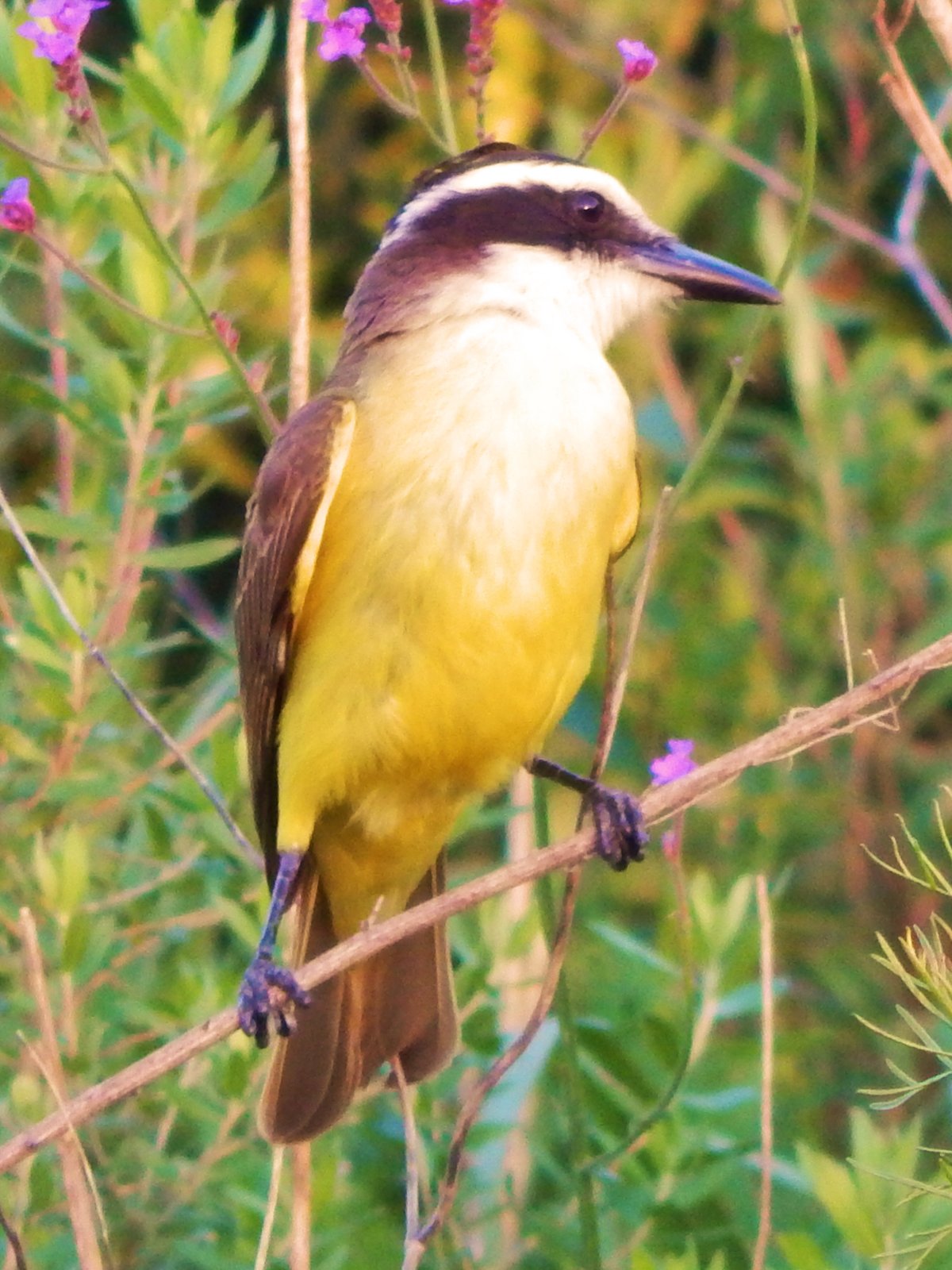
22–24 cm, with a large head and a thick, straight black bill. Crown black with a concealed yellow crown patch, surrounded by a broad white band running across the forehead and along the supercilia to the nape; a broad black mask through the eye. Back olive-brown, wings and tail brown with distinct rufous edges. Throat white, rest of the underparts bright yellow. Male and female are alike.
Confusion species
Boat-billed Flycatcher Megarynchus pitangua has an even broader, heavier bill, a greyer crown and no rufous in the wings and tail, and its calls are quite different. Social Flycatcher Myiozetetes similis and Rusty-margined Flycatcher Myiozetetes cayanensis are much smaller, with a short, stubby bill. White-ringed Flycatcher Conopias albovittatus is smaller, with a white band encircling the whole black crown, and lives in the forest canopy. Lesser Kiskadee Philohydor lictor (eastern Panama) is smaller, with a longer, slimmer bill, and always perches low near water.
Habitat
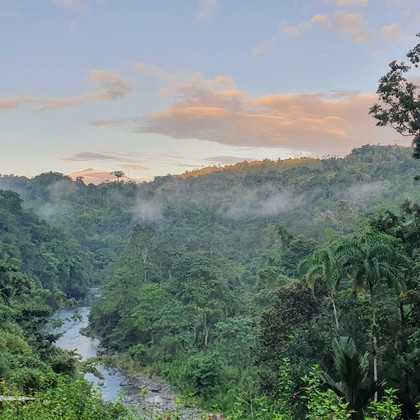
Almost any open or semi-open landscape with trees in the lowlands and lower mountains: villages, towns, parks, pasture with trees, banks of rivers, lakes and lagoons, mangroves and forest edges. It eats almost anything: large insects, small fish and tadpoles taken from the water from a perch, lizards and also fruit. The nest is a large, untidy domed structure with a side entrance, in a tree or on a pole.
Where the bird is most at home, classified by the vegetation units of Mexico and Central America.






Range and movements
From northern Mexico (on the Pacific slope from southern Sonora, on the Atlantic slope from Nuevo León and Tamaulipas) through all of Central America to central Panama. Outside the guide area in extreme southern Texas and over much of South America, to central Argentina.
- Resident
- dark = core range, pale = thinly spread
How and when to look
Common in almost every lowland town and village, often calling loudly from a roof, wire or tree near water.
Conservation status
Not threatened. Very common and benefits from deforestation, settlement and the creation of pastures and ponds.
Scientific name
Pitangus sulphuratus | (Linnaeus, 1766)
Linnaeus described the species in 1766 as [Lanius] sulphuratus; because it was later moved to another genus, the author and year stand in brackets. The genus Pitangus was introduced in 1827 by Swainson. Pitangus derives from Pitanguá guaçú, the Tupí name for a large flycatcher, perhaps the Great Kiskadee. sulphuratus is Latin for 'sulphur-coloured', from sulphur 'sulphur', after the bright yellow underparts. The specimen the first description was based on came from Cayenne, French Guiana.