All species › Passerines › Tyrant flycatchers and allies › Rusty-margined Flycatcher
Position in the tree Birds Aves › Birds with a flexible palate Neognathae › All other modern birds Neoaves › Landbirds Telluraves › Falcons, parrots and passerines Australaves › Falcons and passerines Eufalconimorphae › Parrots and passerines Psittacopasserae
Rusty-margined Flycatcher | Myiozetetes cayanensis
Roestvleugeltiran | Bienteveo alicastaño
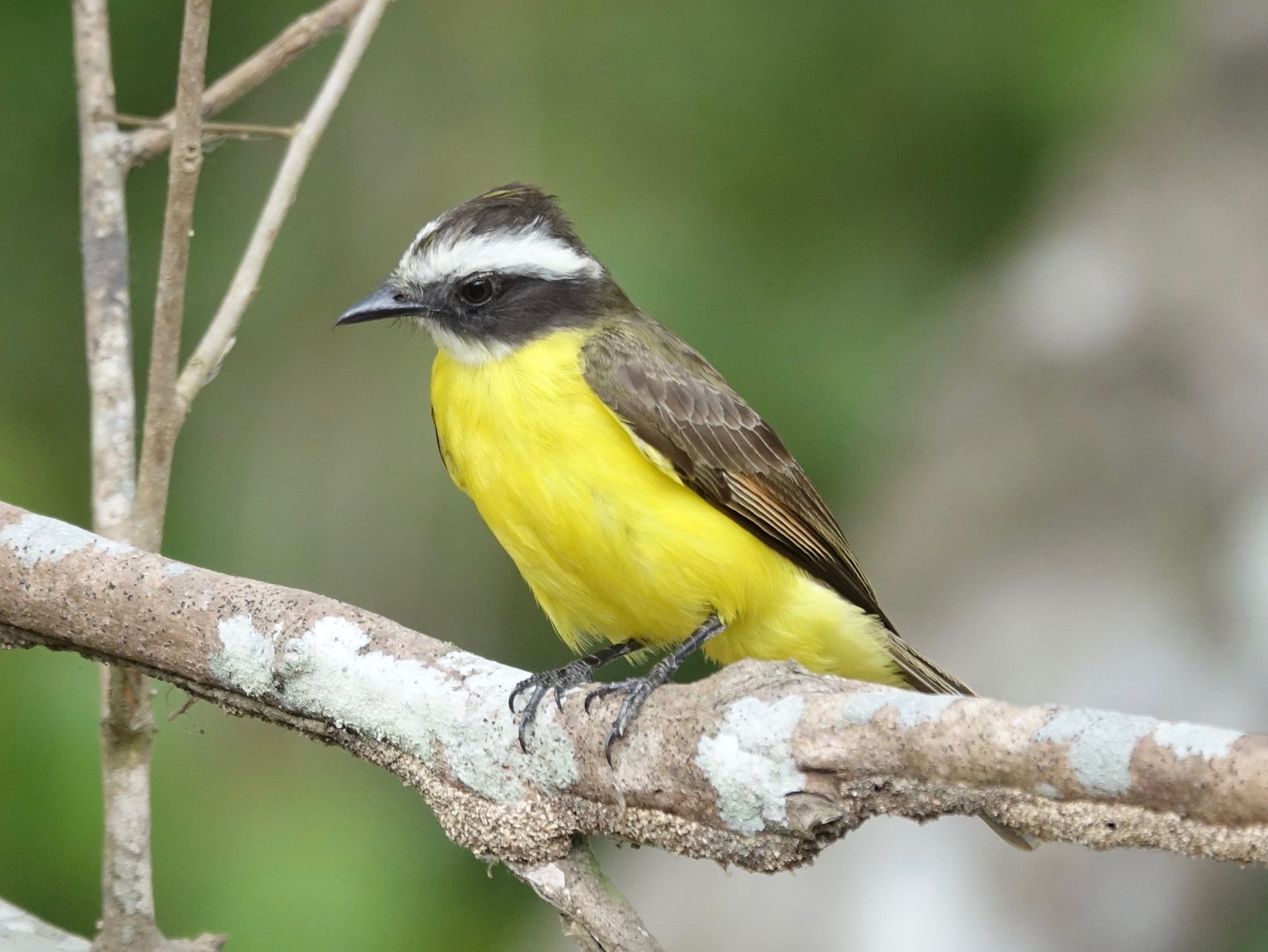
The Rusty-margined Flycatcher closely resembles the far commoner Social Flycatcher, but has a blacker head and rusty edges to the flight feathers. It lives in semi-open country, often near water, and gives itself away with a long, plaintive call. In the guide area it occurs in Panama and south-western Costa Rica.
Voice
A long-drawn, plaintive, whistled wheeeeeeeur, often repeated, as well as short, shrill calls and chattering, especially when a pair greet each other.
Recording: Juan Freile — CC BY-NC-SA 4.0 · converted to mono · xeno-canto
Identification
16–17 cm, with a short, stubby black bill. Crown and mask blackish, with a broad white supercilium that almost meets on the forehead; an orange-red crown patch is usually concealed. Back olive-brown. Flight feathers edged rusty; in adults the wing-coverts lack pale edges. Throat white, rest of the underparts bright yellow. Male and female are alike.
Confusion species
Social Flycatcher Myiozetetes similis has a dark grey rather than blackish crown and mask, pale edges to the wing-coverts and no rusty edges to the flight feathers (although young Social Flycatchers do show rusty edges); its call is different. Grey-capped Flycatcher Myiozetetes granadensis has a grey head without a long supercilium. Great Kiskadee Pitangus sulphuratus is much larger, with a long, thick bill.
Habitat
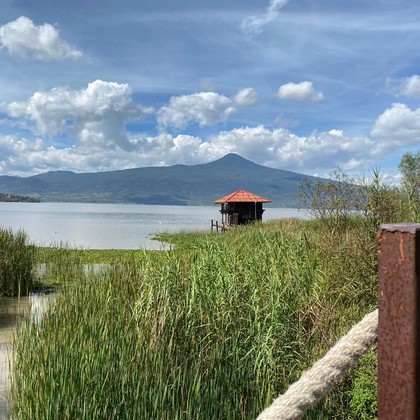
Semi-open lowland country, usually near water: banks of rivers, ponds and marshes, clearings with trees, pasture, gardens and forest edges. It hunts insects from a perch and also eats small fruits. The domed nest of grass and fibres is often placed in a tree or shrub over water.
Where the bird is most at home, classified by the vegetation units of Mexico and Central America.





Range and movements
In the guide area in south-western Costa Rica and in Panama, mainly in the lowlands. Outside the guide area over much of tropical South America, from Colombia and Venezuela to south-western Ecuador, Amazonia and south-eastern Brazil.
- Resident
- dark = core range, pale = thinly spread
How and when to look
In Panama regularly seen along the Panama Canal and at ponds and riverbanks in the lowlands. The long, plaintive call separates it from Social Flycatcher, with which it often occurs.
Conservation status
Not threatened. Widespread in South America and locally common in the guide area in open country near water.
Scientific name
Myiozetetes cayanensis | (Linnaeus, 1766)
Linnaeus described the species in 1766 as [Muscicapa] cayanensis; because it was later moved to another genus, the author and year stand in brackets. The genus Myiozetetes was introduced in 1859 by Sclater. Myiozetetes is Greek, from muia 'fly' and zētētēs 'seeker': 'fly-seeker'. cayanensis refers to Cayenne in French Guiana. The specimen the first description was based on came from Cayenne, French Guiana.