All species › Passerines › New World warblers › Grace's Warbler
Position in the tree Birds Aves › Birds with a flexible palate Neognathae › All other modern birds Neoaves › Landbirds Telluraves › Falcons, parrots and passerines Australaves › Falcons and passerines Eufalconimorphae › Parrots and passerines Psittacopasserae
Grace's Warbler | Setophaga graciae
Grace' zanger | Chipe ceja amarilla
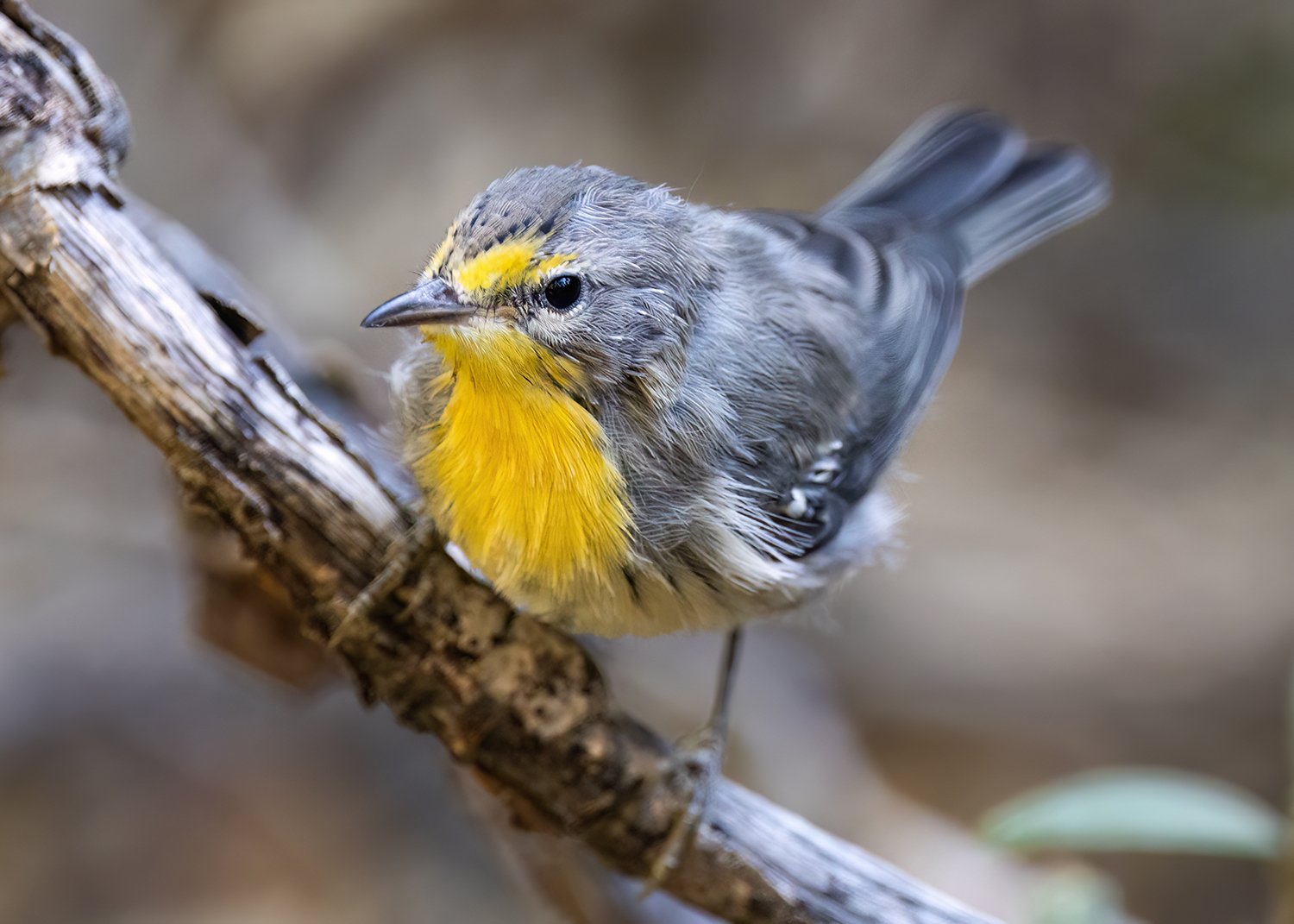
Grace's Warbler is a small grey warbler with a yellow throat and a yellow supercilium that lives almost exclusively in pines. It is resident in the pine forests of the mountains of Mexico and northern Central America and in the pine savannas of Belize, Honduras and Nicaragua. The northern populations move to western Mexico in winter.
Voice
The song is a fast, accelerating trill that often ends on a higher or lower pitch, roughly chee chee chee chichichichi. The call is a soft, high chip.
Recording: Manuel Grosselet — CC BY-NC-SA 4.0 · converted to mono · xeno-canto
Identification
12–13 cm. Grey upperparts with fine black streaks on the back, two white wing bars, a yellow throat and breast, a yellow supercilium in front of the eye that turns white behind the eye, a grey cheek without a mask and white underparts with black streaks on the flanks. Females and young birds are duller and browner, with fewer streaks. The Central American forms (S. g. remota and S. g. decora) show more yellow extending onto the belly and a darker back.
Confusion species
Yellow-throated Warbler Setophaga dominica is larger, has a longer bill, a black mask, a white patch on the neck side and a mostly white supercilium. Townsend's Warbler Setophaga townsendi has a dark cheek patch surrounded by yellow and an olive-green back. Olive Warbler Peucedramus taeniatus, also a bird of pine forest, has a dark mask and no yellow throat or flank streaks.
Habitat
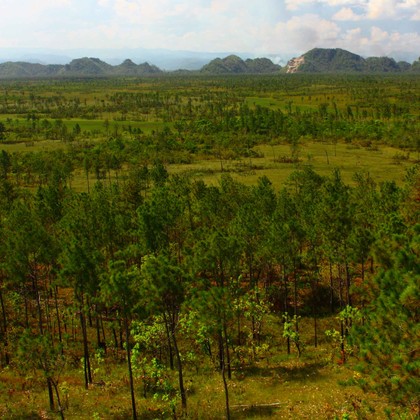
Pine and pine-oak forest in the mountains, mostly between 1000 and 3000 m, and in Belize, Honduras and Nicaragua also lowland pine savanna. It forages high in the crowns of pines, among the needles and along the branches, for insects and joins mixed flocks outside the breeding season.
Where the bird is most at home, classified by the vegetation units of Mexico and Central America.



Range and movements
Breeds from the south-western United States (Arizona, New Mexico, Colorado, Utah) through the Sierra Madre Occidental and the mountains of western and southern Mexico to Chiapas, Guatemala, El Salvador, Honduras and Nicaragua, and in the pine savannas of Belize, Honduras and Nicaragua. The northern birds move to the mountains of western Mexico in winter; from Durango southwards resident.
- Resident
- Summer visitor (c. Apr–Sep)
- Winter visitor (c. Oct–Mar)
- Passage (Mar–Apr, Oct–Nov)
- dark = core range, pale = thinly spread
How and when to look
Grace's Warbler often stays high in pines and therefore often stays out of view; the trill and the yellow throat in the canopy are the best clues. In Belize and Honduras it can also be found in lowland pine savanna.
Conservation status
Not threatened (LC). Fairly common, but the population is declining, especially in the north of the range, because of logging, forest fires and degradation of pine forest.
Scientific name
Setophaga graciae | (Baird, 1865)
Baird described the species in 1865 as Dendroica graciae; because it was later moved to another genus, the author and year stand in brackets. The genus Setophaga was introduced in 1827 by Swainson. Setophaga is Greek, from sēs, sētos 'moth' and -phagos '-eating': 'moth-eater'. graciae honours Grace Darling Page, née Coues (1847–1925), sister of the American ornithologist Elliott Coues. The specimen the first description was based on came from Fort Whipple near Prescott, Arizona.