All species › Passerines › New World blackbirds, troupials and allies › Giant Cowbird
Position in the tree Birds Aves › Birds with a flexible palate Neognathae › All other modern birds Neoaves › Landbirds Telluraves › Falcons, parrots and passerines Australaves › Falcons and passerines Eufalconimorphae › Parrots and passerines Psittacopasserae
Giant Cowbird | Molothrus oryzivorus
Grote koevogel | Tordo gigante
The Giant Cowbird is by far the largest cowbird and parasitises almost exclusively oropendolas and caciques, which breed in colonies of hanging nests. It lives at forest edges and in open country in the lowlands from southern Mexico to Panama.
Voice
Usually silent. In display the male gives shrill, creaking notes and high squeaks; in flight sometimes a sharp chik.
Recording: Paul Molina Abril — CC BY-NC-SA 4.0 · converted to mono · xeno-canto
Identification
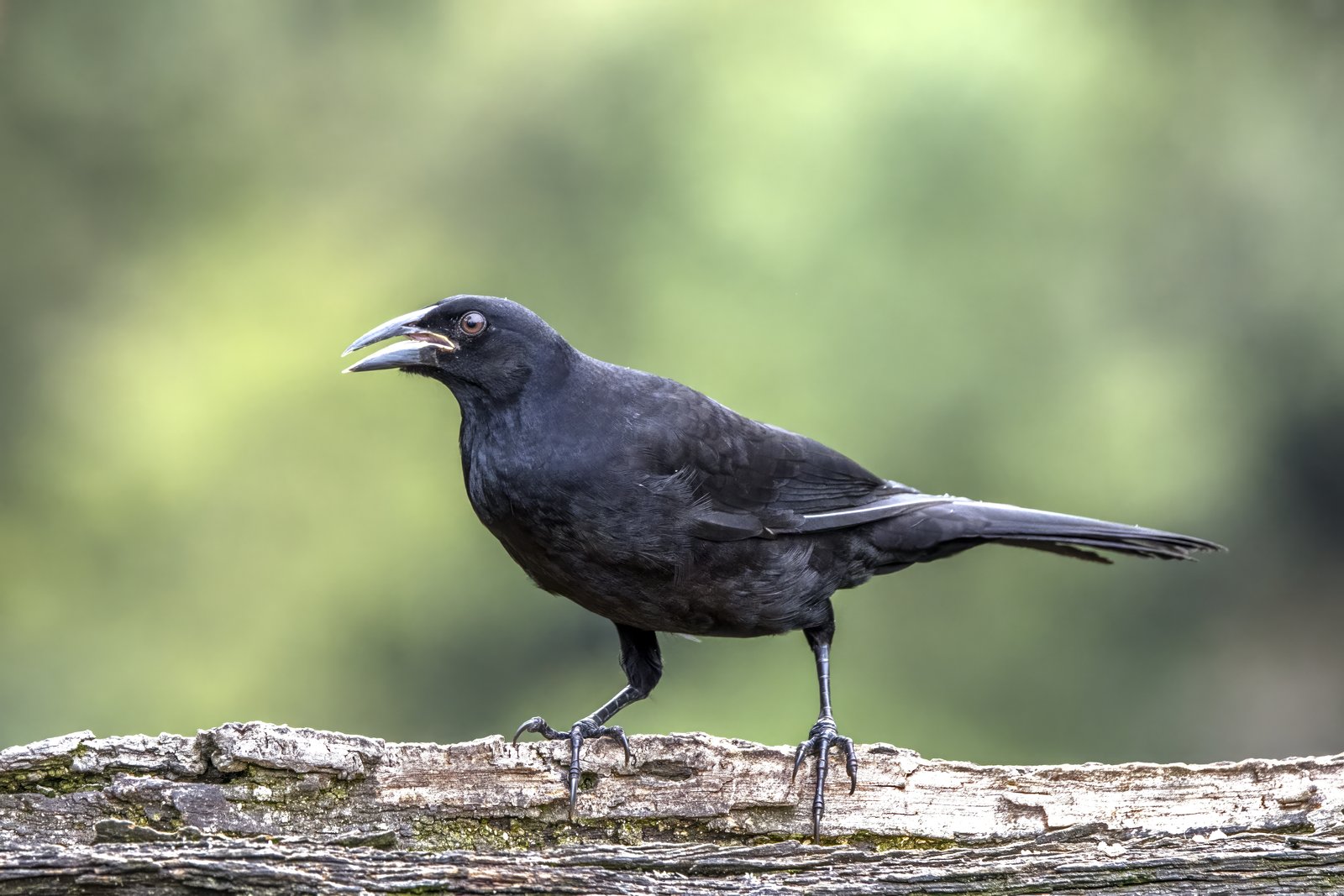
28–36 cm; the male is clearly larger than the female. Male glossy purple-black with a very small head and a ruff of elongated neck feathers that makes the head look even smaller; eye red or orange. Bill black, long and thick, with a small shield-like extension at the base. Long tail. Female smaller and duller blackish-brown, without an obvious ruff. Juveniles browner with a pale bill and pale eye.
Confusion species
Great-tailed Grackle Quiscalus mexicanus has a yellow eye, a long, keeled tail and a slimmer bill; the female is brown. Melodious Blackbird Dives dives is smaller, has a dark eye and lacks the ruff. Bronzed Cowbird Molothrus aeneus is much smaller, with a shorter tail. In flight Giant Cowbird is recognised by its undulating flight, in which a few wingbeats alternate with short glides on closed wings.
Habitat
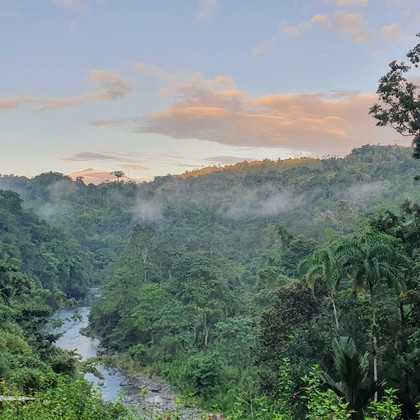
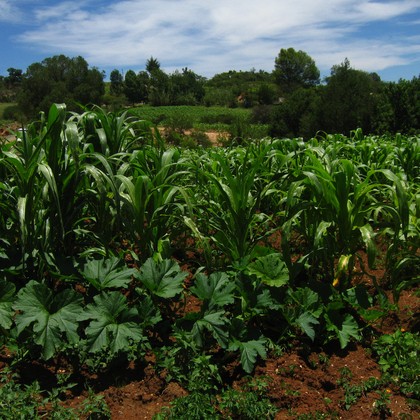
Forest edges, clearings in humid lowland forest, riverbanks and sandbars, pastures with trees and fields near colonies of oropendolas and caciques. It forages on the ground, often along rivers and in open ground, and eats seeds, fruit and insects; it also picks ticks and flies from cattle.
Where the bird is most at home, classified by the vegetation units of Mexico and Central America.




Range and movements
From southern Mexico to northern Argentina. In the guide area in the lowlands of south-eastern Mexico, especially Veracruz, Oaxaca, Tabasco and Chiapas and on the Yucatán Peninsula, and on through Belize, Guatemala, Honduras, Nicaragua and Costa Rica to Panama, with its stronghold on the Caribbean side.
- Resident
- dark = core range, pale = thinly spread
How and when to look
Best seen at an oropendola colony, where females loiter to lay an egg unnoticed. Along rivers small groups forage on sandbars; the small head and undulating flight are then good features.
Conservation status
Not threatened (LC). Widespread and locally common; it benefits from forest clearings and holds its own as long as colonies of oropendolas and caciques remain.
Scientific name
Molothrus oryzivorus | (Gmelin, 1788)
Gmelin described the species in 1788 as O[riolus] oryzivorus; because it was later moved to another genus, the author and year stand in brackets. The genus Molothrus was introduced in 1832 by Swainson. Molothrus is Greek, from mōlos 'struggle' and thrōskō 'to impregnate', perhaps after the brood parasitism or the males' courtship contests. oryzivorus is Latin, from oryza 'rice' and -vorus '-eating': 'rice-eater'. The specimen the first description was based on came from Cayenne, French Guiana.