All species › Passerines › New World blackbirds, troupials and allies › Melodious Blackbird
Position in the tree Birds Aves › Birds with a flexible palate Neognathae › All other modern birds Neoaves › Landbirds Telluraves › Falcons, parrots and passerines Australaves › Falcons and passerines Eufalconimorphae › Parrots and passerines Psittacopasserae
Melodious Blackbird | Dives dives
Rouwtroepiaal | Tordo cantor
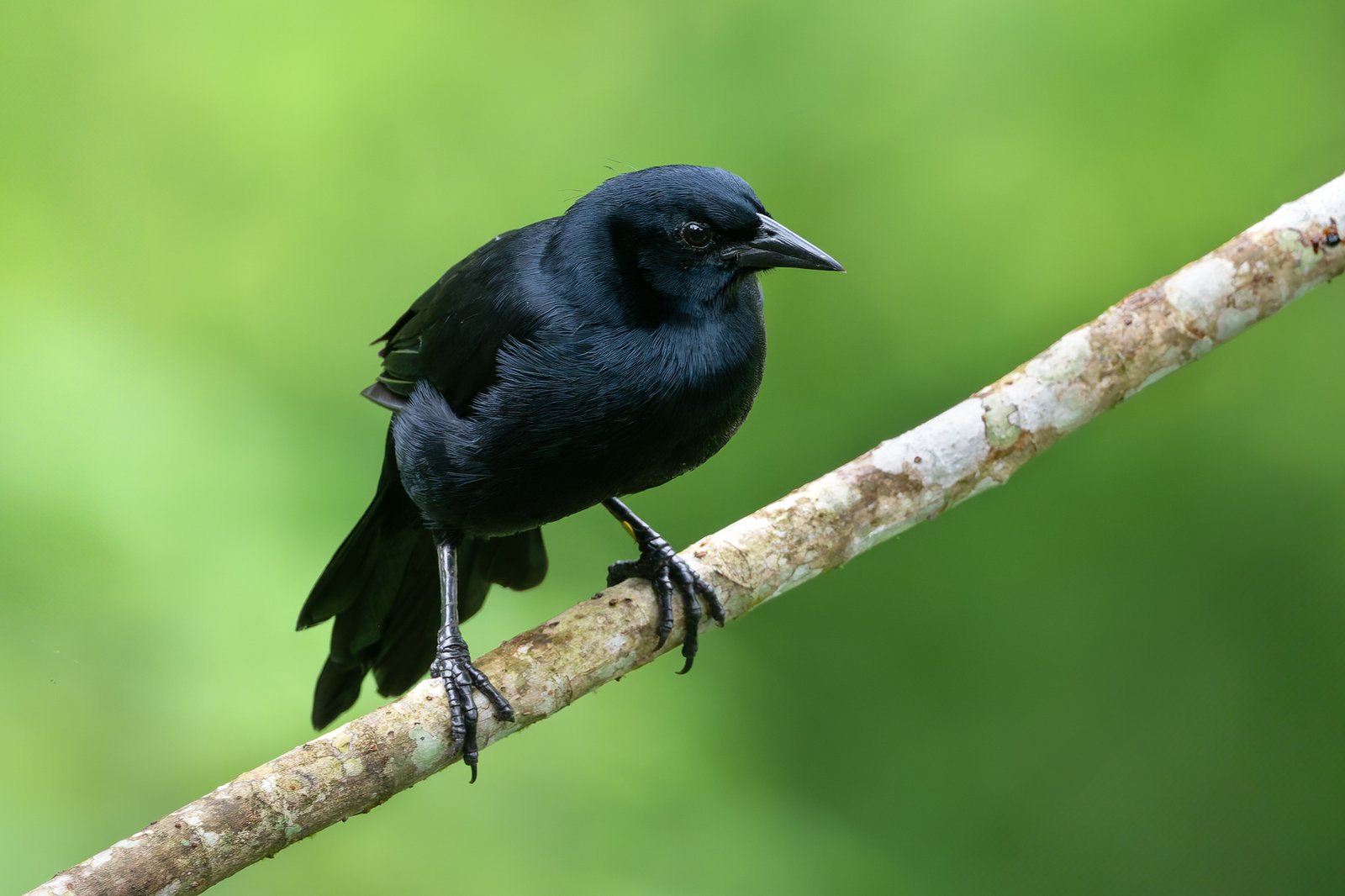
The Melodious Blackbird is an all-black blackbird with a clear, whistled song. In recent decades it has spread strongly southwards with forest clearance and is now a common bird of pastures, gardens and villages from southern Mexico to Costa Rica.
Voice
The song is a loud, clear series of whistles such as chee-oo, weet-weet, often given as a duet by male and female. The call is a dry chuk or chik; also sharp, metallic notes.
Recording: Manuel Grosselet — CC BY-NC-SA 4.0 · shortened to the first 60 s, mono · xeno-canto
Identification
25–28 cm; the female is slightly smaller. Entirely black with a weak blue gloss, especially on head and back; eye dark. Bill black, slender and pointed, fairly long. Tail medium-long and square-ended, not keeled. Legs black. Male and female alike; juveniles duller and browner black.
Confusion species
Great-tailed Grackle Quiscalus mexicanus is larger, the male with a yellow eye and a long, keeled tail, the female brown. Shiny Cowbird Molothrus bonariensis and Bronzed Cowbird Molothrus aeneus are smaller, with a shorter, thicker bill; Bronzed Cowbird has a red eye. Giant Cowbird Molothrus oryzivorus has a small head with a ruff and a red eye.
Habitat
Open and semi-open country: pastures with scattered trees, fields, gardens, villages and town parks, forest edges, open seasonal forest and marsh edges. It avoids closed forest. It often forages on the ground but also in trees, and eats insects, seeds and fruit. It lives in pairs or small groups.
Where the bird is most at home, classified by the vegetation units of Mexico and Central America.






Range and movements
From eastern and southern Mexico to Costa Rica and western Panama. In Mexico mainly on the Gulf side, from San Luis Potosí and Veracruz southwards, in Tabasco, Chiapas and on the Yucatán Peninsula, and locally on the Pacific side in Oaxaca and Chiapas. Common in Belize, Guatemala, El Salvador, Honduras and Nicaragua. It reached Costa Rica in the 1980s and is now widespread there; by now also in western Panama.
- Resident
- dark = core range, pale = thinly spread
How and when to look
In villages and pastures usually heard first by its clear whistles; pairs often sing from a tall tree or a power line. Note the dark eye and square tail to separate it from Great-tailed Grackle.
Conservation status
Not threatened (LC). Common and still spreading thanks to the conversion of forest into pasture.
Scientific name
Dives dives | (Deppe, 1830)
Deppe described the species in 1830 as Icterus dives; because it was later moved to another genus, the author and year stand in brackets. The genus Dives was introduced in 1867 by Cassin. Dives is Latin for 'rich, costly, splendid', taken from the species name Icterus dives, probably after the glossy black plumage. dives is Latin for 'rich, costly, splendid', probably after the glossy black plumage. The specimen the first description was based on came from Mexico.