All species › Passerines › Cardinals and allies › Flame-colored Tanager
Position in the tree Birds Aves › Birds with a flexible palate Neognathae › All other modern birds Neoaves › Landbirds Telluraves › Falcons, parrots and passerines Australaves › Falcons and passerines Eufalconimorphae › Parrots and passerines Psittacopasserae
Flame-colored Tanager | Piranga bidentata
Bloedtangare | Tángara dorso rayado
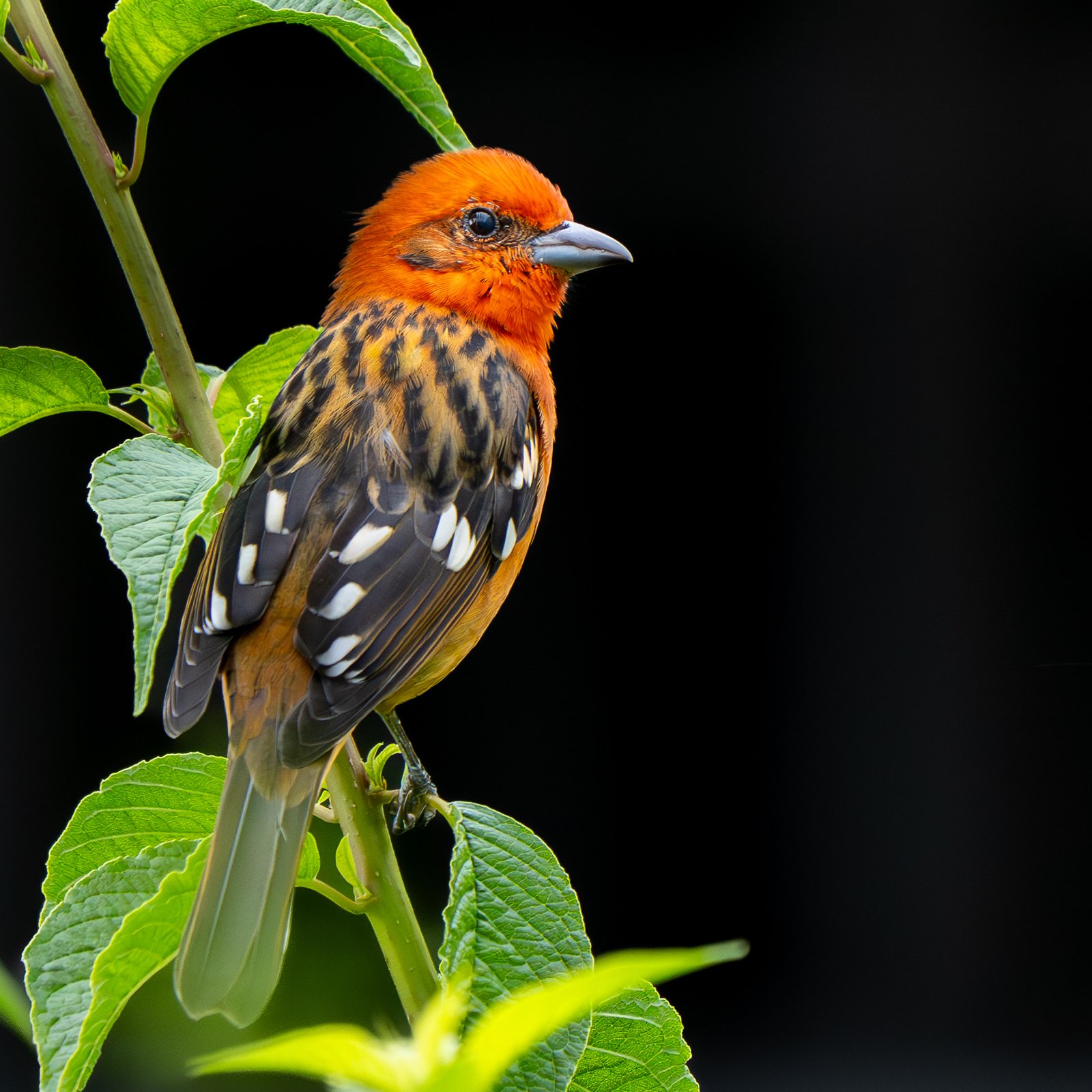
The Flame-colored Tanager is a fairly large tanager of montane forest, with a streaked back and white wing bars. The male is flaming orange-red to red, the female yellow. In the guide area it lives in the mountains of Mexico and Central America to western Panama.
Voice
The call is a rolling prrrek or prr-dik. The song is a series of hoarse, robin-like phrases, often from a high branch.
Recording: Stephan Risch — CC BY-NC-SA 4.0 · converted to mono · xeno-canto
Identification
18–20 cm. A robust tanager with a dark grey bill. The male is orange-red to scarlet, more orange in western Mexico, with a dark rear border to the cheek, a black-streaked back, black wings with two white wing bars and white spots on the tertials, and a black tail with white corners. The female has the same pattern but is olive-yellow above and yellow below.
Confusion species
Western Tanager Piranga ludoviciana has an unstreaked back, a yellow upper wing bar and no white tail corners. White-winged Tanager Piranga leucoptera is much smaller, with an unstreaked back. Summer Tanager Piranga rubra and Hepatic Tanager Piranga flava lack wing bars.
Habitat
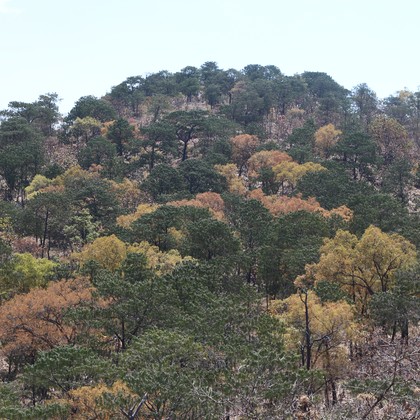
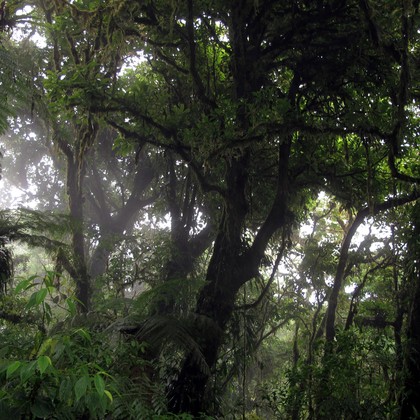
Pine-oak forest, oak forest, cloud forest and montane rainforest, mainly at edges, clearings and semi-open country with tall trees, from about 1000 to 3000 m. It searches the middle levels and canopy for insects and fruit, often in pairs or with mixed flocks.
Where the bird is most at home, classified by the vegetation units of Mexico and Central America.



Range and movements
In Mexico in the Sierra Madre Occidental from Sonora and Chihuahua, in the Sierra Madre Oriental from Nuevo León, and further in the mountains of the centre and south to Oaxaca and Chiapas; further through Guatemala, El Salvador, Honduras and Nicaragua, and in the highlands of Costa Rica and western Panama. Outside the guide area a rare breeding bird in the south-western United States.
- Resident
- dark = core range, pale = thinly spread
How and when to look
In Costa Rica common in the mountains around San Gerardo de Dota and on Cerro de la Muerte, in Mexico in pine-oak forest of the Sierra Madre. It often perches in the open on a bare branch at the forest edge.
Conservation status
Not threatened (LC). Fairly common in montane forest and semi-open country with trees; tolerates some disturbance of the forest.
Scientific name
Piranga bidentata | Swainson, 1827
Swainson described the species in 1827 and placed it straight away in the genus where it still stands. The genus Piranga was introduced in 1808 by Vieillot. Piranga comes from the Tupi tijepiranga, the name of an unidentified small bird. bidentata is Latin for 'two-toothed', after the two tooth-like projections on the cutting edge of the upper mandible. The specimen the first description was based on came from Temascaltepec, Mexico.