All species › Passerines › Cardinals and allies › Western Tanager
Position in the tree Birds Aves › Birds with a flexible palate Neognathae › All other modern birds Neoaves › Landbirds Telluraves › Falcons, parrots and passerines Australaves › Falcons and passerines Eufalconimorphae › Parrots and passerines Psittacopasserae
Western Tanager | Piranga ludoviciana
Louisianatangare | Tángara capucha roja
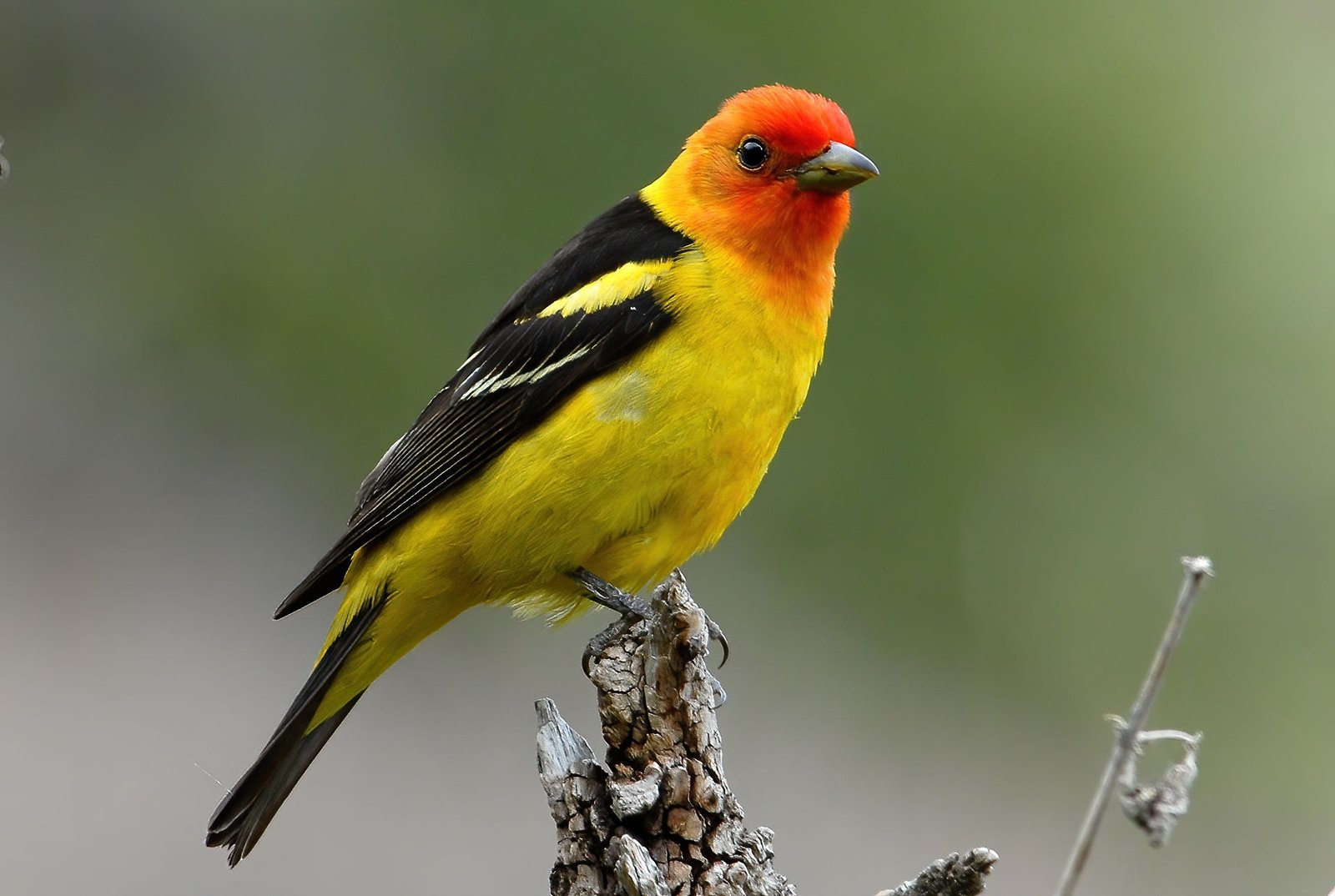
The Western Tanager is a medium-sized tanager that breeds in western North America and winters in Mexico and Central America. The male is yellow with a red head and black back, wings and tail. In winter it is one of the common birds in mixed flocks in highland pine-oak forest.
Voice
The call is a quick, rising pi-tik or pi-ti-rik. The song is a hoarse series of robin-like phrases, in the guide area mostly heard in spring.
Recording: Ed Pandolfino — CC BY-NC-SA 4.0 · converted to mono · xeno-canto
Identification
16–19 cm. A medium-sized tanager with a fairly short, pale bill and two wing bars, the upper yellow and the lower white. The breeding male is bright yellow with an orange-red head and black back, wings and tail; in winter the head is largely yellow with little red and the back is mottled. The female is olive-green above and yellow to greyish below, with a greyish back and the same two wing bars.
Confusion species
Flame-colored Tanager Piranga bidentata has a streaked back, white tail corners and a dark border to the cheek. White-winged Tanager Piranga leucoptera is smaller, with blacker wings and two broad white wing bars. The male Red-headed Tanager Piranga erythrocephala has a red head but an olive-green back and no wing bars.
Habitat
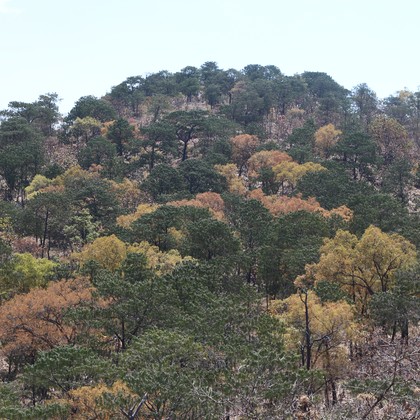
Winters in pine-oak forest, oak forest, dry forest, shade coffee, forest edges and gardens, from the lowlands to about 3000 m, often in mixed flocks. In Baja California it breeds in open montane conifer forest. It eats insects and fruit and visits flowering trees.
Where the bird is most at home, classified by the vegetation units of Mexico and Central America.





Range and movements
In the guide area it breeds only locally in the mountains of northern Baja California. Winters from southern Baja California, Sonora and central Mexico south through Guatemala, El Salvador, Honduras and Nicaragua to Costa Rica; scarce in Panama. Outside the guide area it breeds in the western United States and Canada.
- Winter visitor (c. Oct–Mar)
- dark = core range, pale = thinly spread
How and when to look
In winter best searched for in mixed flocks in pine-oak forest, for example in the highlands of Chiapas and Guatemala. Also in flowering trees in villages and coffee plantations.
Conservation status
Not threatened (LC). Common and widespread; also winters in human-modified country with trees.
Scientific name
Piranga ludoviciana | (Wilson, 1811)
Wilson described the species in 1811 as Tanagra ludoviciana; because it was later moved to another genus, the author and year stand in brackets. The genus Piranga was introduced in 1808 by Vieillot. Piranga comes from the Tupi tijepiranga, the name of an unidentified small bird. ludoviciana refers to Louisiana, then the vast Louisiana Territory, where Lewis and Clark found the species. The specimen the first description was based on came from near Kamiah, Idaho, United States.