All species › Passerines › Mitrospingid tanagers › Dusky-faced Tanager
Position in the tree Birds Aves › Birds with a flexible palate Neognathae › All other modern birds Neoaves › Landbirds Telluraves › Falcons, parrots and passerines Australaves › Falcons and passerines Eufalconimorphae › Parrots and passerines Psittacopasserae
Dusky-faced Tanager | Mitrospingus cassinii
Roetmaskertangare | Tangara carinegruzca
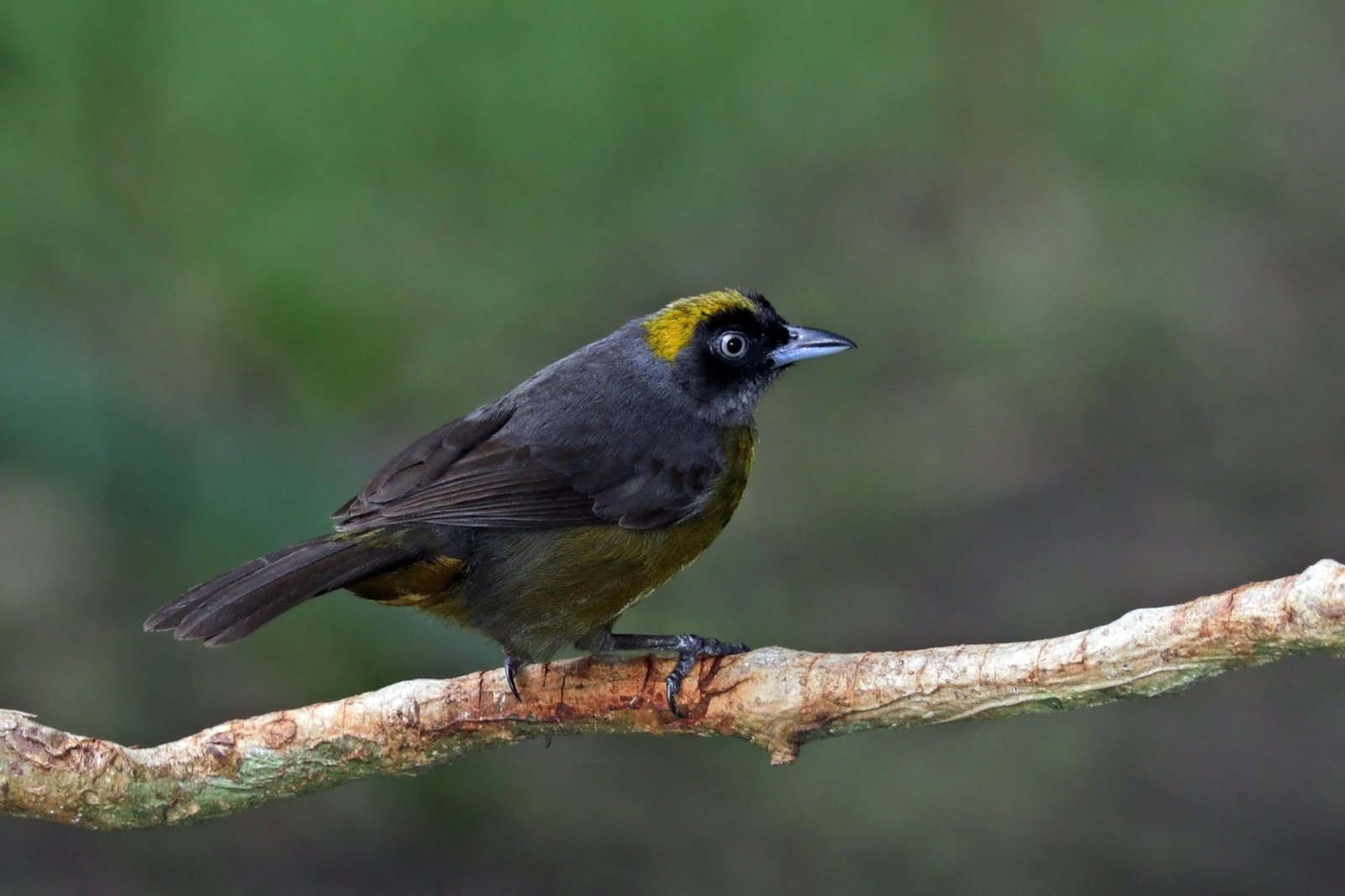
The Dusky-faced Tanager is a dark, grey and olive-yellow songbird of dense undergrowth in humid lowland forest. It moves through the understorey in noisy small groups, often along streams. It resembles a tanager but belongs, with two South American relatives, to a small family of its own, the Mitrospingidae. In the guide area it lives in Costa Rica and Panama.
Voice
Groups keep in contact with a dry, sharp chit and a buzzy, hoarse chatter. The song is little known; a series of short, thin notes.
Recording: Juan Freile — CC BY-NC-SA 4.0 · converted to mono · xeno-canto
Identification
17–18 cm. A slender songbird with a fairly long tail and a pointed, dark bill. Forehead and crown olive-yellow, face and throat blackish like a sooty mask; the eye is pale, greyish white. Upperparts and tail slate-grey, underparts dull olive-yellow, greyer on the flanks. Male and female are alike.
Confusion species
Grey-headed Tanager Eucometis penicillata has a pale grey head with a small crest, an olive-green back and bright yellow underparts, without a dark mask. Carmiol's Tanager Chlorothraupis carmioli is uniformly olive-green with a heavy bill and a dark eye. Female White-throated Shrike-Tanagers Lanio leucothorax are browner and have a hooked bill.
Habitat
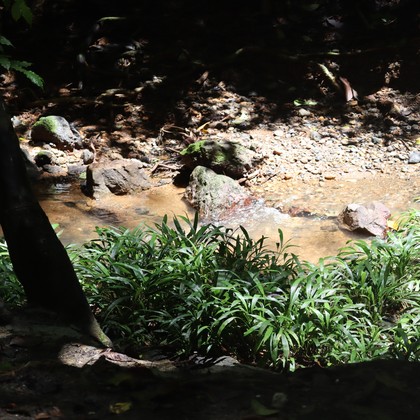
Dense understorey and edges of humid lowland and foothill forest, up to about 1000 m; mainly along streams and creeks, in clearings with scrub and in mature secondary forest. It eats insects and fruit.
Where the bird is most at home, classified by the vegetation units of Mexico and Central America.




Range and movements
Caribbean slope of Costa Rica, locally also on the Pacific slope in the south; in Panama on both slopes. Outside the guide area further in western Colombia and north-western Ecuador.
- Resident
- dark = core range, pale = thinly spread
How and when to look
In Panama regularly seen along Pipeline Road in Soberanía National Park and in Costa Rica at La Selva; the dry chit of a group in the scrub along a stream usually reveals the species before it is seen.
Conservation status
Not threatened (LC). Fairly common in humid lowland forest; declines where forest gives way to farmland.
Scientific name
Mitrospingus cassinii | (Lawrence, 1861)
Lawrence described the species in 1861 as Tachyphonus Cassinii; because it was later moved to another genus, the author and year stand in brackets. The genus Mitrospingus was introduced in 1898 by Ridgway. Mitrospingus is Greek, from mitra 'cap, head-dress' and spingos 'finch': 'capped finch', after the contrasting crown. cassinii honours the American ornithologist John Cassin (1813–1869). The specimen the first description was based on came from Lion Hill, on the Panama Railroad.