All species › Jacamars and puffbirds › Jacamars › Dusky-backed Jacamar
Position in the tree Birds Aves › Birds with a flexible palate Neognathae › All other modern birds Neoaves › Landbirds Telluraves › Raptors, owls, kingfishers and woodpeckers Afroaves › Mousebirds, rollers and woodpeckers Coraciimorphae › Trogons and cavity nesters Cavitaves › Hornbills, kingfishers and woodpeckers Picocoraciae › Kingfishers, bee-eaters and woodpeckers Picodynastornithes
Dusky-backed Jacamar | Brachygalba salmoni
Zwartrugglansvogel | Jacamará dorsioscuro
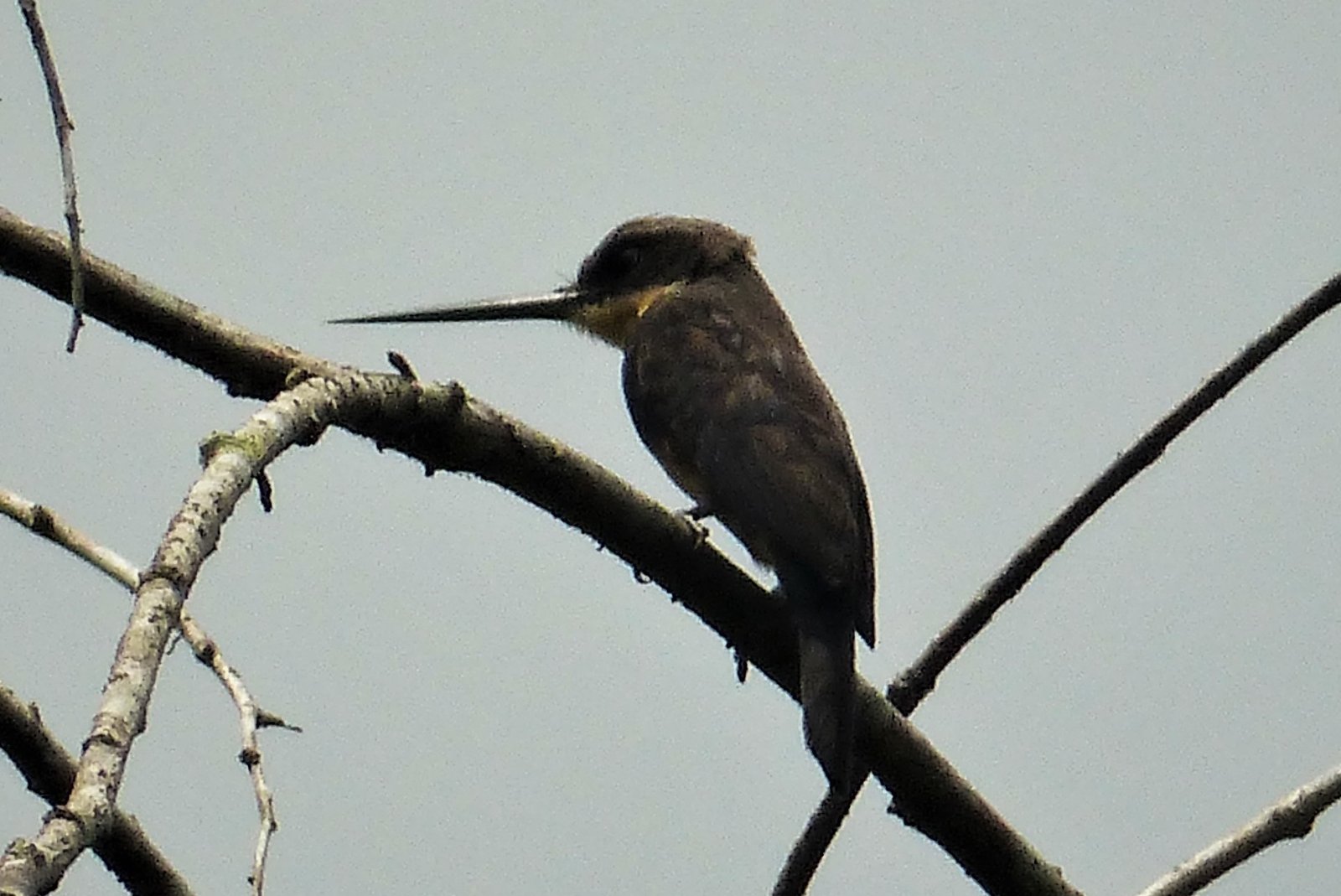
The Dusky-backed Jacamar is a small, dark jacamar that within the guide area occurs only in eastern Panama. It sits upright on an open branch at a forest edge or above a stream and sallies out from there to catch insects in the air. The long, thin black bill and rufous belly mark it as a jacamar, but it lacks the green gloss and rufous tail of the Rufous-tailed Jacamar.
Voice
High, thin peet calls, often in a series that accelerates into a shrill trill. Pairs often call together.
Recording: Iván Lau — CC BY-NC-SA 4.0 · converted to mono · xeno-canto
Identification
18 cm. Upperparts, head and breast blackish with a faint greenish or bluish gloss; belly and undertail coverts rufous. The throat is white in the male and buff in the female. The bill is long, straight, thin and black, the tail fairly short and dark. Usually in pairs or small family groups.
Confusion species
Rufous-tailed Jacamar Galbula ruficauda is larger and glossy green above and on the breast, with a longer tail with rufous outer feathers. Great Jacamar Jacamerops aureus is much larger, with a thick, slightly curved bill and golden-green upperparts.
Habitat
Edges of humid lowland forest, clearings with scattered trees, banks of streams and rivers and tall secondary forest, in the guide area mainly below 500 m. It hunts flying insects such as butterflies, wasps and dragonflies from a regular lookout perch. It digs its nest in a steep stream bank or earth bank.
Where the bird is most at home, classified by the vegetation units of Mexico and Central America.




Range and movements
Within the guide area only in eastern Panama, mainly in Darién and the Emberá comarca, with a few records further west in Panamá province. Outside the guide area in north-western Colombia.
- Resident
- dark = core range, pale = thinly spread
How and when to look
Most often seen in the lowlands of Darién, along streams and forest edges around Yaviza and El Real. Look for a small, dark, long-billed bird sitting upright on a bare branch above the water.
Conservation status
Not threatened. Its global range is small, but the species tolerates clearings and forest edges.
Scientific name
Brachygalba salmoni | Sclater & Salvin, 1879
Sclater & Salvin described the species in 1879 and placed it straight away in the genus where it still stands. The genus Brachygalba was introduced in 1854 by Bonaparte. Brachygalba combines Greek brakhus 'short' with galba, shortened from the genus Galbula: 'short jacamar', after the smaller size and shorter tail. salmoni honours the British engineer and collector Thomas Knight Salmon (1841–1878), who worked in Colombia. The specimen the first description was based on came from Río Nechí, Antioquia, Colombia.