All species › Jacamars and puffbirds › Jacamars › Great Jacamar
Position in the tree Birds Aves › Birds with a flexible palate Neognathae › All other modern birds Neoaves › Landbirds Telluraves › Raptors, owls, kingfishers and woodpeckers Afroaves › Mousebirds, rollers and woodpeckers Coraciimorphae › Trogons and cavity nesters Cavitaves › Hornbills, kingfishers and woodpeckers Picocoraciae › Kingfishers, bee-eaters and woodpeckers Picodynastornithes
Great Jacamar | Jacamerops aureus
Grote glansvogel | Jacamar grande
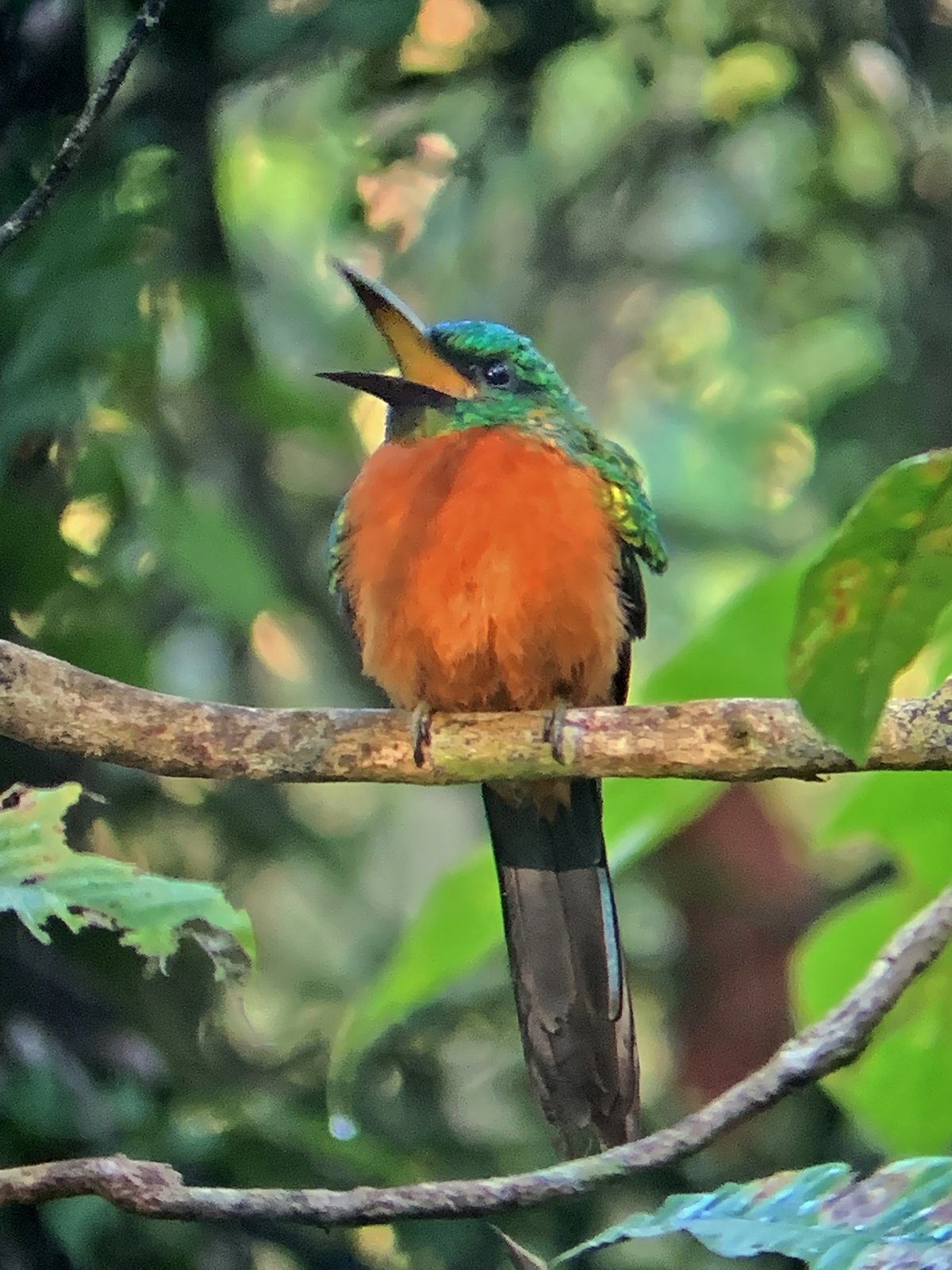
The Great Jacamar is the largest jacamar and differs from the other members of the family in its heavy, slightly curved bill. It perches motionless for long periods on a branch in the middle layer of humid forest and is therefore inconspicuous. In the guide area it lives in the lowlands from Honduras to Panama.
Voice
A long, plaintive whistle that first rises and then falls, wheeeeeeoooow, recalling the call of a raptor. Also a soft mewing sound.
Recording: Jacob Wijpkema — CC BY-NC-SA 4.0 · converted to mono · xeno-canto
Identification
25–30 cm. Upperparts metallic green with a coppery or golden sheen, the long graduated tail blue-green above and dark below. Underparts plain rufous. The male has a white patch on the lower throat, which the female lacks. The bill is black, thick and slightly decurved, shorter and heavier than in other jacamars.
Confusion species
Rufous-tailed Jacamar Galbula ruficauda is much smaller and slimmer, with a long, thin, straight bill, a green breast band and rufous outer tail feathers. Trogons sit just as upright and still, but have a short, broad bill and a tail with white or black markings on the underside.
Habitat
Interior of tall humid lowland and foothill forest, up to about 800 m, often near gaps, streams or fallen trees. It sits in the middle tree layer and catches large insects such as butterflies, cicadas and beetles, taken in flight or from foliage. It nests in a hole in an arboreal termite nest.
Where the bird is most at home, classified by the vegetation units of Mexico and Central America.




Range and movements
Caribbean lowlands of eastern Honduras (Olancho and Gracias a Dios, scarce), Nicaragua and Costa Rica. In Panama on the Caribbean slope and in the east on both slopes, east to Darién. Outside the guide area from Colombia to Amazonia.
- Resident
- dark = core range, pale = thinly spread
How and when to look
Regularly seen along Pipeline Road (Camino del Oleoducto) in Soberanía and in Darién in Panama, and in the Caribbean lowlands of Limón in Costa Rica. The long, plaintive whistle is often the first sign.
Conservation status
Not threatened. It disappears where old lowland forest is cleared and avoids heavily fragmented forest.
Scientific name
Jacamerops aureus | (Müller, 1776)
Müller described the species in 1776 as Alcedo aurea; because it was later moved to another genus, the author and year stand in brackets. The genus Jacamerops was introduced in 1830 by Lesson. Jacamerops joins French jacamar (from Tupi) with Greek merops 'bee-eater', after the stout, curved bill. aureus is Latin for 'golden', from aurum 'gold', after the golden-green glossy upperparts. The specimen the first description was based on came from Berbice, Guyana.