All species › Gannets and cormorants › Cormorants and shags › Double-crested Cormorant
Position in the tree Birds Aves › Birds with a flexible palate Neognathae › All other modern birds Neoaves › Birds of the elements Elementaves › Tropicbirds and waterbirds Phaethoquornithes › Core waterbirds Aequornithes
Double-crested Cormorant | Nannopterum auritum
Geoorde aalscholver | Cormorán orejudo
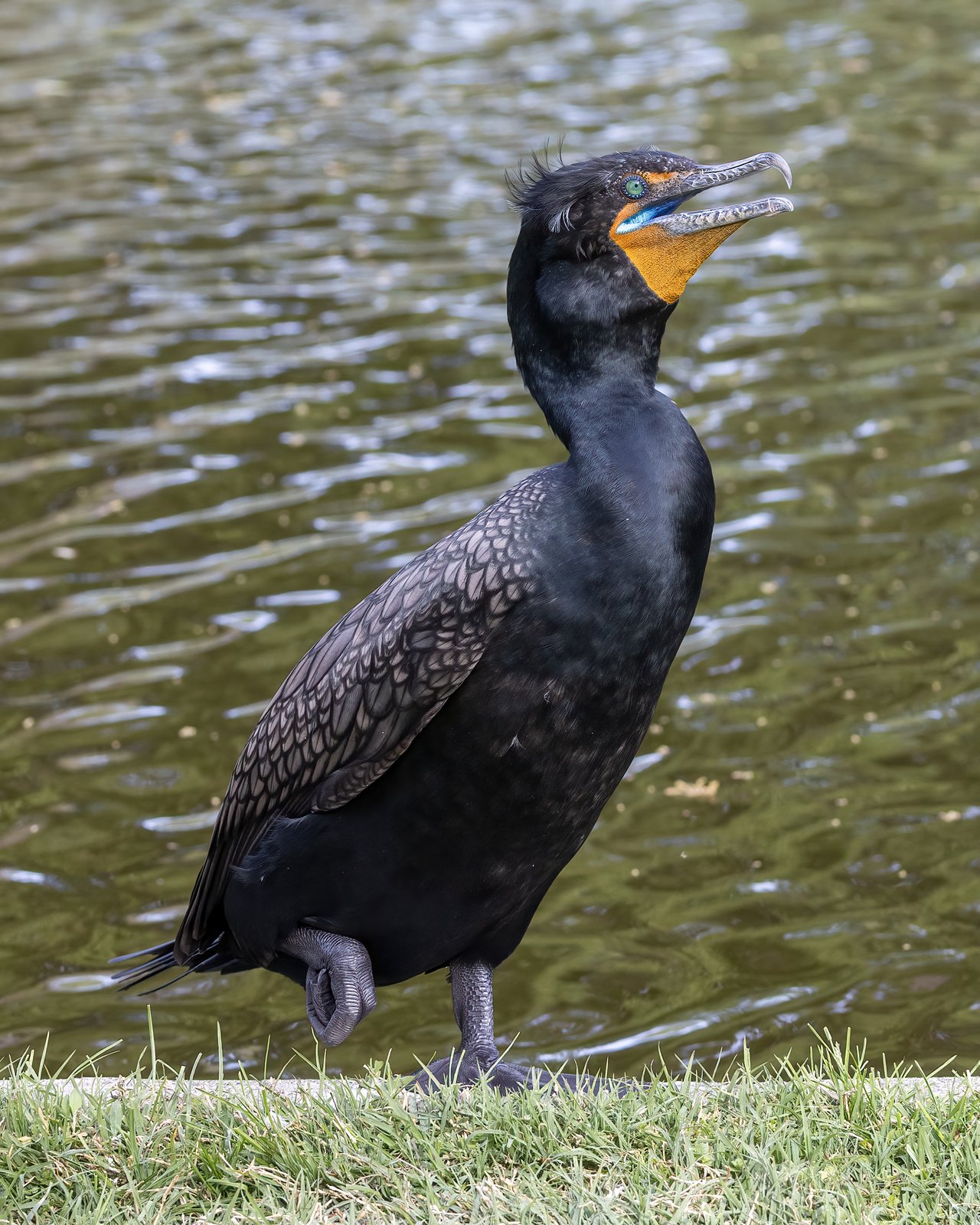
The Double-crested Cormorant is a large, black cormorant with conspicuous orange-yellow gular skin. It is named after the two crests on the head that the birds wear briefly in the breeding season. In the guide area it breeds mainly along the coasts and on islands of north-western Mexico; in winter many migrants from North America arrive, on coastal lagoons and inland lakes.
Voice
Usually silent. At the colony low grunts and groans; young beg with high-pitched squeals.
Recording: Bruce Lagerquist — CC BY-NC-SA 4.0 · converted to mono · xeno-canto
Identification
70–90 cm. A bulky cormorant with a thick neck, a fairly short tail and a powerful, hooked bill. Adults are black with a greenish gloss; the feathers of the mantle and wing coverts are bronze-brown with a black edge. The bare skin of the lores and throat is bright orange-yellow and rounded at the rear. In breeding plumage the birds have two crests behind the eye, which are partly white in birds from north-western Mexico. The eye is green. Juveniles are brown, with a pale neck and breast and a darker belly. In flight the neck is slightly kinked, so the head looks held a little higher than the body.
Confusion species
Neotropic Cormorant Nannopterum brasilianum is smaller and slimmer, with a longer tail, a thinner bill and duller gular skin that comes to a point at the rear; in flight the neck is straight. Brandt's Cormorant Urile penicillatus has a shorter tail and dull brown to blue gular skin with a pale band behind it, and flies with the neck held straight. Pelagic Cormorant Urile pelagicus is much smaller and slimmer, with a thin bill and a small head.
Habitat
Coastal lagoons, estuaries, bays, rocky coasts and islands, but also large lakes, reservoirs and rivers inland. It fishes by diving, alone or in groups. It breeds in colonies on the ground on rocky islets, on cliffs or in trees and mangroves; in winter it forms large roosts on islets, posts and trees.
Where the bird is most at home, classified by the vegetation units of Mexico and Central America.






Range and movements
Breeds along the coasts of Baja California, on islands in the Gulf of California and along the coast of Sonora and Sinaloa. On the Caribbean side locally present year-round along the north coast of the Yucatán Peninsula. In winter migrants spread over lakes, reservoirs and coastal lagoons of northern and central Mexico, on both the Pacific side and along the Gulf coast; further south scarce, and in Central America rare. Outside the guide area in much of North America, from Alaska and southern Canada to Florida, and on Cuba and the Bahamas.
- Resident
- dark = core range, pale = thinly spread
How and when to look
In the Gulf of California and along the Pacific coast of Baja California the species is common all year. In winter large flocks can be seen on coastal lagoons and lakes in northern and central Mexico. In flying groups, the kinked neck and the orange-yellow gular skin help to tell it from Neotropic Cormorant.
Conservation status
Not threatened. The North American population has grown strongly after a steep decline caused by pesticides in the twentieth century. In the guide area the island colonies are sensitive to disturbance and to introduced predators.
Scientific name
Nannopterum auritum | (Lesson, 1831) (GBIF: Phalacrocorax auritus)
Lesson described the species in 1831 as Carbo auritus; because it was later moved to another genus, the author and year stand in brackets. The genus Nannopterum was introduced in 1899 by Sharpe. Nannopterum is Greek, from nannos 'dwarf' and pteron 'wing', after the stubby wings of the flightless Galápagos cormorant for which the genus was erected. auritum is Latin for 'eared', after the two crests on the head in breeding plumage. The specimen the first description was based on came from North America (originally given in error as New Zealand).