All species › Gannets and cormorants › Cormorants and shags › Brandt's Cormorant
Position in the tree Birds Aves › Birds with a flexible palate Neognathae › All other modern birds Neoaves › Birds of the elements Elementaves › Tropicbirds and waterbirds Phaethoquornithes › Core waterbirds Aequornithes
Brandt's Cormorant | Urile penicillatus
Brandts aalscholver | Cormorán de Brandt
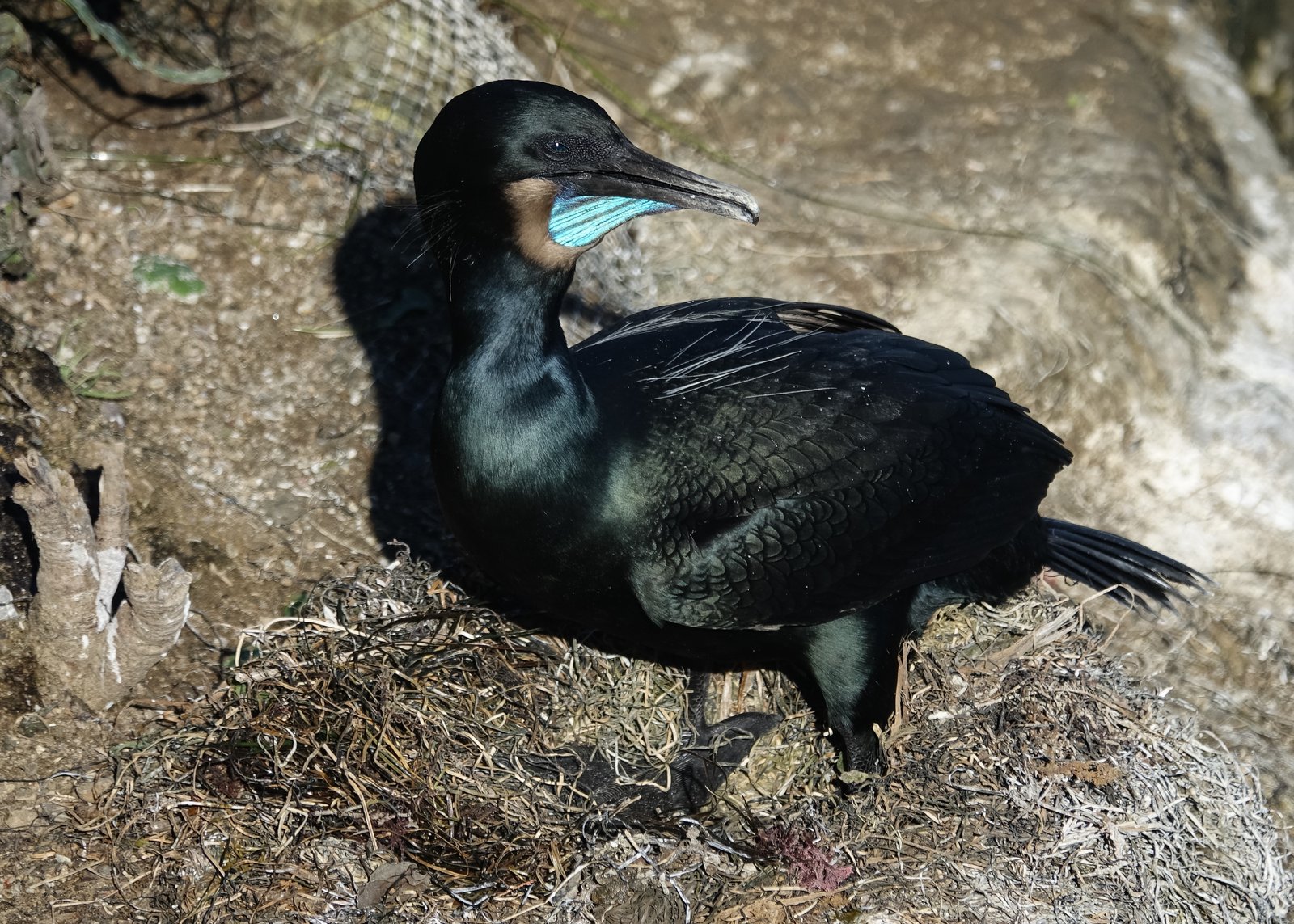
Brandt's Cormorant is a large, dark sea cormorant of the Pacific coast of North America. In the guide area it lives only in north-western Mexico, along the coasts of Baja California and in the Gulf of California. It often fishes in large flocks over shallow sea floors and kelp forests and breeds in dense colonies on rocky islands.
Voice
Usually silent. At the colony low croaks and grunts.
Recording: Paul Marvin — CC BY-NC-SA 4.0 · converted to mono · xeno-canto
Identification
80–90 cm. A heavy cormorant with a fairly short tail, a thick neck and a dark bill. Adults are black with a blue-green gloss. In breeding plumage the bare gular pouch is bright cobalt blue, with a band of pale, buffy feathers behind it, and thin white plumes on the sides of the neck and back; outside the breeding season the pouch is dull. The eye is blue. Juveniles are dark grey-brown, with a pale V on the breast and a pale band behind the throat. It flies with the neck and head outstretched, often in long lines low over the sea.
Confusion species
Double-crested Cormorant Nannopterum auritum has a longer tail and orange-yellow gular skin, and flies with a kinked neck. Pelagic Cormorant Urile pelagicus is smaller and much slimmer, with a thin bill, a small head and, in breeding plumage, red facial skin and white flank patches. Juveniles resemble young Double-crested Cormorants but are darker and plainer, with a shorter tail.
Habitat
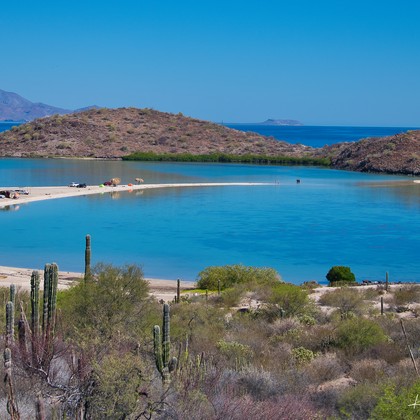
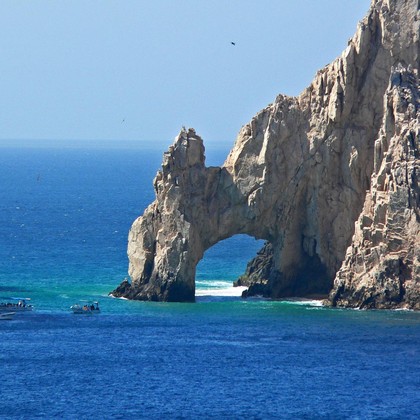
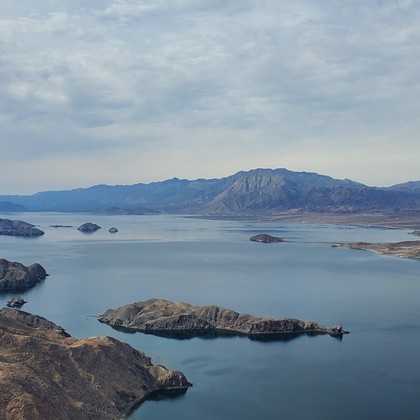
Rocky coasts, rocky islands and the shallow coastal waters around them, often near kelp forests; also bays and harbours, but rarely brackish or fresh water. It dives near the bottom for fish and invertebrates, often in large flocks. It breeds in dense colonies on flat or gently sloping rocky plateaus of islands; the nest is a heap of seaweed and plant material.
Where the bird is most at home, classified by the vegetation units of Mexico and Central America.
Range and movements
Along the Pacific coast of Baja California and on the islands off it, such as the Coronado Islands, Todos Santos and the San Benito Islands, and in the northern and central Gulf of California, with colonies on a number of islands. Outside the breeding season birds wander south along the coast of Sonora and Sinaloa, but further south the species is rare. Outside the guide area along the Pacific coast of North America north to British Columbia and south-eastern Alaska.
- Resident
- dark = core range, pale = thinly spread
How and when to look
Boat trips from Ensenada to the Todos Santos Islands and trips on the Gulf of California give the best chance; flocks of fishing birds can often also be seen from rocky headlands. In spring the blue gular pouch of breeding birds is clearly visible through binoculars.
Conservation status
Not threatened. Numbers fluctuate strongly with the availability of fish; during warm-water events such as El Niño many breeding attempts fail. Colonies are sensitive to disturbance by people, boats and introduced predators, and birds drown in fishing nets.
Scientific name
Urile penicillatus | (Brandt, 1837)
Brandt described the species in 1837 as Carbo penicillatus; because it was later moved to another genus, the author and year stand in brackets. The genus Urile was introduced in 1855 by Bonaparte. Urile probably derives from a Russian vernacular name for the Red-faced Cormorant (Urile urile); the exact origin is uncertain. penicillatus is Latin for 'pencilled, tufted', after the fine white plumes on head and neck in breeding plumage. The specimen the first description was based on came from not stated.