All species › Passerines › Cardinals and allies › Crimson-collared Grosbeak
Position in the tree Birds Aves › Birds with a flexible palate Neognathae › All other modern birds Neoaves › Landbirds Telluraves › Falcons, parrots and passerines Australaves › Falcons and passerines Eufalconimorphae › Parrots and passerines Psittacopasserae
Crimson-collared Grosbeak | Periporphyrus celaeno
Roodkraagkardinaal | Picogordo cuello rojo
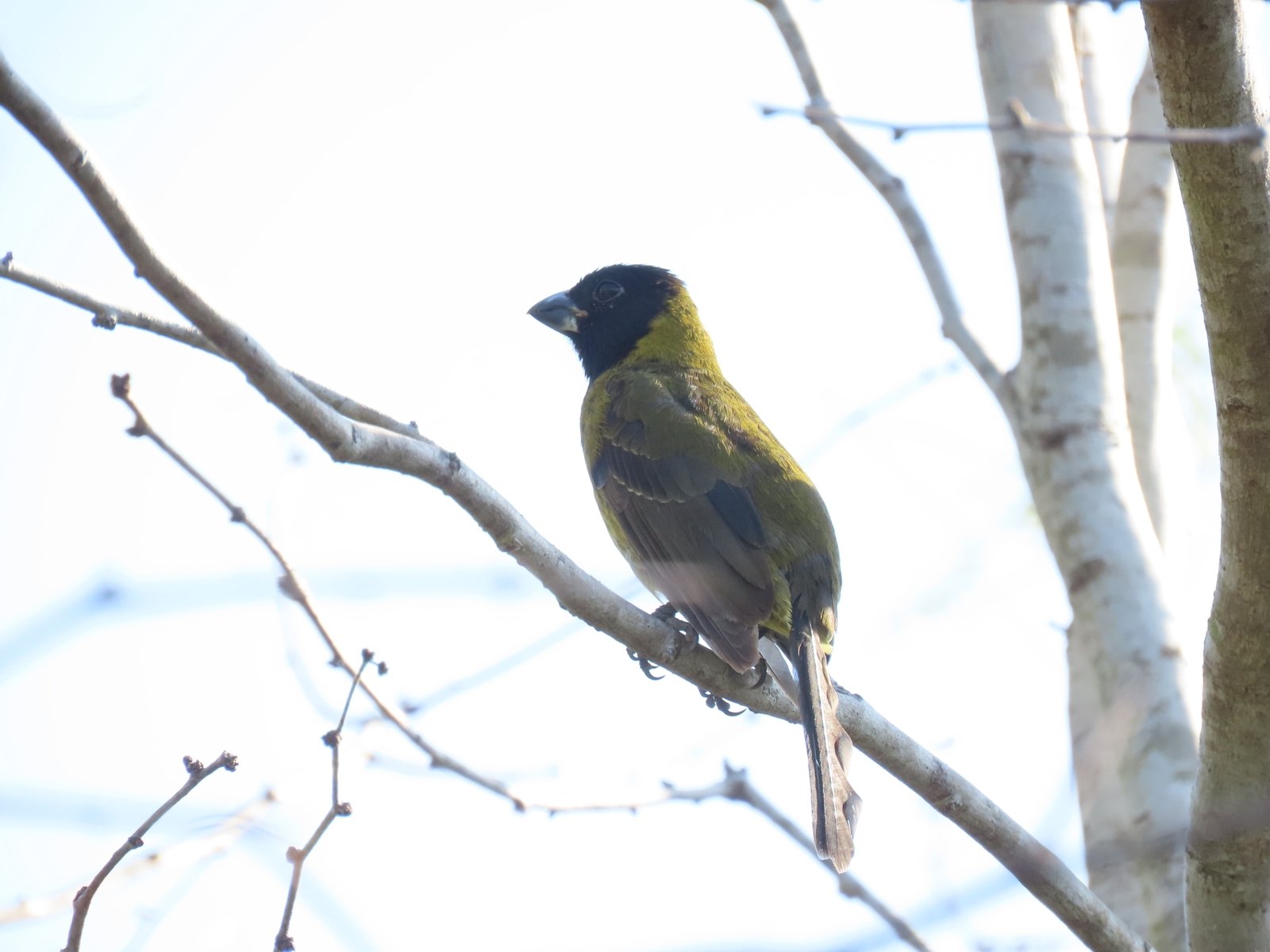
The Crimson-collared Grosbeak is a large, heavy-billed grosbeak found only in north-eastern Mexico. The male is black with dull crimson; the female is olive-green with the same black head. It lives hidden in dense thickets and the forest understorey.
Voice
The song is a short, clear and melodious series of whistled notes. The call is a high, thin and slightly falling seeeuw.
Recording: Leonardo Guzman Hernandez — CC BY-NC-SA 4.0 · converted to mono · xeno-canto
Identification
21–22 cm. A large, long-tailed grosbeak with a thick, conical blackish bill. The male has a black head, throat and upper breast; the rest of the body is dull crimson, brightest in a broad collar around the neck and on the belly, with blackish wings and tail. The female has the same black head and throat but is otherwise olive-green, yellower below. Young males resemble the female with red patches.
Confusion species
Black-faced Grosbeak Caryothraustes poliogaster (mainly from southern Veracruz southward) has a black mask but a yellow-green head and back and a grey belly, and lives in groups in the canopy. Black-headed Saltator Saltator atriceps is larger, with a white throat and an olive-green back. The female Northern Cardinal Cardinalis cardinalis is brown with a crest and a red bill.
Habitat
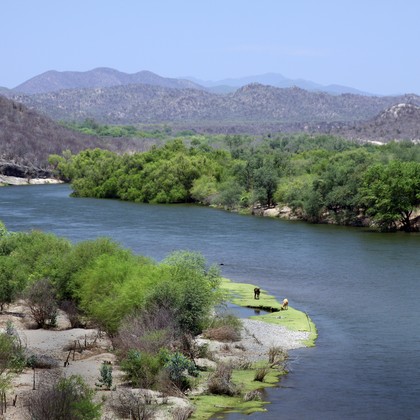
Dense thickets, the understorey of humid and semi-humid forest, forest edges, riverside woodland and overgrown plantations, also dense thorn scrub; from sea level to about 1200 m. It feeds low in the vegetation and on the ground on seeds, fruit and insects.
Where the bird is most at home, classified by the vegetation units of Mexico and Central America.



Range and movements
Endemic to north-eastern Mexico: from central Nuevo León and Tamaulipas through eastern San Luis Potosí and Querétaro to Hidalgo, northern Veracruz and northern Puebla. A rare vagrant to southern Texas.
- Resident
- dark = core range, pale = thinly spread
How and when to look
Regularly seen in El Cielo Biosphere Reserve near Gómez Farías in Tamaulipas, especially in dense thickets along forest edges and trails. The high, thin call often gives away a bird that keeps hidden.
Conservation status
Not threatened (LC). Locally fairly common within a restricted range; declines where forest and thickets are converted to pasture and cropland.
Scientific name
Periporphyrus celaeno | (Deppe, 1830) (GBIF: Rhodothraupis celaeno)
Deppe described the species in 1830 as Tanagra Celaeno; because it was later moved to another genus, the author and year stand in brackets. The genus Periporphyrus was introduced in 1850 by Reichenbach. Periporphyrus is Greek, from peri 'very, around' and porphureos 'purple-red', after the red plumage. celaeno derives from Greek kelainos 'dark, black', after the black head and breast; Celaeno is also a figure of Greek myth (a Pleiad and a Harpy). The specimen the first description was based on came from Papantla, Veracruz, Mexico.