All species › Passerines › Cardinals and allies › Lemon-spectacled Tanager
Position in the tree Birds Aves › Birds with a flexible palate Neognathae › All other modern birds Neoaves › Landbirds Telluraves › Falcons, parrots and passerines Australaves › Falcons and passerines Eufalconimorphae › Parrots and passerines Psittacopasserae
Lemon-spectacled Tanager | Chlorothraupis olivacea
Geelbrauwtangare | Tangara olivácea
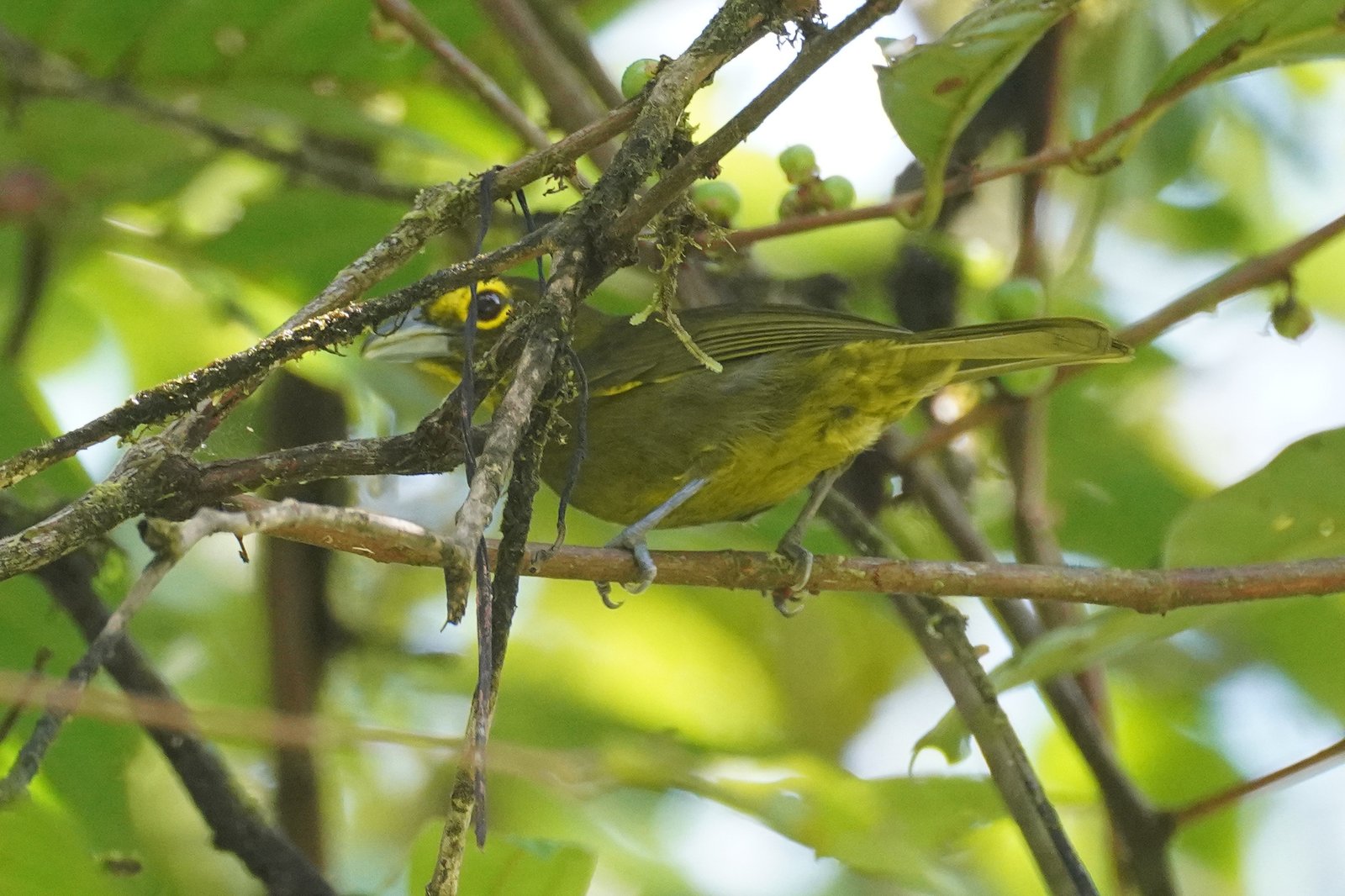
The Lemon-spectacled Tanager is a stocky, dark olive-green songbird with yellow spectacles around the eye and a yellow throat. It lives in groups in the understorey of the Chocó rainforest. In the guide area it occurs only in eastern Panama.
Voice
Groups give a harsh, nasal and hoarse chatter. The dawn song consists of repeated, whistled and somewhat hoarse phrases.
Recording: Jaime Suárez — CC BY-NC-SA 4.0 · shortened to the first 60 s, mono · xeno-canto
Identification
16–18 cm. A fairly robust songbird with a heavy, dark bill. Dark olive-green, slightly paler and yellower below. Lores and a broad ring around the eye bright yellow, forming yellow spectacles; the throat is also yellow. Male and female are alike.
Confusion species
Carmiol's Tanager Chlorothraupis carmioli lacks the yellow spectacles and has a less yellow throat; in eastern Panama it lives mainly higher on the slopes. Female ant tanagers are browner, with no yellow around the eye.
Habitat
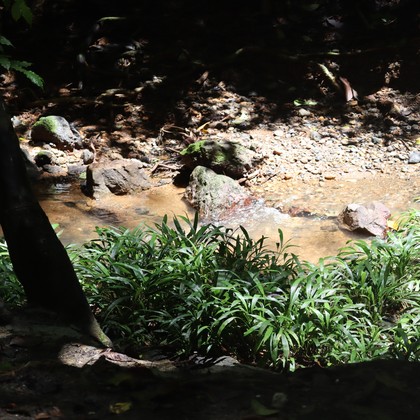
Lower and middle levels of very humid lowland and foothill rainforest, also mature secondary forest, mostly below 800 m. It lives in groups, often with mixed flocks of other forest birds, and eats insects and fruit.
Where the bird is most at home, classified by the vegetation units of Mexico and Central America.


Range and movements
In the guide area only in eastern Panama, mainly in Darién and adjacent eastern Guna Yala. Outside the guide area in the Chocó lowlands from western Colombia to north-western Ecuador.
- Resident
- dark = core range, pale = thinly spread
How and when to look
Most likely in the lowland forest of Darién, for example around Cana and El Real, where groups move through the understorey with their harsh calls.
Conservation status
Not threatened (LC). Within the guide area restricted to eastern Panama, where it depends on continuous lowland forest that is shrinking through deforestation.
Scientific name
Chlorothraupis olivacea | (Cassin, 1860)
Cassin described the species in 1860 as Orthogonys olivaceus; because it was later moved to another genus, the author and year stand in brackets. The genus Chlorothraupis was introduced in 1883 by Salvin & Godman. Chlorothraupis is Greek, from khlōros 'green' and thraupis, an unidentified small finch-like bird (in ornithology 'tanager'): 'green tanager'. olivacea is modern Latin for 'olive-coloured', after the dark olive-green plumage. The specimen the first description was based on came from Río Truandó, northwestern Colombia.