All species › Passerines › Cardinals and allies › Black-faced Grosbeak
Position in the tree Birds Aves › Birds with a flexible palate Neognathae › All other modern birds Neoaves › Landbirds Telluraves › Falcons, parrots and passerines Australaves › Falcons and passerines Eufalconimorphae › Parrots and passerines Psittacopasserae
Black-faced Grosbeak | Caryothraustes poliogaster
Grijsbuikkardinaal | Picogordo cara negra
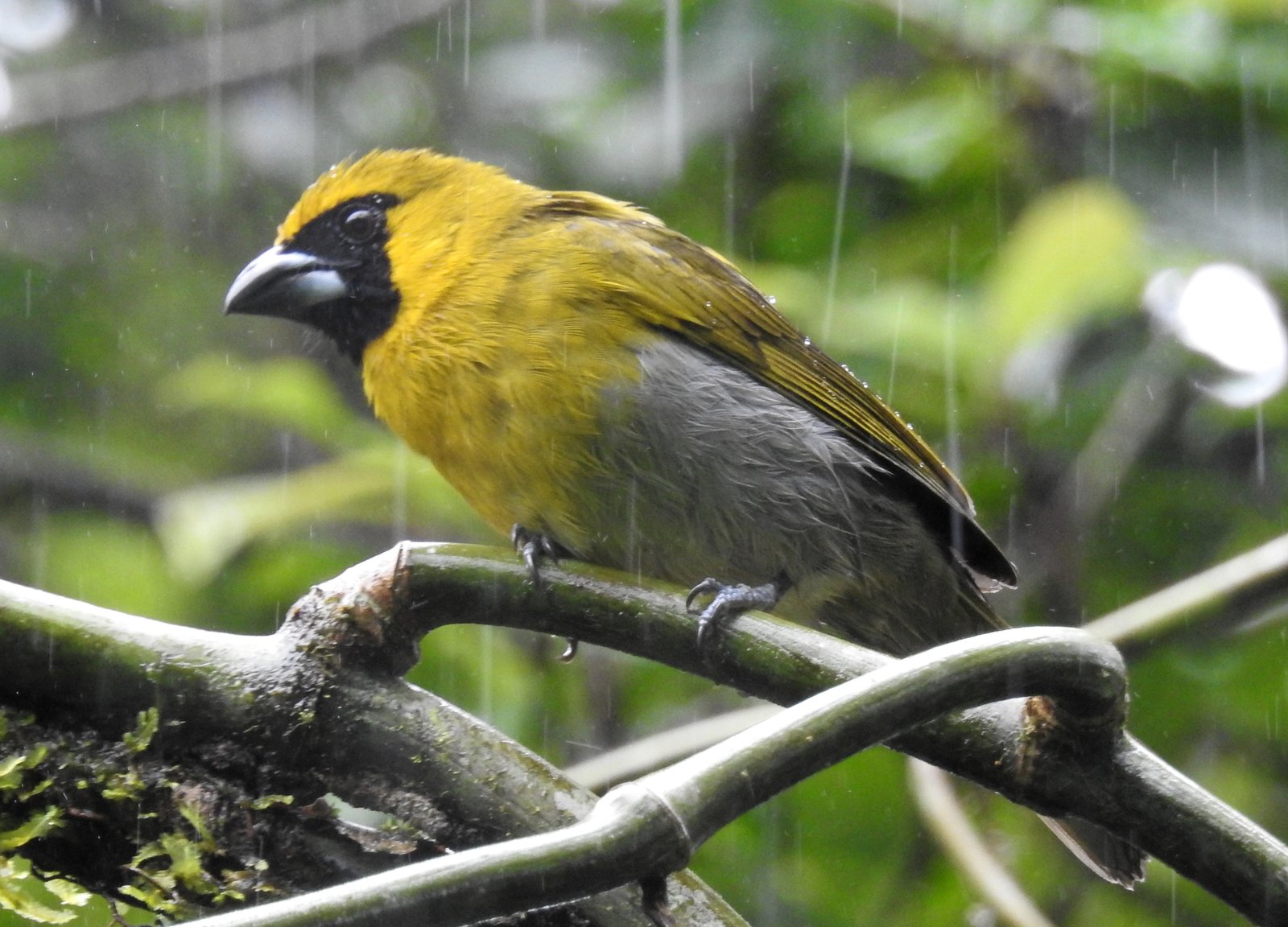
The Black-faced Grosbeak is a stocky, yellow-green grosbeak with a black face, a grey belly and a thick, conical bill. It lives in noisy groups in the canopy and middle storey of humid lowland forest and often joins mixed flocks. In the guide area it occurs from south-eastern Mexico to Panama.
Voice
Groups keep in contact with harsh, buzzy dzeeer calls and sharp chip notes. The song is a short series of clear whistled notes, often repeated two or three times.
Recording: Bill Pyle — CC BY-NC-SA 4.0 · shortened to the first 60 s, mono · xeno-canto
Identification
16–17 cm. A stocky, fairly short-tailed grosbeak with a heavy, conical grey-black bill. Forehead, lores, eye-ring, cheeks and throat form a black mask. Crown, nape and upperparts olive yellow-green, yellowest on the crown and around the edge of the mask; rump grey. Breast yellow-green; belly, flanks and undertail coverts grey. Wings and tail dark with olive-green edges. The sexes are alike.
Confusion species
Yellow-green Grosbeak Caryothraustes canadensis (in the guide area only in eastern Panama) is smaller, has black only around the base of the bill and on the chin, and is entirely yellow below without a grey belly. Crimson-collared Grosbeak Rhodothraupis celaeno (north-eastern Mexico) has a wholly black head and throat; the female is olive-green without grey. Black-headed Saltator Saltator atriceps is larger and has a white throat bordered with black.
Habitat
Canopy and middle storey of humid evergreen lowland and foothill forest, also tall secondary forest, forest edges and shade plantations of coffee and cacao; mainly below 1000 m, locally to about 1400 m. It eats seeds, fruit and insects, often in mixed flocks with tanagers and ant tanagers.
Where the bird is most at home, classified by the vegetation units of Mexico and Central America.




Range and movements
Caribbean slope of south-eastern Mexico (from southern Veracruz and northern Oaxaca through Tabasco, Chiapas and the southern Yucatán Peninsula) through Belize, Guatemala, Honduras and Nicaragua to Costa Rica; in Panama to the centre of the country. Outside the guide area at most very locally in extreme north-western Colombia.
- Resident
- dark = core range, pale = thinly spread
How and when to look
Groups are often heard first by their buzzy calls high in the trees, for example at La Selva in Costa Rica or at Tikal in Guatemala. They move with mixed flocks along forest edges and clearings.
Conservation status
Not threatened (LC). Common in humid forest; declines where forest is cleared, but persists in forest remnants and shade plantations.
Scientific name
Caryothraustes poliogaster | (Du Bus de Gisignies, B-AL, 1847)
Du Bus de Gisignies, B-AL described the species in 1847 as Pitylus poliogaster; because it was later moved to another genus, the author and year stand in brackets. The genus Caryothraustes was introduced in 1850 by Reichenbach. Caryothraustes is Greek, from karuon 'nut' and thraustēs 'breaker': 'nut-cracker', after the heavy, conical bill. poliogaster is Greek, from polios 'grey' and gastēr 'belly', after the grey belly. The specimen the first description was based on came from Guatemala.