All species › Passerines › New World blackbirds, troupials and allies › Carib Grackle
Position in the tree Birds Aves › Birds with a flexible palate Neognathae › All other modern birds Neoaves › Landbirds Telluraves › Falcons, parrots and passerines Australaves › Falcons and passerines Eufalconimorphae › Parrots and passerines Psittacopasserae
Carib Grackle | Quiscalus lugubris
Caribische troepiaal | Zanate caribeño
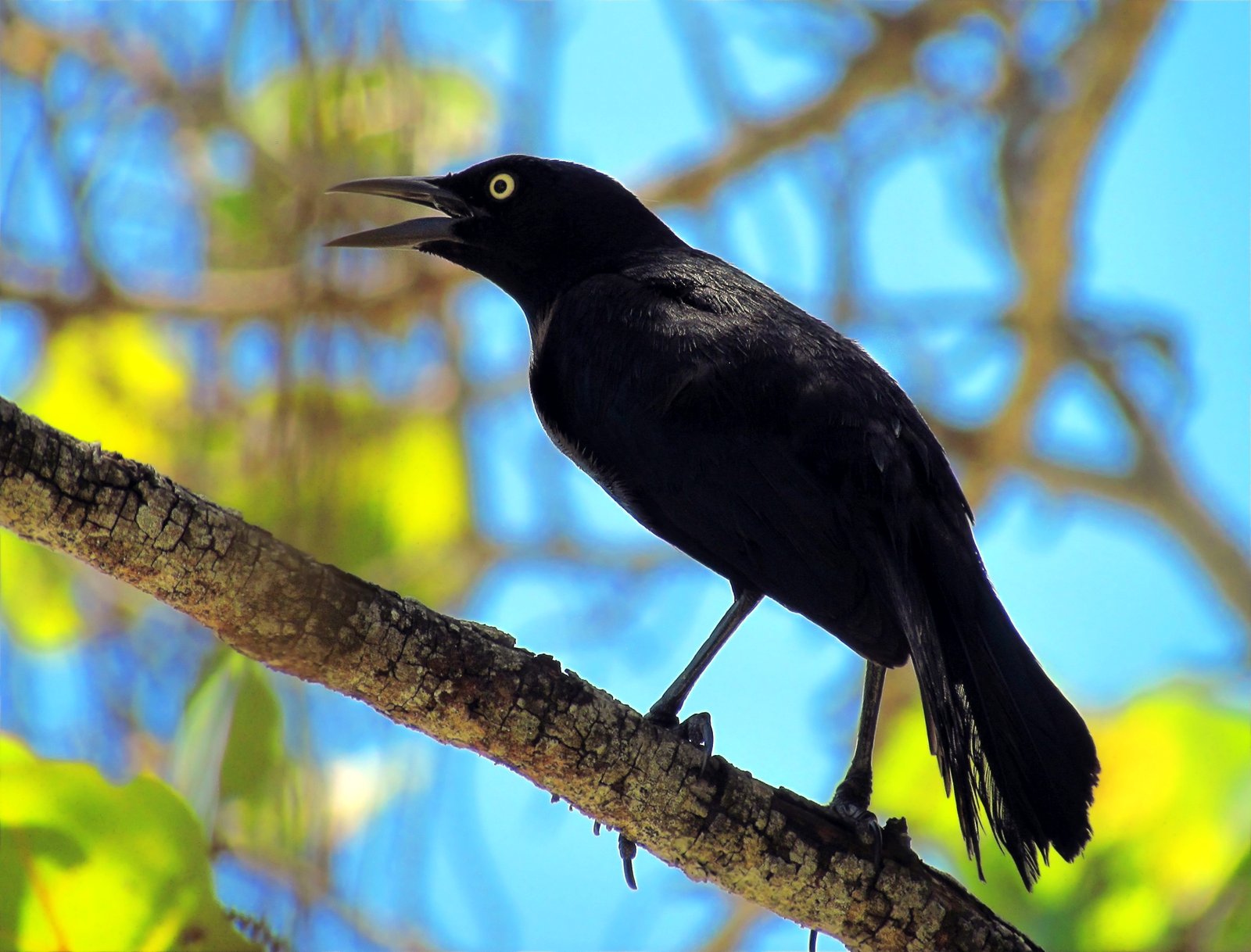
The Carib Grackle is a small grackle of the Lesser Antilles and northern South America. It lives in groups in villages, gardens and open country. In the guide area it occurs only in Panama, where it has become established only in recent decades.
Voice
The song is a series of high, clear, bell-like notes followed by a rattle, roughly chee-chee-chee-cheek. The call is a short, sharp chuk; groups chatter constantly.
Recording: Tristan Guillebot de Nerville — CC BY-NC-SA 4.0 · converted to mono · xeno-canto
Identification
20–28 cm; the male is clearly larger than the female. Male black with a purple-blue to violet gloss; eye pale yellow. Bill fairly slim, pointed and slightly curved. Tail medium-long and keeled, V-shaped in cross-section. Female smaller, duller and browner, with a paler throat, a shorter tail and also a pale eye. Juveniles brown with a dark eye.
Confusion species
Great-tailed Grackle Quiscalus mexicanus is much larger, the male with a much longer tail; the female is warm brown with a pale supercilium. Shiny Cowbird Molothrus bonariensis, which lives in the same open country, has a dark eye, a short, conical bill and a square tail.
Habitat
Villages and towns, gardens, parks, cattle pastures, fields and edges of marshes and mangroves. It forages in groups on the ground, often on lawns or with cattle, and eats insects, seeds, fruit and food scraps. It breeds in small colonies in trees and palms.
Where the bird is most at home, classified by the vegetation units of Mexico and Central America.




Range and movements
Lesser Antilles, Trinidad and Tobago, northern Venezuela, the Guianas and north-eastern Brazil, spreading westwards in Colombia. In the guide area only in Panama, where it has become established in recent decades and is still expanding; its exact distribution there is still changing.
- Resident
- dark = core range, pale = thinly spread
How and when to look
In Panama check groups of grackles in villages and on lawns for a small grackle with a yellow eye and a short, keeled tail; the difference from Great-tailed Grackle is clearest in size when both feed together.
Conservation status
Not threatened (LC). Common within its range and benefits from villages and open farmland. It is expanding.
Scientific name
Quiscalus lugubris | Swainson, 1838
Swainson described the species in 1838 and placed it straight away in the genus where it still stands. The genus Quiscalus was introduced in 1816 by Vieillot. Quiscalus goes back to Linnaeus's species name Gracula quiscula; where he got the word is uncertain, possibly from Taíno quisqueya, a name for Hispaniola. lugubris is Latin for 'mournful', after the all-black 'mourning' plumage. The specimen the first description was based on came from Guyana.