All species › Gannets and cormorants › Cormorants and shags › Pelagic Cormorant
Position in the tree Birds Aves › Birds with a flexible palate Neognathae › All other modern birds Neoaves › Birds of the elements Elementaves › Tropicbirds and waterbirds Phaethoquornithes › Core waterbirds Aequornithes
Pelagic Cormorant | Urile pelagicus
Pelagische aalscholver | Cormorán pelágico
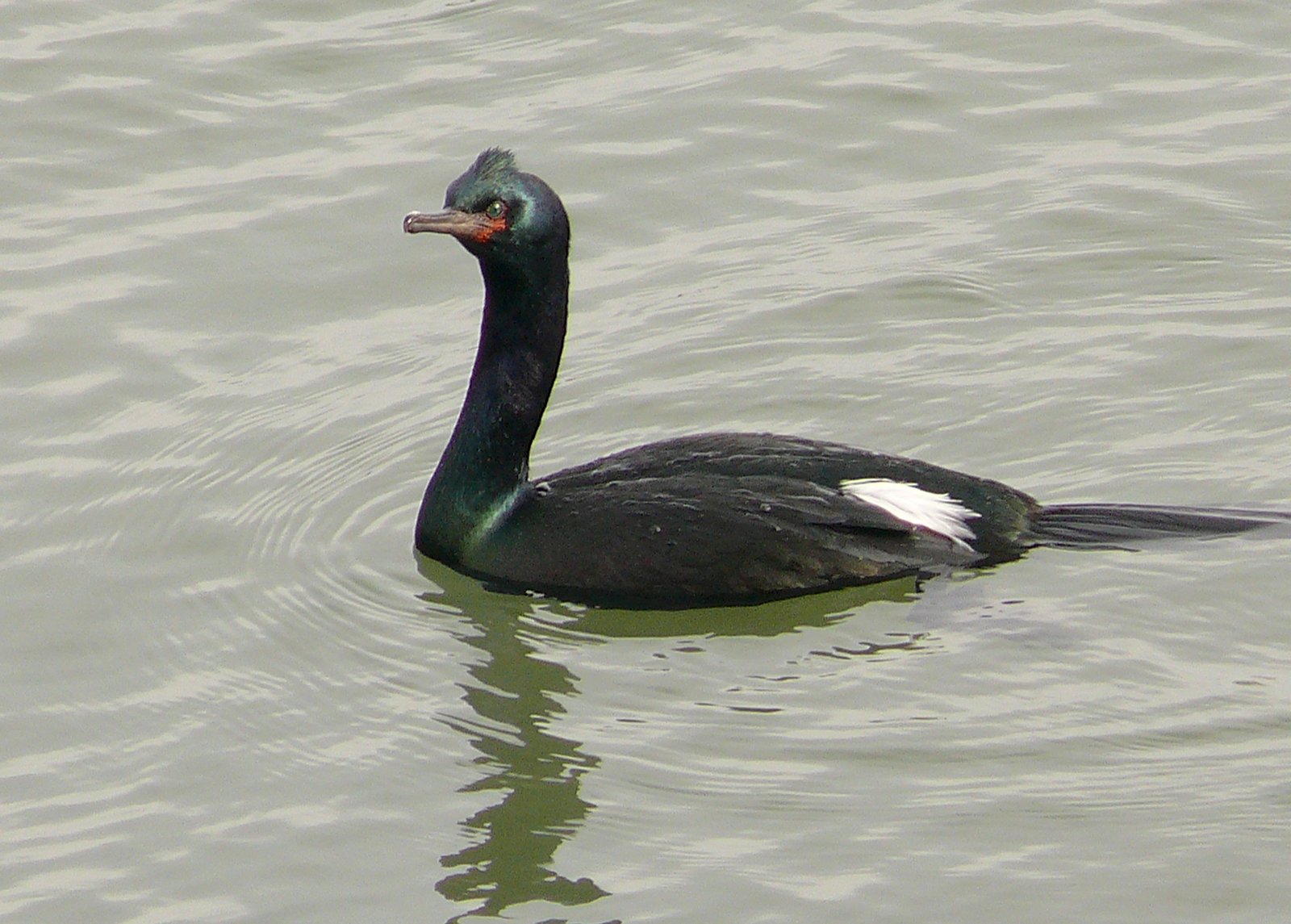
The Pelagic Cormorant is the smallest and slimmest cormorant of the Pacific coast of North America. Despite its name it does not live on the open sea but along rocky coasts. In the guide area it is a rare winter visitor in the far north-west, along the Pacific coast of Baja California.
Voice
Almost silent in winter; at the colony soft groans and grunts.
Recording: Ian Cruickshank — CC BY-NC-SA 4.0 · shortened to the first 60 s, mono · xeno-canto
Identification
64–76 cm. A small, very slim cormorant with a thin neck, a small head and a strikingly thin, dark bill. Adults are black with a strong green and purple gloss. In breeding plumage they have a small patch of red facial skin at the base of the bill, two short crests on the crown and nape, thin white plumes on the neck and a white flank patch; in winter, when they appear in the guide area, these features are largely absent. Juveniles are uniformly dark brown, without a pale breast. It flies with a thin, outstretched neck and a small head, giving it a loon-like look in flight.
Confusion species
Brandt's Cormorant Urile penicillatus is larger and heavier, with a thicker neck, a larger head, a thicker bill and a pale band behind the throat. Double-crested Cormorant Nannopterum auritum is much bulkier, with orange-yellow gular skin; juveniles have a pale neck and breast. Loons such as Pacific Loon Gavia pacifica have a pointed, straight bill and pale underparts and do not hold the bill downwards in flight.
Habitat
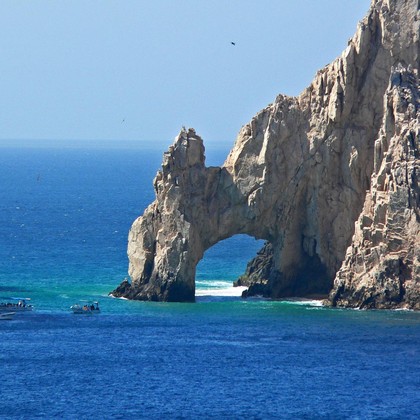
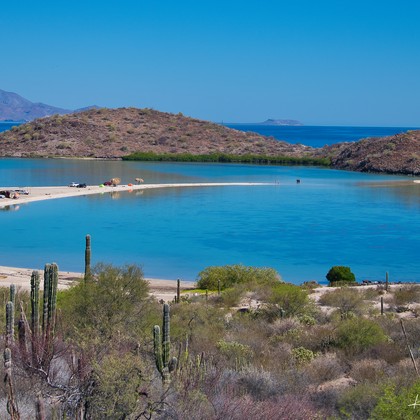
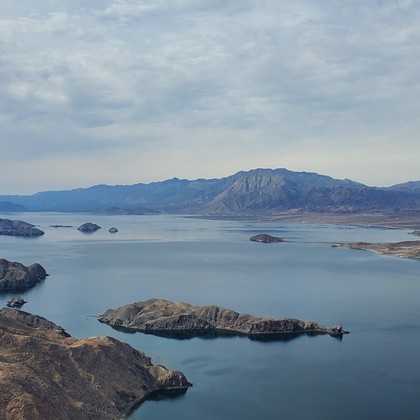
Steep rocky coasts, cliffs and rocky islands with the water around them, also harbours with piers and breakwaters; it usually fishes alone or in small groups close to the shore, diving down to the bottom. It breeds on narrow ledges of steep cliffs, outside the guide area.
Where the bird is most at home, classified by the vegetation units of Mexico and Central America.
Range and movements
In the guide area only in winter, in small numbers along the Pacific coast of northern Baja California, for example at the Coronado Islands, Ensenada and Todos Santos; further south and in the Gulf of California very rare. Outside the guide area the species breeds along the Pacific coasts of North America, from California to Alaska, and of north-eastern Asia, south to Japan and China.
- Winter visitor (c. Oct–Mar)
- dark = core range, pale = thinly spread
How and when to look
The best chance is in winter on rocky coasts and piers between Tijuana and Ensenada and at the islands offshore. Among Brandt's and Double-crested Cormorants, look for a smaller, slimmer bird with a thin bill and a strong gloss.
Conservation status
Not threatened. The global population is large. In the guide area a rare winter visitor without a breeding population.
Scientific name
Urile pelagicus | (Pallas, 1811) (GBIF: Phalacrocorax pelagicus)
Pallas described the species in 1811 as Phalacrocorax pelagicus; because it was later moved to another genus, the author and year stand in brackets. The genus Urile was introduced in 1855 by Bonaparte. Urile probably derives from a Russian vernacular name for the Red-faced Cormorant (Urile urile); the exact origin is uncertain. pelagicus is Latin for 'of the sea', after its life along the open coast. The specimen the first description was based on came from eastern Kamchatka and the Aleutian Islands.