All species › Swifts › Hummingbirds › Blue-vented Hummingbird
Position in the tree Birds Aves › Birds with a flexible palate Neognathae › All other modern birds Neoaves › Birds of the elements Elementaves › Nightjars and swifts Strisores
Blue-vented Hummingbird | Saucerottia hoffmanni
Costaricaanse blauwbuikamazilia | Amazilia culiazul
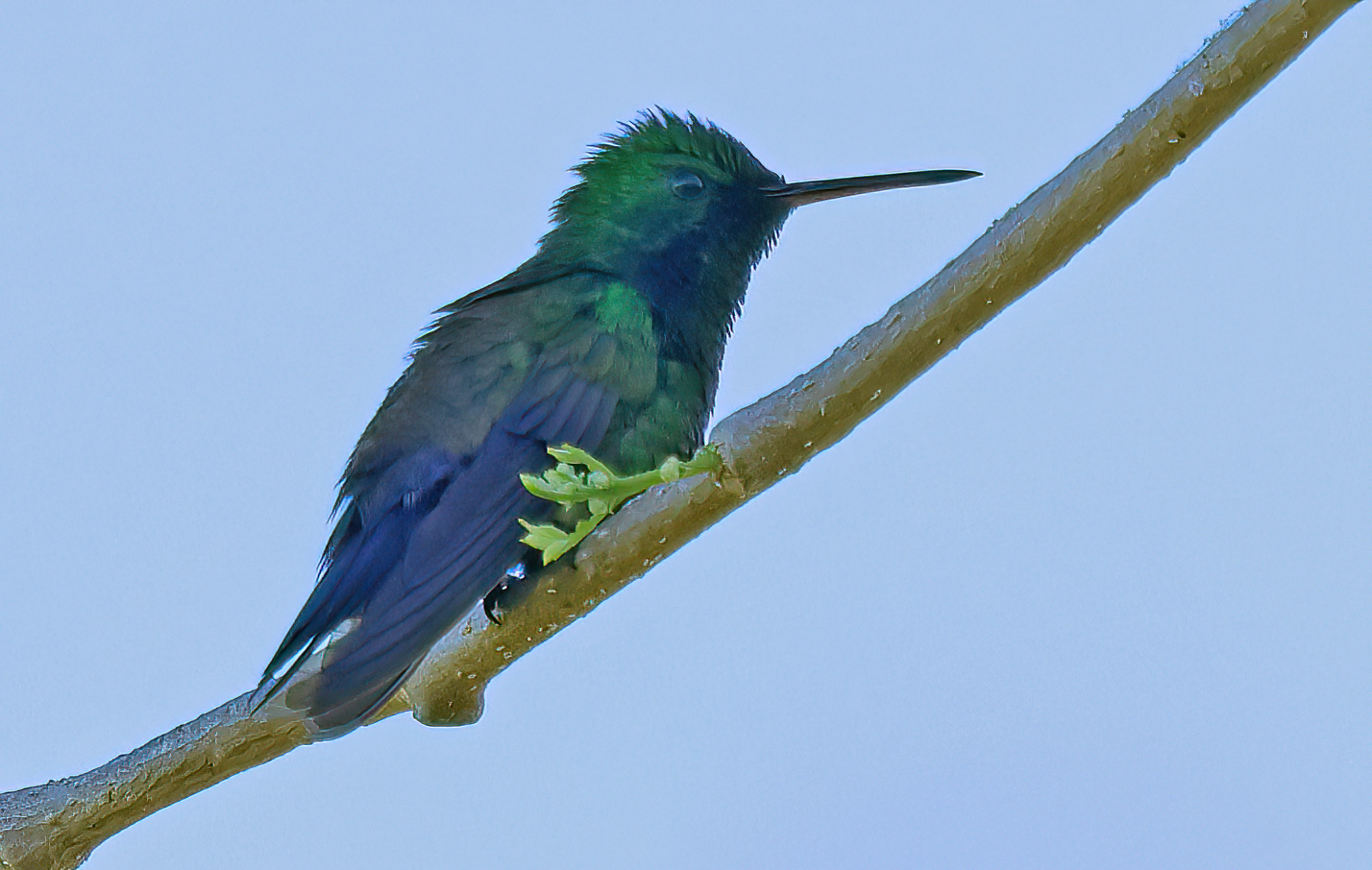
The Blue-vented Hummingbird is a small green hummingbird with a blue-black tail that occurs only in western Nicaragua and Costa Rica. In the Central Valley of Costa Rica it is one of the commonest hummingbirds of gardens and coffee plantations. It was long included in Steely-vented Hummingbird of Colombia and Venezuela.
Voice
A dry, short chit and a dry, twittering rattle in chases. The song is a series of high, scratchy notes.
Recording: Paul Driver — CC BY-NC-SA 4.0 · converted to mono · xeno-canto
Identification
8–9 cm, with a straight black bill with a pale base to the lower mandible. The head, upperparts, throat and breast are glittering green; the rump is bronzy. The undertail coverts are steel-blue with pale fringes and the tail is blue-black. The leg feathering is white and stands out as white ‘puffs’. The sexes are alike; the female is slightly duller and has a greyer belly.
Confusion species
Blue-tailed Hummingbird Saucerottia cyanura has rufous in the wings and a purplish-bronze rump; both occur in western Nicaragua. Snowy-bellied Hummingbird Saucerottia edward has a white belly. Rufous-tailed Hummingbird Amazilia tzacatl is larger, has a red bill and a rufous tail. Charming Hummingbird Polyerata decora has a blue breast and a grey belly.
Habitat
Dry and semi-deciduous forest, forest edges, gallery forest, scrub, shade coffee, pasture with trees and gardens, from sea level to about 1700 m. It feeds at flowering trees, shrubs and hedges and fiercely defends flower-rich spots.
Where the bird is most at home, classified by the vegetation units of Mexico and Central America.






Range and movements
Endemic to the guide area. On the Pacific side of Nicaragua, mainly around Managua, Masaya, Carazo and Rivas, and in the north of the central highlands; in Costa Rica on the Pacific side from Guanacaste to Puntarenas and in the Central Valley. Scarce elsewhere.
- Resident
- dark = core range, pale = thinly spread
How and when to look
In gardens, parks and coffee plantations in the Central Valley, around San José, Alajuela and Heredia, and in the dry forest of Guanacaste in Costa Rica; in Nicaragua in gardens around Managua and Masaya.
Conservation status
Not evaluated as a separate species; the IUCN includes it in Steely-vented Hummingbird of Colombia and Venezuela, which is not threatened globally. Common in Costa Rica and often in gardens and coffee plantations, so little sensitive to disturbance.
Scientific name
Saucerottia hoffmanni | (Cabanis & Heine, 1860)
Cabanis & Heine described the species in 1860 as Hemithylaca Hoffmanni; because it was later moved to another genus, the author and year stand in brackets. The genus Saucerottia was introduced in 1850 by Bonaparte. Saucerottia honours the French physician and ornithologist Antoine Constant Saucerotte; the name derives from the epithet saucerottei (1846). hoffmanni honours the German physician and naturalist Karl Hoffmann (1823–1859), who collected in Costa Rica. The specimen the first description was based on came from Costa Rica.