All species › Swifts › Hummingbirds › Berylline Hummingbird
Position in the tree Birds Aves › Birds with a flexible palate Neognathae › All other modern birds Neoaves › Birds of the elements Elementaves › Nightjars and swifts Strisores
Berylline Hummingbird | Saucerottia beryllina
Berylamazilia | Amazilia berilina
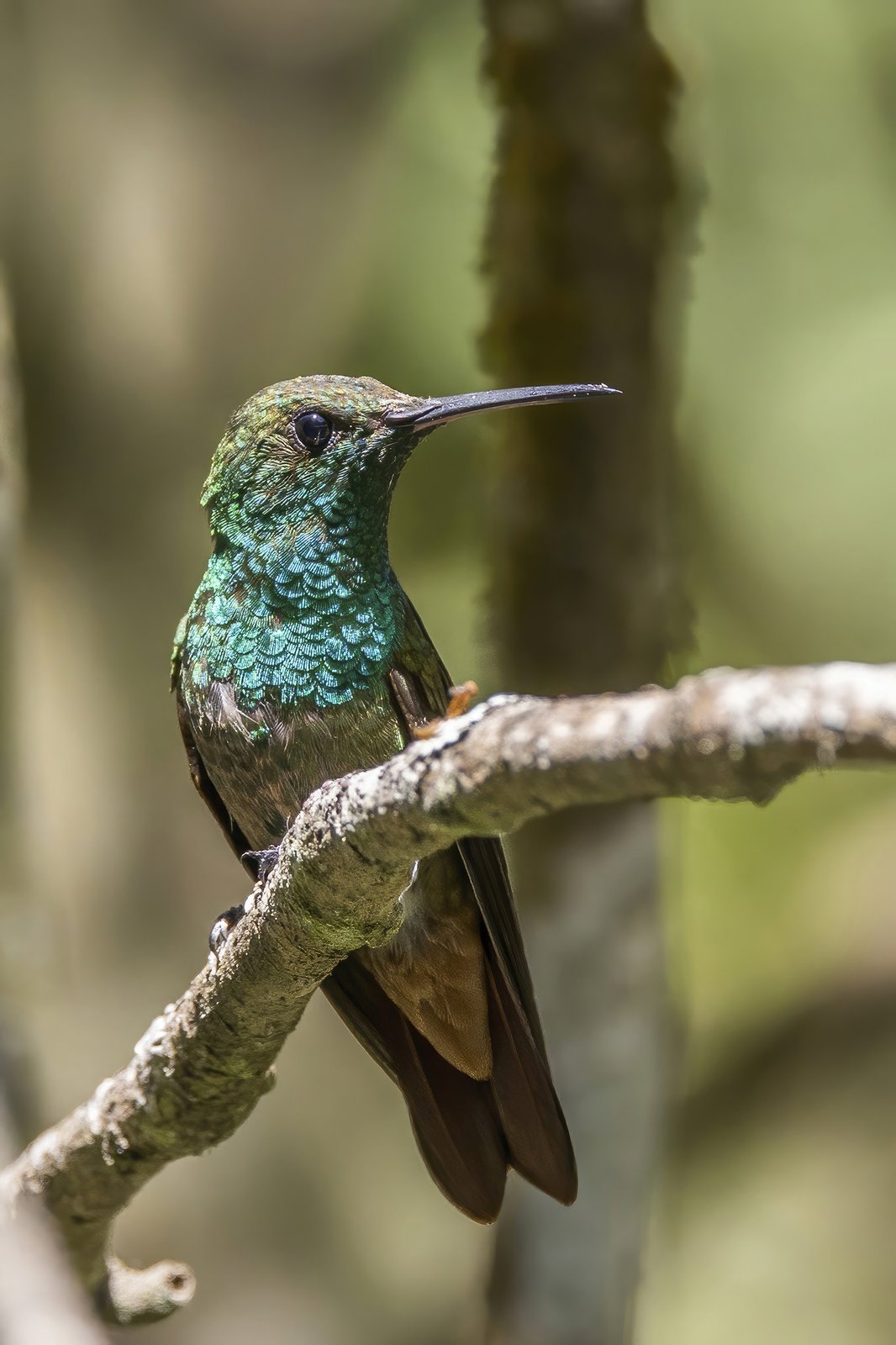
The Berylline Hummingbird is one of the commonest hummingbirds of the mountains of Mexico and northern Central America, also in gardens and parks of cities such as Mexico City. The combination of a green body, rufous wings and a purplish-brown tail is distinctive. In summer it reaches south-eastern Arizona in small numbers.
Voice
A dry, buzzy dzzit and a dry, twittering rattle. The song is a series of high, squeaky and scratchy notes.
Recording: Pritam Baruah — CC BY-NC-SA 4.0 · converted to mono · xeno-canto
Identification
9–10 cm, with a straight black bill with a red base to the lower mandible. The head, throat and breast are glittering green. The wings have a rufous patch at the base of the secondaries. The rump, uppertail coverts and tail are purplish-chestnut to purple-bronze. The lower belly is greyish-brown to buff. The female is duller, with a greyer belly.
Confusion species
Blue-tailed Hummingbird Saucerottia cyanura has a blue-black tail and blue-violet uppertail coverts; both occur in southern Chiapas and Guatemala, where intermediates are reported. Rufous-tailed Hummingbird Amazilia tzacatl has a red bill with a black tip, a rufous tail and no rufous in the wings. Buff-bellied Hummingbird Amazilia yucatanensis has a buff belly and a rufous tail, but no rufous in the wings, and lives in the lowlands. White-eared Hummingbird Basilinna leucotis has a broad white stripe behind the eye.
Habitat
Pine-oak forest, oak forest, cloud forest, forest edges, scrub, coffee plantations, gardens and parks, mainly between about 1000 and 3000 m; locally lower. It feeds at flowering shrubs and trees, often in gardens and at feeders.
Where the bird is most at home, classified by the vegetation units of Mexico and Central America.






Range and movements
From Sonora and Chihuahua through the Sierra Madre Occidental, the Trans-Mexican Volcanic Belt and the mountains of Guerrero, Oaxaca and Chiapas to the highlands of Guatemala, El Salvador and Honduras; also in the mountains of western Veracruz and Puebla. Outside the guide area a scarce summer visitor to south-eastern Arizona.
- Resident
- dark = core range, pale = thinly spread
How and when to look
In the parks and gardens of Mexico City, such as Chapultepec Park and the university nature reserve in El Pedregal, in the mountains around Oaxaca and in the gardens around Antigua in Guatemala.
Conservation status
Not threatened. Common in a large range. The species also uses gardens, parks and plantations and appears little sensitive to disturbance.
Scientific name
Saucerottia beryllina | (Deppe, 1830)
Deppe described the species in 1830 as Trochilus beryllinus; because it was later moved to another genus, the author and year stand in brackets. The genus Saucerottia was introduced in 1850 by Bonaparte. Saucerottia honours the French physician and ornithologist Antoine Constant Saucerotte; the name derives from the epithet saucerottei (1846). beryllina is Latin for 'beryl-coloured' (from beryllus 'beryl', a green gemstone), after the glittering green plumage. The specimen the first description was based on came from Mexico (not specified further).