All species › Swifts › Hummingbirds › Azure-crowned Hummingbird
Position in the tree Birds Aves › Birds with a flexible palate Neognathae › All other modern birds Neoaves › Birds of the elements Elementaves › Nightjars and swifts Strisores
Azure-crowned Hummingbird | Saucerottia cyanocephala
Hemelsblauwe amazilia | Colibrí corona azul
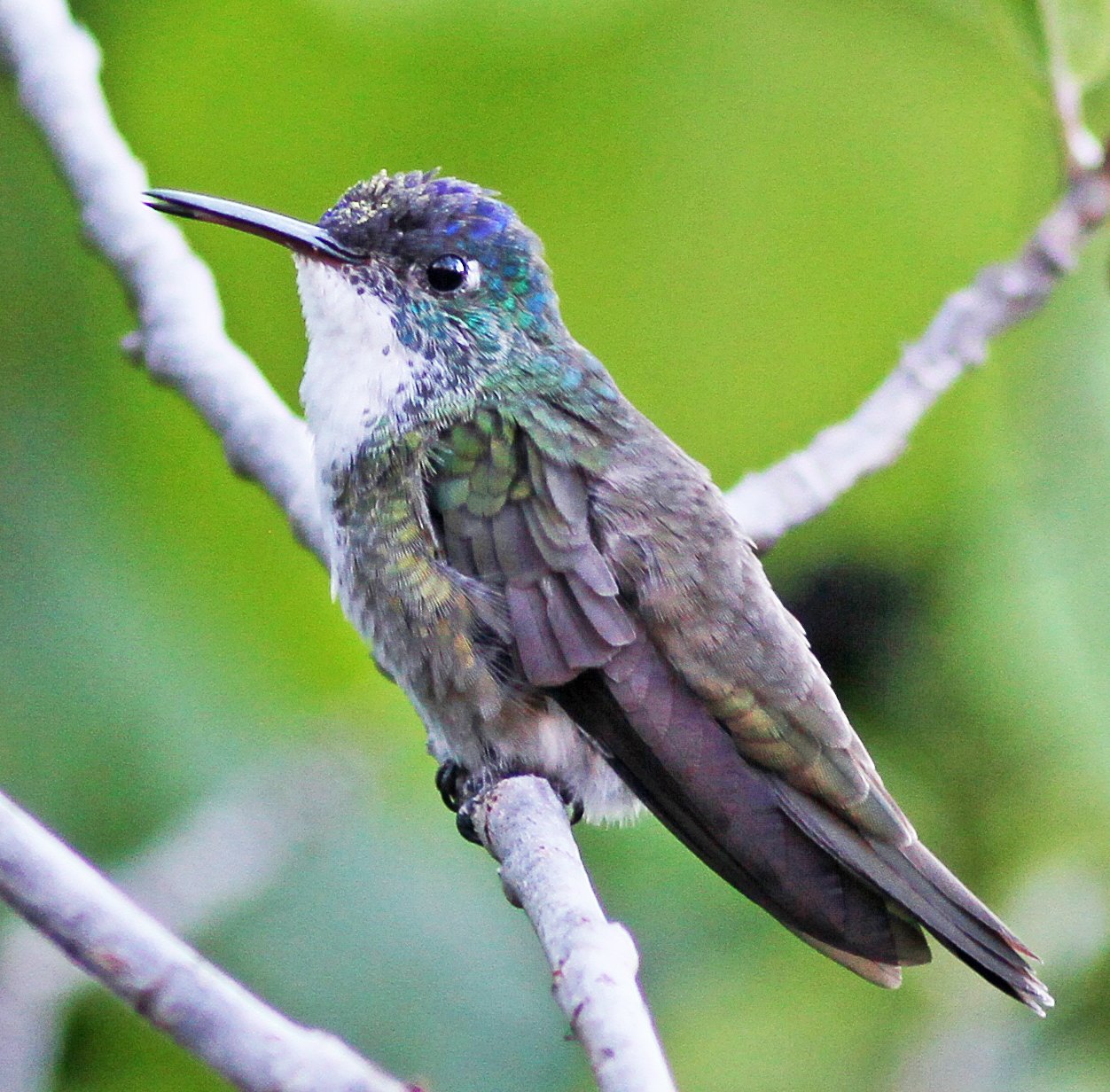
The Azure-crowned Hummingbird is a medium-sized hummingbird of the mountains of eastern and southern Mexico and northern Central America. The glittering blue crown and white underparts are its main features. Besides montane forest, the species also inhabits the lowland pine savannas of Belize, Honduras and Nicaragua.
Voice
A dry, hard tsik or chit, and a dry, twittering rattle. The song is a high, squeaky series of notes.
Recording: GABRIEL LEITE — CC BY-NC-SA 4.0 · converted to mono · xeno-canto
Identification
10–11 cm, with a straight black bill with a pink to red base to the lower mandible. The crown is glittering azure-blue to turquoise, the rest of the upperparts bronze-green. The underparts are white with green flanks. The tail is dull bronze-green to olive, with a dark band near the tip. The sexes are alike; the female has a duller crown.
Confusion species
Violet-crowned Hummingbird Ramosomyia violiceps has an all-red bill with a dark tip and entirely white flanks; the two come close only in Oaxaca. Green-fronted Hummingbird Ramosomyia viridifrons has a green crown and a red bill. White-bellied Emerald Chlorestes candida is smaller, has a green crown and lives mainly in the lowlands. Honduran Emerald Amazilia luciae has a glittering blue-green throat and occurs only in dry valleys in Honduras.
Habitat
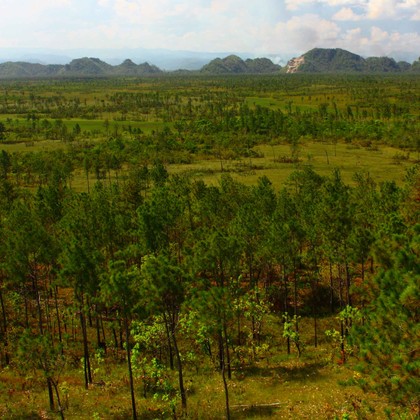
Forest edges, open pine-oak forest, cloud forest, secondary forest, shade coffee and gardens in the mountains, mainly between about 600 and 2400 m; in Belize, Honduras and Nicaragua also in lowland pine savanna. It feeds at flowering trees and shrubs, often at mid-level up to the canopy.
Where the bird is most at home, classified by the vegetation units of Mexico and Central America.





Range and movements
Endemic to the guide area. In Mexico from southern Tamaulipas and eastern San Luis Potosí through Hidalgo, Puebla and Veracruz to Oaxaca and Chiapas; further in Belize, the highlands of Guatemala, Honduras, El Salvador and northern Nicaragua, and in the pine savannas of the Mosquitia in eastern Honduras and north-eastern Nicaragua.
- Resident
- dark = core range, pale = thinly spread
How and when to look
In gardens and coffee plantations around Antigua and Cobán in Guatemala, in the Mountain Pine Ridge in Belize, in La Tigra National Park near Tegucigalpa in Honduras and in the mountains around Xalapa in Veracruz.
Conservation status
Not threatened. Fairly common to common in a large range. The species also uses forest edges, coffee plantations and gardens.
Scientific name
Saucerottia cyanocephala | (Lesson, 1830)
Lesson described the species in 1830 as Ornismya cyanocephalus; because it was later moved to another genus, the author and year stand in brackets. The genus Saucerottia was introduced in 1850 by Bonaparte. Saucerottia honours the French physician and ornithologist Antoine Constant Saucerotte; the name derives from the epithet saucerottei (1846). cyanocephala is Greek, from kuanos 'dark blue' and kephalē 'head', after the blue crown. The specimen the first description was based on came from Veracruz, Mexico (originally given in error as 'Brazil').