All species › Waders, gulls and terns › Skimmers, noddies, terns and gulls › Black Skimmer
Position in the tree Birds Aves › Birds with a flexible palate Neognathae › All other modern birds Neoaves › Birds of the elements Elementaves › Cranes and waders Gruimorphae
Black Skimmer | Rynchops niger
Amerikaanse schaarbek | Rayador americano
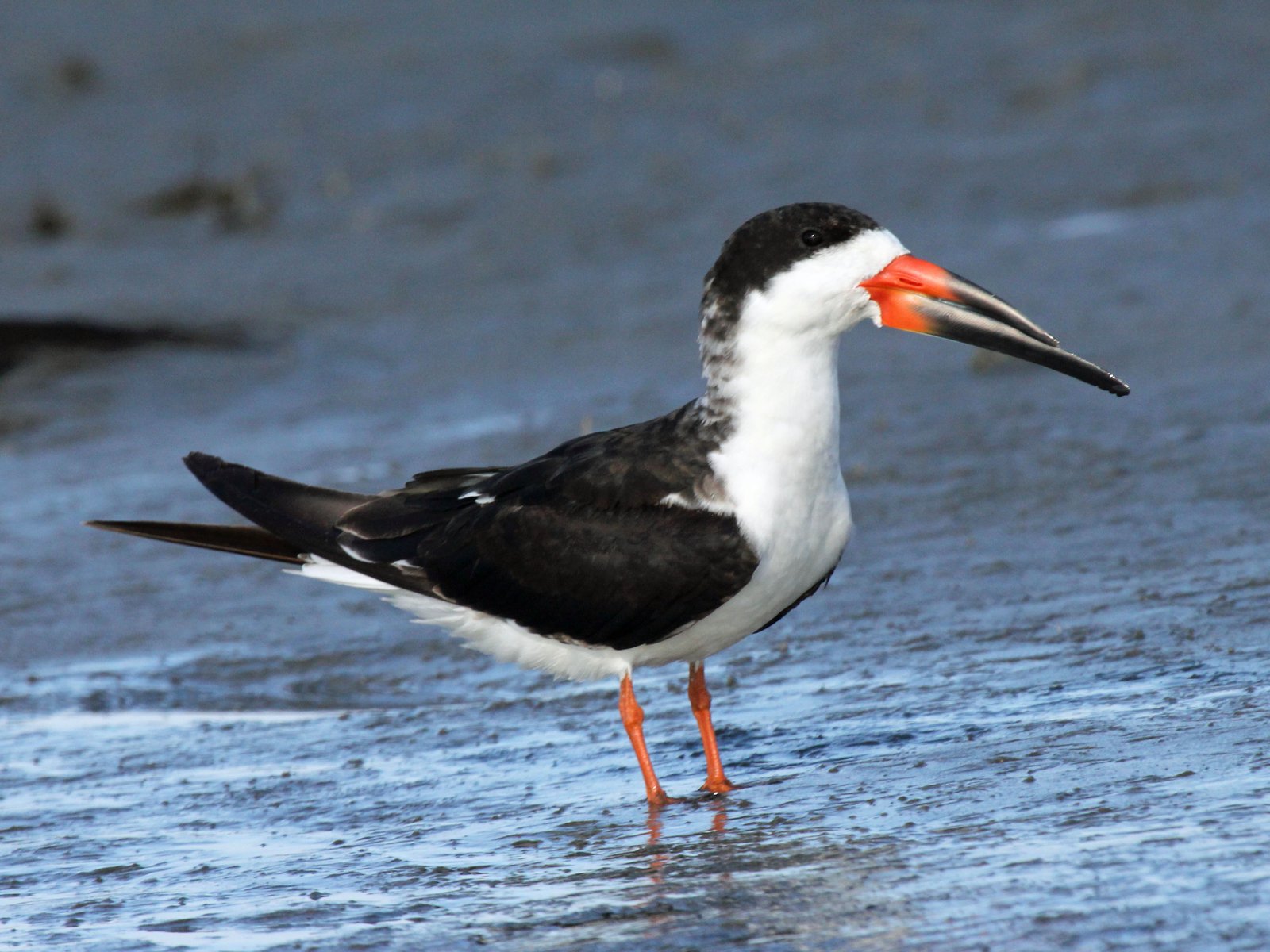
The Black Skimmer is a black-and-white coastal bird with a long red-and-black bill whose lower mandible extends well beyond the upper. It feeds by flying low over calm water with the bill open; the lower mandible slices through the surface and the bill snaps shut as soon as it touches a small fish. In the guide area it rests in flocks on sandbars, beaches and embankments along lagoons and river mouths, and it is often active at dusk and at night.
Voice
A nasal, barking kaup or kak-kak-kak, often in chorus from a resting or flushing flock, also at night.
Recording: Manuel Grosselet — CC BY-NC-SA 4.0 · converted to mono · xeno-canto
Identification
40–50 cm, with long, narrow wings and a short, slightly forked tail. The upperparts are black, the forehead and underparts white. The bill is long, laterally compressed and red with a black outer half; the lower mandible is clearly longer than the upper. The short legs are red. Males are larger and heavier-billed than females. Outside the breeding season the back is browner and a white band crosses the hindneck. Juveniles are brown with pale fringes above and have a shorter, dull red bill. In flight the white trailing edge to the wing and the white underwing stand out.
Confusion species
The bill shape and skimming feeding action rule out confusion with any other species. At a distance and at rest a flock may suggest terns such as Royal Tern Thalasseus maximus, which has an orange bill and a pale grey back. Laughing Gull Leucophaeus atricilla has a black head in breeding plumage, but a grey back and a short bill.
Habitat
Sheltered coastal waters: lagoons, estuaries, river mouths, salt pans, harbours and shallow bays; sometimes also large rivers and lakes close to the coast. It breeds in colonies, often together with terns, on bare sandbars, shell banks and beaches; the nest is a shallow scrape in the sand.
Where the bird is most at home, classified by the vegetation units of Mexico and Central America.



Range and movements
Along both coasts of Mexico, from the Gulf of California and Baja California to Chiapas and from Tamaulipas through Veracruz to the Yucatán Peninsula; it breeds locally here on sandbars in lagoons and river mouths. Farther south along the Pacific and Caribbean coasts of Central America to Panama, mainly outside the breeding season. Outside the guide area the species breeds along the coasts of the United States and across much of South America, along the coasts and the large rivers to Argentina.
- Resident
- dark = core range, pale = thinly spread
How and when to look
Lagoons and river mouths at high tide, when the birds rest packed together on sandbars. At dusk and in calm weather the skimming flights over smooth water can be watched.
Conservation status
Not threatened. The world population is large, but colonies on beaches and sandbars are sensitive to disturbance by recreation, free-roaming dogs, high water and predators, and have declined in parts of North America.
Scientific name
Rynchops niger | Linnaeus, 1758
Linnaeus described the species in 1758 and placed it straight away in the genus where it still stands. He introduced the genus Rynchops in that same work. Rynchops comes from the Greek rhunkhos, 'bill', and ōps, 'face' — a 'bill-face', for the striking bill with its much longer lower mandible. niger is Latin for 'black' — for the black upperparts. The specimen the first description was based on came from coast of South Carolina, USA.