All species › Waders, gulls and terns › Skimmers, noddies, terns and gulls › Blue-billed White Tern
Position in the tree Birds Aves › Birds with a flexible palate Neognathae › All other modern birds Neoaves › Birds of the elements Elementaves › Cranes and waders Gruimorphae
Blue-billed White Tern | Gygis candida
Zuidzeeopaalstern | Charrán blanco piquiazul
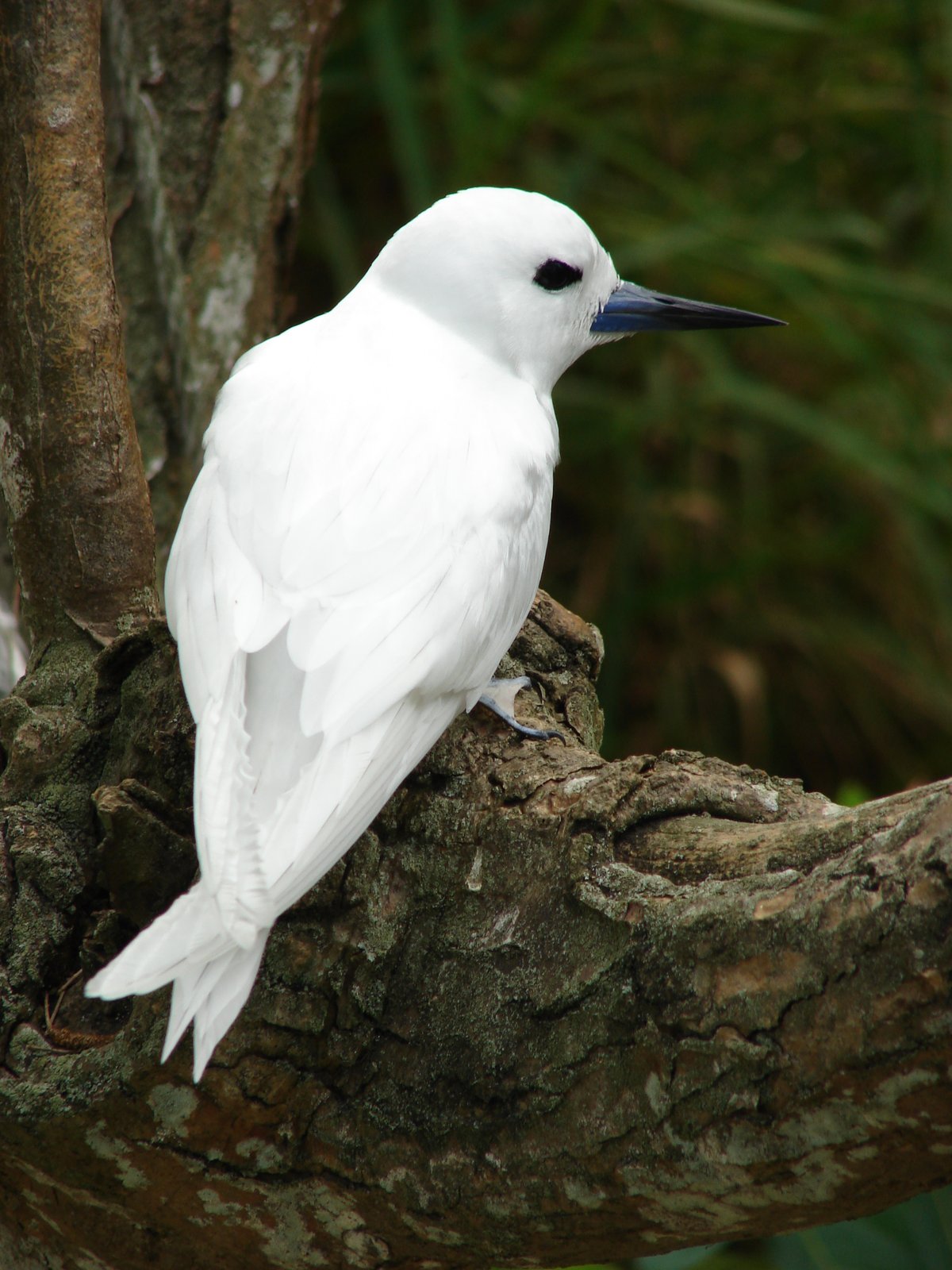
The Blue-billed White Tern is a small, all-white tern with large dark eyes that breeds on wooded islands in the tropical Pacific and Indian Oceans. In the guide area Isla del Coco, more than 500 km off the Pacific coast of Costa Rica, is the only breeding site. Birds often flutter in pairs around the treetops and feed at sea by shallow plunging.
Voice
A soft, nasal, buzzing heech and a rapid, chattering geh-geh-geh, mainly around the nest trees; mostly silent at sea.
Recording: Eric Knight — CC BY 4.0 · converted to mono · iNaturalist
Identification
25–30 cm, delicate, all white with a slightly forked tail and broad, rounded wings that look translucent against the light. A narrow black ring around the large black eye makes the eye look even bigger. The bill is fairly long, pointed and slightly upturned, black with a blue base; the legs are bluish grey. The sexes are alike. Juveniles have brown and grey barring on the back and wings and a dark spot behind the eye.
Confusion species
Atlantic White Tern Gygis alba of the South Atlantic is very similar but does not occur in the guide area. Red-billed Tropicbird Phaethon aethereus is also largely white, but much larger, with a red bill, a black eye-stripe and long central tail feathers.
Habitat
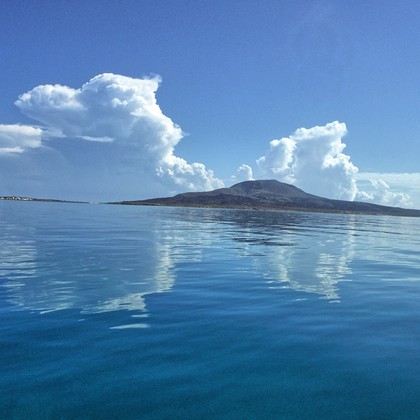
Open tropical sea around oceanic islands. On Isla del Coco it breeds in the forest and in trees along the bays; the single egg is laid without a nest in a fork or hollow of a bare branch. It feeds over the open sea, often together with noddies and over shoals of predatory fish.
Where the bird is most at home, classified by the vegetation units of Mexico and Central America.

Range and movements
In the guide area it breeds only on Isla del Coco (Costa Rica), where birds are present all year. Elsewhere rare at sea off the Pacific coast, including around the Revillagigedo Islands (Mexico) and off Panama. Outside the guide area widespread on tropical islands in the Pacific and Indian Oceans, from Hawaii and French Polynesia to the Seychelles.
- Resident
- Summer visitor (c. Apr–Sep)
- Passage (Mar–Apr, Oct–Nov)
- dark = core range, pale = thinly spread
How and when to look
Isla del Coco, reachable only by boat, is the one place to see the species with certainty in the guide area; around Chatham and Wafer bays birds flutter low among the trees.
Conservation status
Not threatened. The world population is large. Isla del Coco is a protected national park; introduced rats, cats and pigs pose a risk to nests there.
Scientific name
Gygis candida | (Gmelin, 1789) (GBIF: Gygis alba)
Gmelin described the species in 1789 as Sterna Candida; because it was later moved to another genus, the author and year stand in brackets. The genus Gygis was introduced in 1832 by Wagler. Gygis probably derives from Greek gugēs, the name of an unidentified bird in classical literature; the origin is uncertain. candida is Latin for 'shining white', after the all-white plumage. The specimen the first description was based on came from Kiritimati (Christmas Island), Kiribati.