All species › Waders, gulls and terns › Auks, puffins and murres › Scripps's Murrelet
Position in the tree Birds Aves › Birds with a flexible palate Neognathae › All other modern birds Neoaves › Birds of the elements Elementaves › Cranes and waders Gruimorphae
Scripps's Murrelet | Synthliboramphus scrippsi
Scripps' alk | Mérgulo de Scripps
Scripps's Murrelet is a small black-and-white auk of the islands off southern California and northern Baja California. The chicks leave the nest one to two days after hatching and jump into the sea at night, after which they swim out to open water with their parents. Until 2012 it was treated together with Guadalupe Murrelet as a single species.
Voice
Mostly silent at sea. At the colony at night a rapid series of high, even see notes and short tsip calls between partners.
Recording: Matthew L. Brady — CC BY-NC-SA 4.0 · converted to mono · xeno-canto
Identification
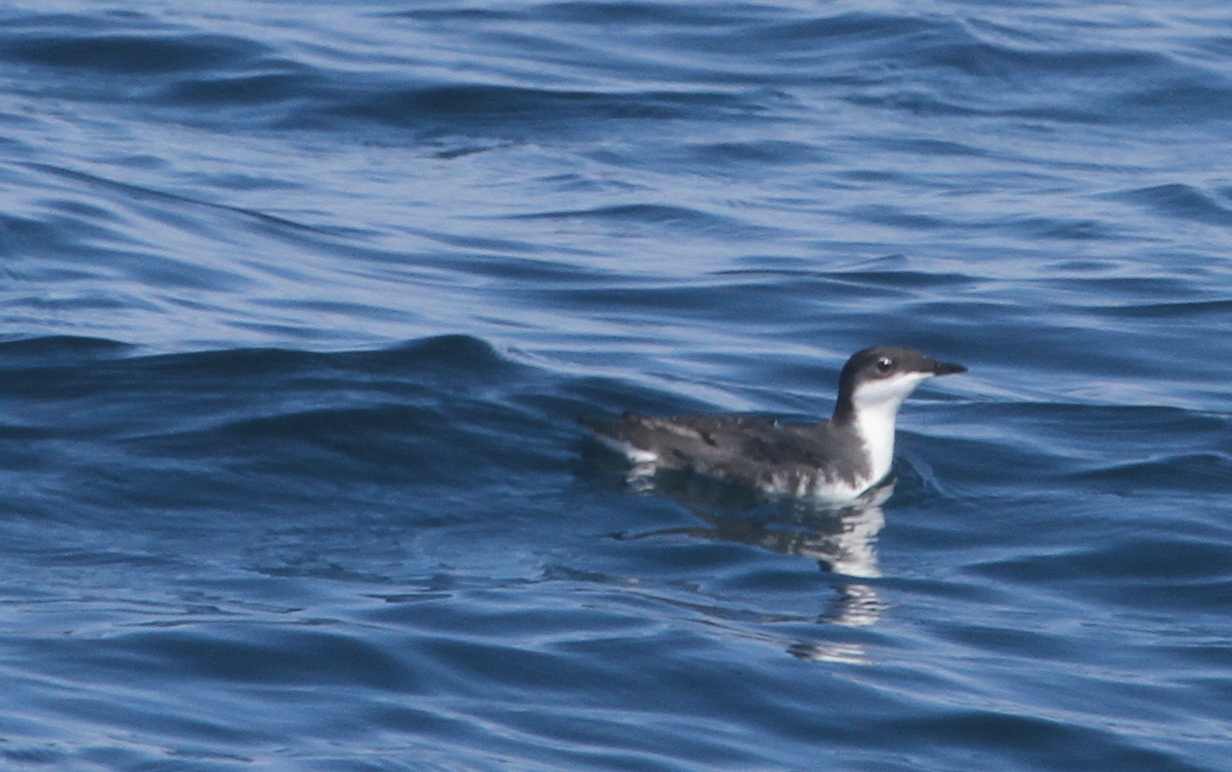
23–25 cm, small, with a small head, a thin, pointed black bill and bluish-grey legs. Black above, with a bluish-grey sheen in fresh plumage that becomes browner later in the season, and bright white below. The black cap reaches down to eye level, so that the eye lies within the black, with a thin white crescent above and below the eye. The underwing is bright white. Male and female are alike.
Confusion species
Guadalupe Murrelet Synthliboramphus hypoleucus has more white in front of and above the eye, so that the eye stands in a white field. Craveri's Murrelet Synthliboramphus craveri has a dusky underwing, a slightly longer bill, a dark half-collar on the breast sides and black that extends below the eye. Cassin's Auklet Ptychoramphus aleuticus is plain grey with a pale eye.
Habitat
Breeds on islands with cliffs and rocky slopes, in crevices, cavities under boulders and under dense shrubs. It forages at sea over the continental shelf and beyond, usually in pairs. It dives for small schooling fish such as anchovies and for fish larvae.
Where the bird is most at home, classified by the vegetation units of Mexico and Central America.


Range and movements
In the guide area it breeds on islands off the Pacific coast of northern Baja California, from the Coronado Islands through Todos Santos and San Jerónimo to the San Benito Islands, and in the breeding season is found at sea around those islands. After breeding some move north to off California and beyond. Outside the guide area the species breeds on the Channel Islands off southern California.
- Resident
- dark = core range, pale = thinly spread
How and when to look
Pelagic trips to the Coronado Islands or Todos Santos from March to May give the best chance; pairs then drift around the islands and fly off low, showing the white underwing.
Conservation status
Vulnerable. The population is small, confined to a small number of islands and declining. Introduced rats, cats and deer mice take eggs and birds; oil from shipping and disturbance by artificial light are further threats. Introduced predators have been removed from several islands on both sides of the border, after which breeding success has increased.
Scientific name
Synthliboramphus scrippsi | (Green & Arnold, 1939)
Green & Arnold described the species in 1939 as Endomychura hypoleuca scrippsi; because it was later moved to another genus, the author and year stand in brackets. The genus Synthliboramphus was introduced in 1837 by Brandt. Synthliboramphus is Greek, from sunthlibō 'to compress' and rhamphos 'bill', after the short, laterally compressed bill. scrippsi honours the Scripps family; Jobling lists both Ellen Browning Scripps (1836–1932), founder of the Scripps Institution of Oceanography, and the newspaper owner Robert Paine Scripps (1895–1938). The specimen the first description was based on came from Anacapa Island, California, USA.